Have you ever typed a question and suddenly wondered, “Is it when can I or when I can?” 🤔 If you have searched for when can I vs when I can, you are probably dealing with one of the most common English word-order questions.
These two phrases contain the same words, but they are used differently depending on the sentence structure. “When can I” is generally used for a direct question, such as “When can I leave?”
On the other hand, “when I can” usually appears inside an indirect question or statement, such as “I don’t know when I can leave.” Understanding this small but important grammar difference can make your English sound more natural and accurate.
In this guide, we will explain the rule in simple terms, provide plenty of real-world examples, and show you an easy trick for remembering when to use each form. ✍️
|Full Proof vs Foolproof: Which Is Correct?
|Input vs Imput: Which Is Correct? Meaning, Usage, and Examples
|Company-Wide vs Companywide: Which Is Correct?
Quick Answer: When Can I vs When I Can
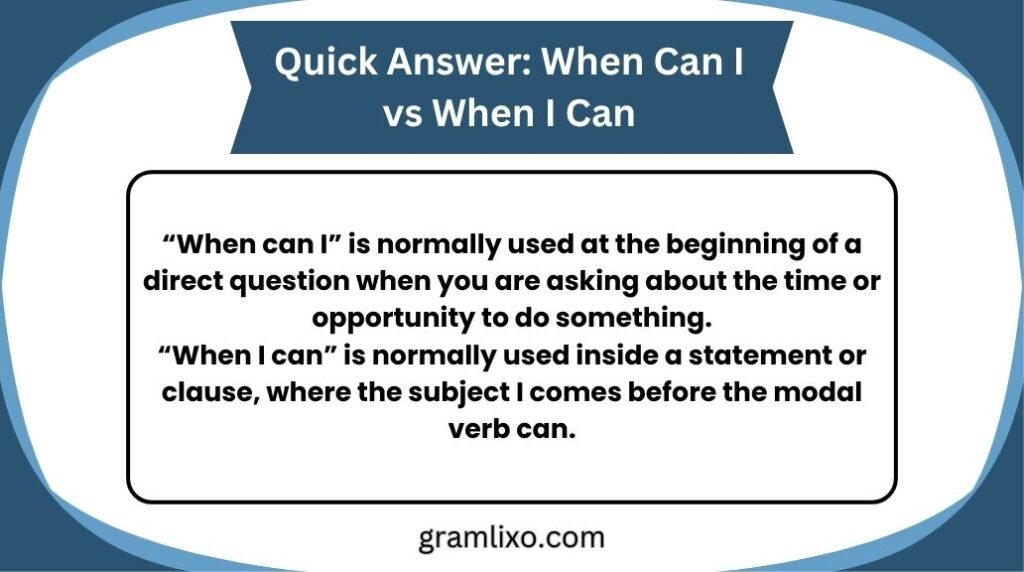
“When can I” is normally used at the beginning of a direct question when you are asking about the time or opportunity to do something.
“When I can” is normally used inside a statement or clause, where the subject I comes before the modal verb can.
- Correct question: When can I call you?
- Correct statement: I will call you when I can.
- Correct question: When can I start?
- Correct statement: I will start when I can.
The key difference is question word order versus statement word order.
Important rules:
Direct question → when + can + subject
Indirect question/statement → when + subject + can
So, “When can I?” and “when I can” can both be correct. The surrounding sentence determines which one you need.
Understanding the Basics of When Can I vs When I Can
The main difference between these expressions is word order.
English direct questions commonly place an auxiliary verb or modal verb before the subject. Because can is a modal verb, a direct question normally follows this pattern:
When + can + subject + main verb?
For example:
When can I leave?
Here:
- When = question word
- can = modal verb
- I = subject
- leave = main verb
However, when the question is embedded inside another sentence, English normally uses statement word order:
When + subject + can + main verb
For example:
I don’t know when I can leave.
Here, when I can leave is an indirect question. It is no longer the main question, so the words do not switch into direct-question order.
Cambridge’s grammar guidance explains that direct questions commonly use auxiliary/modal verb + subject + main verb order, while indirect wh-questions use statement order: subject + verb.
Comparison Table
| Form | Type | Meaning | Example | Correct/Incorrect |
|---|---|---|---|---|
| When can I…? | Direct question | Asking directly about the time or opportunity | When can I leave? | ✅ Correct |
| When I can… | Indirect question/clause | Refers to the time or situation in which something is possible | I don’t know when I can leave. | ✅ Correct |
| When I can…? | Direct question | Attempts to ask a direct question | When I can leave? | ❌ Usually incorrect |
| When can I leave? | Direct question | Directly asks about permission/time | When can I leave? | ✅ Correct |
| I know when I can leave. | Statement | Gives information about the time | I know when I can leave. | ✅ Correct |
| I know when can I leave. | Indirect question | Uses direct-question word order inside a statement | I know when can I leave. | ❌ Incorrect |
The crucial point is that neither phrase is automatically wrong. The grammar depends on the sentence structure.
Correct Meanings and Uses of “When Can I”
1. “When can I” for a direct question
Use when can I when you are directly asking someone about the time at which you can do something.
The basic structure is:
When + can + I + base verb?
Examples:
- When can I call you?
- When can I come over?
- When can I start?
- When can I apply?
- When can I leave?
- When can I see the doctor?
- When can I get my results?
Sentence breakdown
Consider:
When can I submit the form?
- When asks about time.
- can expresses possibility or permission.
- I is the subject.
- submit is the base-form verb.
Because this is a direct question, can comes before I.
Test Tip
Ask yourself:
Am I directly asking someone a question?
If the answer is yes, “when can I” is usually the correct structure.
2. “When can I” can express permission
Sometimes can means that you want permission rather than simply asking about a schedule.
For example:
When can I use the conference room?
This could mean:
- When is the room available?
- When do I have permission to use it?
Similarly:
When can I leave work early?
This may ask when leaving early is permitted.
More examples:
- When can I take a break?
- When can I use your computer?
- When can I access the files?
- When can I enter the building?
The exact meaning comes from context.
3. “When can I” can express possibility
Can can also describe whether something is possible.
For example:
When can I meet with you?
The speaker wants to know what time is possible.
Other examples include:
- When can I get an appointment?
- When can I pick up my order?
- When can I expect a response?
- When can I receive the package?
In each case, the speaker is directly asking about a future opportunity or possibility.
Correct Meanings and Uses of “When I Can”
1. “When I can” inside an indirect question
This is where many English learners become confused.
Consider:
When can I leave?
This is a direct question.
Now place it inside another sentence:
I don’t know when I can leave.
Notice what happened.
The original direct question was:
When can I leave?
Inside the larger sentence, it becomes:
when I can leave
The subject I now comes before can.
This is called statement word order.
Cambridge specifically notes that indirect reports of wh-questions use statement order rather than direct-question order.
2. “When I can” after verbs such as “know”
Many indirect questions begin with verbs such as:
- know
- ask
- wonder
- remember
- understand
- find out
- decide
- tell
- explain
Examples:
I don’t know when I can leave.
She asked when I can start.
Can you tell me when I can apply?
I’m wondering when I can visit.
Please explain when I can access the system.
In all these examples, when I can is part of a larger sentence.
3. “When I can” in a statement
The phrase does not always introduce a question.
It can simply describe a time or situation.
For example:
I’ll call you when I can.
Here, when I can means something like:
when I am able to
Another example:
I’ll help you when I can.
This does not directly ask anything. It makes a statement about future action.
More examples:
- I’ll visit when I can.
- I’ll respond when I can.
- I’ll help when I can.
- I’ll finish the project when I can.
- I’ll send the documents when I can.
In these cases, when I can is a subordinate clause.
When Can I vs When I Can: The Most Important Rule
The simplest way to understand this topic is to separate direct questions from embedded questions.
Direct question
When can I start?
This is a complete question.
The structure is:
When + can + I + verb
Indirect question
I don’t know when I can start.
This is a statement containing a question.
The structure is:
when + I + can + verb
Compare them side by side
Direct: When can I start?
Indirect: Do you know when I can start?
The second sentence is not:
❌ Do you know when can I start?
That structure incorrectly carries direct-question word order into the indirect question.
Examples That Make the Difference Easy
Here are several pairs to help you recognize the pattern.
Example 1
Direct:
When can I call you?
Indirect:
I don’t know when I can call you.
Example 2
Direct:
When can I submit my application?
Indirect:
Could you tell me when I can submit my application?
Example 3
Direct:
When can I meet the manager?
Indirect:
I’m not sure when I can meet the manager.
Example 4
Direct:
When can I start working?
Indirect:
She asked when I can start working.
Example 5
Direct:
When can I pick up the package?
Indirect:
Do you know when I can pick up the package?
Notice the consistent pattern:
Direct → can + I
Indirect → I + can
Case Study: A Workplace Conversation
Imagine that Maya has just joined a company. She wants to know when she can access a particular software system.
She could ask her manager:
“When can I access the new system?”
That is a direct question.
Her manager might answer:
“You can access it tomorrow morning.”
Later, Maya talks to a coworker.
She says:
“I don’t know when I can access the new system.”
This sentence is not a direct question. Maya is making a statement.
Now imagine she wants to ask her coworker politely:
“Could you tell me when I can access the new system?”
Again, when I can is correct because it is embedded inside the larger question Could you tell me…?
Workplace email example
Imagine you are writing to an HR department.
A direct version could be:
When can I expect to receive my employment documents?
A more indirect version could be:
Could you please let me know when I can expect to receive my employment documents?
Both are grammatically correct.
The second version is often more polite and appropriate for professional communication because the actual question is embedded within a polite request.
Grammar Rules Behind “When Can I” vs “When I Can”
The difference comes from subject-verb inversion.
In many direct English questions, an auxiliary or modal verb appears before the subject.
For example:
Can I leave?
Instead of:
I can leave?
The same pattern applies when when is added:
When can I leave?
The structure is:
Question word + modal + subject + main verb
However, indirect questions generally use normal statement order:
I don’t know when I can leave.
The embedded clause follows:
Question word + subject + modal + main verb
Cambridge describes standard question formation as auxiliary/modal + subject + main verb, while its guidance on indirect questions explains that the reported clause uses statement order.
This is why:
✅ When can I leave?
is correct as a direct question, while:
✅ I don’t know when I can leave.
is correct as an indirect question.
But:
❌ I don’t know when can I leave.
is not standard English because it incorrectly uses direct-question word order inside an indirect question.
Why “When Can I” Sounds Different From “When I Can”
The two forms can feel confusing because they contain identical words.
The difference is syntactic, not lexical.
Compare:
When can I go?
and
I don’t know when I can go.
The words themselves have not changed in meaning.
What changed is their grammatical position.
In the first sentence, when can I go is the main question.
In the second sentence, when I can go is a subordinate clause functioning as the object of know.
This is similar to other common pairs:
Where are you?
I don’t know where you are.
And:
What can she do?
I don’t know what she can do.
And:
When will they arrive?
I don’t know when they will arrive.
Once you understand this pattern, when can I vs when I can becomes much easier.
Common Mistakes With “When Can I” vs “When I Can”
Mistake 1: Using direct-question order inside an indirect question
Incorrect:
❌ I don’t know when can I leave.
Correct:
✅ I don’t know when I can leave.
Why?
Because when I can leave is an indirect question.
Mistake 2: Treating every sentence beginning with “when” as a direct question
Not every sentence containing when is a question.
For example:
I’ll call you when I can.
This is a statement.
There is no need to write:
❌ I’ll call you when can I.
The phrase when I can works as a subordinate clause.
Mistake 3: Forgetting that “can” needs a base verb
After can, use the base form of the verb.
Correct:
When can I go?
When can I start?
When can I apply?
Incorrect:
❌ When can I goes?
❌ When can I started?
❌ When can I applying?
The modal can is followed by the base form of the main verb.
Why Do People Make This Mistake?
There are several common reasons.
1. Fast typing
When people type quickly, they often write the sentence exactly as they hear it.
This can cause word-order errors.
2. Autocorrect
Autocorrect may change words or structures unexpectedly, especially when you type incomplete sentences.
3. Lack of grammar knowledge
English learners may know that “When can I leave?” is correct but may not realize that the structure changes inside an indirect question.
4. Direct translation
Speakers of languages with different question structures may naturally transfer their native-language word order into English.
5. Confusion between direct and indirect questions
This is the biggest reason.
Once you learn to identify whether you are asking a question directly or embedding the question inside another sentence, the problem becomes much easier.
Similar Grammar Confusions
The when can I vs when I can problem belongs to a larger group of English grammar issues involving word order, contractions, or similar-looking forms.
| Confusion | Correct Forms | Common Error |
|---|---|---|
| when can I / when I can | When can I go? / I know when I can go. | I know when can I go. |
| it’s / its | It’s cold. / The dog wagged its tail. | Mixing possession and contraction |
| you’re / your | You’re ready. / Your phone is here. | Using your for you’re |
| they’re / their / there | They’re here. / Their car is there. | Mixing the three forms |
| who’s / whose | Who’s calling? / Whose phone is this? | Mixing contraction and possession |
| then / than | Then we left. / Taller than me. | Confusing comparison and time |
| affect / effect | It affected me. / The effect was strong. | Using the wrong noun/verb |
| your / you’re | Your answer is correct. / You’re correct. | Missing apostrophe |
Learning these distinctions improves both grammar accuracy and writing clarity.
When Can I vs When I Can in Different Contexts
Everyday Conversation
In everyday speech, direct questions are extremely common.
Examples:
When can I see you?
When can I come over?
When can I call?
When can I get my order?
For indirect questions:
Do you know when I can see you?
I’m not sure when I can come over.
She asked when I can call.
The same rule applies in casual conversation as in formal writing.
Professional Writing
Professional communication often uses indirect questions because they can sound more polite and less demanding.
Direct:
When can I expect the report?
Indirect:
Could you please let me know when I can expect the report?
The second version is especially useful in workplace emails.
Other examples:
Could you tell me when I can schedule the meeting?
Please let me know when I can submit the revised document.
I would appreciate it if you could confirm when I can access the account.
Notice that when I can remains in statement order inside these longer sentences.
Creative Writing
Creative writing can use both structures depending on the character’s intention.
For example:
“When can I see him?” she asked.
This is a direct question.
But narration could say:
She wondered when she could see him again.
Here, the question is embedded in the narrative.
Creative writers may also use unusual structures intentionally for voice or dramatic effect, but standard grammar remains the safest choice unless there is a deliberate stylistic reason to depart from it.
Social Media and Texting
Texting is more flexible, and people frequently omit punctuation or use shortened structures.
You might see:
when can i call?
or:
do you know when i can call?
In informal messages, lowercase writing may be acceptable stylistically, but the grammatical distinction remains the same.
For clear communication:
When can I call?
is a direct question.
Do you know when I can call?
is an indirect question.
Why “When Can I vs When I Can” Matters
At first glance, this may seem like a tiny grammar issue. But small word-order differences can affect clarity.
1. Clarity in communication
Correct word order helps readers immediately understand whether you are asking something or making a statement.
Compare:
When can I submit it?
with:
I don’t know when I can submit it.
The first requests information. The second communicates uncertainty.
2. Professionalism
Grammar mistakes in workplace emails can make otherwise good writing look rushed or careless.
For example:
❌ Could you tell me when can I submit the report?
looks less polished than:
✅ Could you tell me when I can submit the report?
Correct grammar creates a stronger professional impression.
3. Accuracy in digital communication
Email, messaging apps, online forms, and social media all depend heavily on written communication.
Because people often communicate without facial expressions or vocal tone, grammar and word order can help prevent misunderstandings.
A Useful Reminder
Direct questions invert; indirect questions usually don’t.
That short rule can save you from many common mistakes.
A Simple Trick to Remember the Rule
Use the “Question Alone” Test.
Suppose you have this sentence:
I don’t know when I can leave.
Temporarily remove the beginning:
When can I leave?
If the original idea can be turned into a direct question, notice what happens to the word order.
Direct:
When can I leave?
Indirect:
I don’t know when I can leave.
The direct question has:
can + I
The indirect question has:
I + can
Another memory trick
Think:
Direct = Flip
When can I…?
Indirect = Normal
when I can…
“Normal” here means ordinary statement word order.
The Role of “When” in English Grammar
The word when can serve several grammatical functions.
It can introduce a direct question:
When can I leave?
It can introduce an indirect question:
I don’t know when I can leave.
It can introduce a subordinate clause:
I’ll leave when I can.
Cambridge describes when as a eh-word used to ask about time and also as a conjunction that can introduce subordinate clauses.
This explains why you should not assume that every sentence beginning with when follows direct-question word order.
Consider:
When I arrive, I’ll call you.
This is not a question.
It means:
At the time that I arrive, I’ll call you.
Likewise:
I’ll help you when I can.
Here, when I can means approximately when I am able to.
“When Can I” vs “When I Can” in Polite Questions
A particularly useful pattern is:
Could you tell me when I can…?
This is grammatically correct and polite.
Examples:
- Could you tell me when I can apply?
- Could you tell me when I can pick up the order?
- Could you tell me when I can schedule the appointment?
- Could you tell me when I can access the account?
Do not change these into:
❌ Could you tell me when can I apply?
The question is already introduced by Could you tell me…?
The words following when form an indirect question, so use statement word order.
Cambridge’s grammar guidance similarly illustrates that indirect wh-questions use subject + verb order rather than direct-question inversion.
A Note About “When I Can” and “When I Could”
Sometimes learners confuse can and could as well.
Compare:
When can I leave?
and:
I don’t know when I can leave.
These are straightforward.
But you may also see:
I don’t know when I could leave.
Here, could may indicate a possible opportunity, hypothetical situation, or a more tentative meaning depending on context.
For example:
If I finish early, I could leave at six.
The key point remains the same:
Direct: When can I…?
Indirect: when I can…
The word order rule does not disappear when you use another modal.
Special Exception or Edge Case
There is no special brand-name exception that changes the standard grammar rule for when can I and when I can.
However, informal spoken English can sometimes sound different from carefully edited written English. Speakers may use fragments, repetitions, or conversational constructions that do not follow the clean patterns expected in formal writing.
For example, someone might say:
“When can I—actually, wait—when am I supposed to go?”
Spoken language allows interruptions and repairs.
That does not mean the standard written rule has changed.
For formal writing, academic work, professional emails, and polished content, follow the standard distinction between direct and indirect questions.
When Can I vs When I Can: Quick Recap Checklist
Use this checklist whenever you are unsure.
| Question | If Yes → Use |
|---|---|
| Am I asking the question directly? | When can I…? |
| Is “when” part of a larger question? | when I can… |
| Am I saying “I don’t know…”? | when I can… |
| Am I saying “Can you tell me…”? | when I can… |
| Am I saying “I wonder…”? | when I can… |
| Am I simply stating that I will do something when possible? | when I can… |
| Is the sentence simply asking “At what time am I able to…?” | When can I…? |
Practice Example 1
Choose the correct form:
______ submit the application?
Answer:
When can I submit the application? ✅
It is a direct question.
Practice Example 2
I don’t know ______ submit the application.
Answer:
when I can submit the application. ✅
It is an indirect question.
Practice Example 3
Could you tell me ______ submit the application?
Answer:
when I can submit the application? ✅
Again, it is an indirect question embedded inside a larger question.
Common Sentence Patterns to Memorize
Instead of memorizing hundreds of individual examples, learn these useful patterns.
Pattern 1: Direct question
When can I + base verb?
Examples:
- When can I leave?
- When can I start?
- When can I apply?
- When can I call?
Pattern 2: Indirect question
I don’t know when I can + base verb.
Examples:
- I don’t know when I can leave.
- I don’t know when I can start.
- I don’t know when I can apply.
- I don’t know when I can call.
Pattern 3: Polite request
Could you tell me when I can + base verb?
Examples:
- Could you tell me when I can leave?
- Could you tell me when I can start?
- Could you tell me when I can apply?
- Could you tell me when I can call?
Pattern 4: Future statement
I’ll + verb + when I can.
Examples:
- I’ll call when I can.
- I’ll visit when I can.
- I’ll help when I can.
- I’ll respond when I can.
These four patterns cover a large percentage of everyday situations.
FAQs About When Can I vs When I Can
1. Is “when can I” grammatically correct?
Yes. “When can I” is grammatically correct when it begins a direct question.
Example:
When can I leave?
It asks directly about the time or opportunity to leave.
2. Is “when I can” grammatically correct?
Yes. “When I can” is also grammatically correct, but it normally appears inside a statement, an indirect question, or a subordinate clause.
Examples:
I don’t know when I can leave.
I’ll call you when I can.
3. Which is correct: “When can I go?” or “When I can go?”
Both can be correct, but they have different grammatical roles.
When can I go? = direct question.
I don’t know when I can go. = indirect question.
By themselves, “When I can go?” is generally not the standard form of a direct question.
4. Should I say “Can you tell me when can I” or “Can you tell me when I can”?
Use:
Can you tell me when I can…? ✅
For example:
Can you tell me when I can submit the form?
Do not use:
❌ Can you tell me when can I submit the form?
The clause after when is an indirect question, so it uses statement word order.
5. Why does “can” come before “I” in “When can I?”
Because “When can I…?” is a direct question. English normally places a modal or auxiliary verb before the subject in this type of question.
For example:
Can I leave?
becomes:
When can I leave?
6. Why does “I” come before “can” in “when I can”?
Because “when I can” is normally part of an indirect question or subordinate clause. Such clauses generally use statement word order.
For example:
Direct: When can I leave?
Indirect: I don’t know when I can leave.
The indirect clause uses I + can rather than can + I.
Conclusion
The difference between when can I vs when I can becomes simple once you understand direct and indirect questions. Use “when can I” when you are asking a question directly, such as “When can I leave?” Use “when I can” when the question is embedded inside another sentence, such as “I don’t know when I can leave.” You can also use “when I can” in ordinary statements, such as “I’ll help you when I can.”
Remember the easiest rule: direct questions use “can I,” while indirect questions normally use “I can.” This small distinction makes your English clearer, more natural, and more professional.
So, the next time you hesitate between “when can I” and “when I can,” look at the sentence around the phrase. Ask yourself whether you are asking the question directly or placing it inside another sentence.
Direct question? Flip it: “When can I?” Embedded clause? Keep it natural: “when I can.” 🎯

I’m Christopher Garcia, an English writer and grammar enthusiast at Gramlixo. I enjoy making grammar easy to understand through clear explanations and practical examples.


[…] |When Can I vs When I Can: Which Is Correct? A Complete Grammar Guide […]