Have you ever written a sentence and suddenly stopped because you could not decide between tortuous vs torturous? You are not alone. These two adjectives look almost identical, sound similar, and share the same Latin roots, so confusing them is surprisingly easy.
However, they do not usually mean the same thing. Tortuous generally describes something that twists, bends, winds, or takes a complicated and indirect route.
Torturous, on the other hand, describes something painful, unpleasant, or difficult to endure. For example, a winding mountain road can be tortuous, while a painful experience can be torturous. Sometimes one situation can genuinely be both.
Understanding the difference between tortuous vs torturous will help you choose the right word in professional writing, academic work, everyday conversation, and online communication.
Let’s untangle these two commonly confused words once and for all. 🔍
|Continuous vs Contious: Which Spelling Is Correct?
|Patron vs Benefactor: What’s the Difference?
|Propose vs Purpose: What’s the Difference? Meaning, Usage, and Examples
Quick Answer: Tortuous vs Torturous
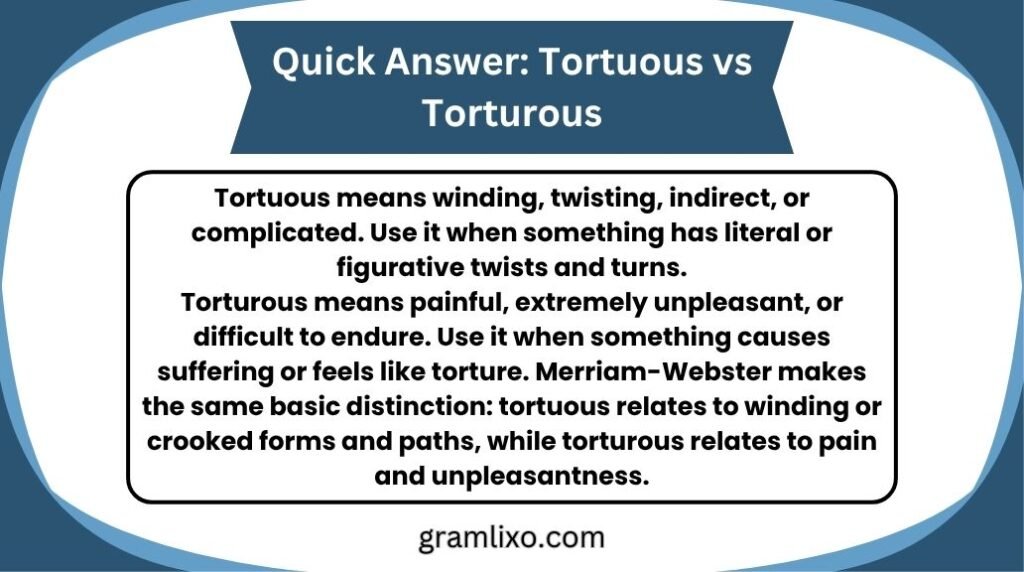
Tortuous means winding, twisting, indirect, or complicated. Use it when something has literal or figurative twists and turns.
Torturous means painful, extremely unpleasant, or difficult to endure. Use it when something causes suffering or feels like torture. Merriam-Webster makes the same basic distinction: tortuous relates to winding or crooked forms and paths, while torturous relates to pain and unpleasantness.
Easy memory trick:
- Tortuous → twists and turns 🌀
- Torturous → torture and pain 😣
Understanding the Basics of Tortuous vs Torturous
The easiest way to understand tortuous vs torturous is to focus on the idea behind each word.
Tortuous is about shape, direction, complexity, or indirectness.
Torturous is about pain, suffering, unpleasantness, or extreme difficulty.
Consider these examples:
- We drove along a tortuous mountain road.
- The long wait at the airport was torturous.
In the first sentence, the road has many bends and turns. In the second, the experience is painful or extremely unpleasant.
Merriam-Webster defines tortuous as something marked by repeated twists, bends, or turns. It can also mean devious, indirect, circuitous, or involved.
Merriam-Webster defines torturous as very unpleasant or painful, something that causes torture, or something painfully difficult or slow.
Tortuous vs Torturous Comparison Table
| Form | Type | Meaning | Example | Correct/Incorrect |
|---|---|---|---|---|
| Tortuous | Adjective | Winding, twisting, indirect, or complicated | We followed a tortuous road through the mountains. | ✅ Correct |
| Torturous | Adjective | Painful, unpleasant, or difficult to endure | The recovery period was torturous. | ✅ Correct |
| Tortuous | Adjective | Painful or agonizing | The injury was tortuous. | ❌ Usually incorrect |
| Torturous | Adjective | Winding or full of bends | We drove along a torturous mountain road. | ⚠️ Usually use tortuous for precision |
| Tortuous | Adjective | Direct and straightforward | It was a tortuous explanation. | ❌ Incorrect if you mean simple/direct |
| Torturous | Adjective | Pleasant and comfortable | The vacation was torturous but relaxing. | ❌ Incorrect |
The distinction is important because the words can overlap in certain situations. A winding road can also be painful to travel, so describing it as both tortuous and torturous can be grammatically and logically appropriate when both meanings apply. Merriam-Webster specifically notes this overlap.
What Does “Tortuous” Mean?
Tortuous is an adjective describing something characterized by twists, bends, turns, indirect movement, or complicated structure.
Its most literal meaning is winding or twisting.
Example 1: A Winding Road
The hikers followed a tortuous path through the forest.
Here, tortuous describes the path.
The path is not necessarily painful. Instead, it probably has numerous curves, turns, or changes in direction.
Example 2: A Complicated Explanation
The lawyer gave a tortuous explanation of the contract.
Here, there is no physical road.
Instead, tortuous is being used figuratively. The explanation is complicated, indirect, or difficult to follow.
Example 3: An Indirect Process
The company took a tortuous route to reach an agreement.
The word describes a process with many complications, delays, or indirect steps.
Merriam-Webster lists meanings that include winding, devious, tricky, circuitous, and involved.
Common Synonyms for Tortuous
Depending on the context, synonyms can include:
- Winding
- Twisting
- Curving
- Circuitous
- Indirect
- Complicated
- Convoluted
- Meandering
- Crooked
- Serpentine
Tortuous in a Sentence
The tortuous mountain road required careful driving.
Breakdown:
- Tortuous = adjective
- Mountain road = noun being described
- Meaning = the road contains many bends and turns
Another example:
The negotiations followed a tortuous path before the two sides reached an agreement.
Here, tortuous describes the complicated and indirect nature of the negotiations.
What Does “Torturous” Mean?
Torturous is an adjective connected to torture, pain, suffering, or extreme unpleasantness.
If something is torturous, it is difficult to experience or endure.
Example 1: Physical Pain
The patient described the treatment as torturous.
The treatment caused severe discomfort or suffering.
Example 2: Emotional Pain
Waiting for the final decision was torturous.
The waiting may not involve physical pain. Instead, the emotional experience is extremely unpleasant.
Example 3: Extreme Difficulty
The final hours of the race were torturous.
The race may have been physically exhausting and extremely difficult.
Merriam-Webster also recognizes torturous in the sense of something painfully difficult or slow.
Common Synonyms for Torturous
Depending on context, you might use:
- Painful
- Agonizing
- Excruciating
- Harrowing
- Unbearable
- Miserable
- Cruel
- Difficult
- Tormenting
- Unpleasant
Torturous in a Sentence
The endless delay was torturous.
Breakdown:
- Torturous = adjective
- Delay = noun being described
- Meaning = the delay was extremely unpleasant or difficult to endure
Tortuous vs Torturous: The Core Difference
The biggest difference can be reduced to one simple question:
Does the word describe twists or pain?
If it describes twists, bends, turns, indirectness, or complexity, choose tortuous.
If it describes pain, suffering, unpleasantness, or something difficult to endure, choose torturous.
Compare These Sentences
Tortuous:
The river follows a tortuous route through the valley.
The river bends and turns.
Torturous:
The final week of the project was torturous.
The week was extremely stressful or unpleasant.
Both:
The tortuous mountain trail became torturous after six hours of climbing.
This sentence uses both words correctly.
- Tortuous trail = the trail twists and turns.
- Torturous climb = the experience is extremely painful or difficult.
This kind of overlap is recognized by Merriam-Webster. A situation can genuinely have both characteristics.
How to Remember Tortuous vs Torturous
Memory tricks can make confusing vocabulary much easier.
Think “Twists” for Tortuous
Notice that tortuous has an “u” before the final ous.
Think:
Tortuous = turns and twists
Imagine a winding road with a series of hairpin turns. 🛣️
If something keeps changing direction, tortuous is probably the right choice.
Examples
- a tortuous road
- a tortuous river
- a tortuous trail
- a tortuous argument
- a tortuous explanation
- a tortuous process
Think “Torture” for Torturous
Torturous contains the word torture.
That makes the connection easier:
Torturous = torture = pain
If something causes intense discomfort or suffering, choose torturous.
Examples
- a torturous experience
- a torturous wait
- a torturous treatment
- a torturous decision
- a torturous journey
- a torturous recovery
The One-Line Memory Trick
Tortuous twists; torturous hurts.
That is probably the simplest way to remember the difference. 🧠
Correct Meanings and Uses of Tortuous
The word tortuous has more than one useful meaning.
1. Tortuous Means Winding
This is the most literal meaning.
The tortuous road climbed toward the mountain summit.
The road contains many bends.
2. Tortuous Means Twisting
It can describe something that physically curves or twists.
The tortuous river disappeared around the hill.
The river changes direction repeatedly.
3. Tortuous Means Indirect
The word can describe a route or process that does not take a direct path.
The proposal took a tortuous route through several committees.
The process was complicated and indirect.
4. Tortuous Means Complicated
It can also describe difficult language, reasoning, or explanations.
The report contained a tortuous explanation of the new policy.
The explanation was complicated and difficult to follow.
Test Tip for Tortuous
Ask:
Can I replace “tortuous” with “winding,” “indirect,” or “complicated”?
If yes, tortuous is probably correct.
For example:
The tortuous road was difficult to navigate.
Replace it:
The winding road was difficult to navigate.
The meaning still works. ✅
Correct Meanings and Uses of Torturous
Now let’s look at torturous.
1. Torturous Means Painful
The injury caused a torturous sensation.
The sensation was extremely painful.
2. Torturous Means Extremely Unpleasant
The three-hour delay was torturous.
The delay was very difficult to endure.
3. Torturous Means Emotionally Agonizing
Making the decision was torturous.
The decision caused intense emotional distress.
4. Torturous Means Painfully Difficult
The final stage of the competition was torturous.
The experience was extremely difficult and exhausting.
Test Tip for Torturous
Ask:
Can I replace “torturous” with “painful,” “agonizing,” or “extremely unpleasant”?
If yes, torturous is probably correct.
For example:
The waiting period was torturous.
Try:
The waiting period was painful and extremely unpleasant.
The meaning remains logical. ✅
Tortuous vs Torturous in Real-Life Writing
Knowing dictionary definitions is helpful, but real writing is where these words can become confusing.
Imagine a manager writing this email:
We have had a torturous process getting this project approved.
Is that wrong?
Not necessarily. If the manager means the process was painful, frustrating, or extremely difficult, torturous works.
But suppose the manager writes:
The project followed a tortuous process involving six departments.
Here, tortuous emphasizes the process’s complicated and indirect nature.
The Difference in Workplace Meaning
Tortuous process:
The process is complicated, indirect, or full of twists and turns.
Torturous process:
The process is painful, frustrating, unpleasant, or difficult to endure.
One describes structure.
The other describes experience.
Case Study: A Workplace Email
Imagine a project manager sending this email:
The approval process has been tortuous, with multiple revisions and reviews.
This is a strong use of tortuous.
Why?
The approval process has taken an indirect and complicated route.
Now imagine a different email:
The six-month delay has been torturous for the entire team.
This uses torturous correctly.
Why?
The emphasis is on how unpleasant and difficult the delay has been.
What if Both Are True?
You could write:
The project has followed a tortuous path, and the repeated delays have made the experience torturous.
This is an excellent example of the distinction.
The path is complicated.
The experience is painful or unpleasant.
Grammar Rules: Why Tortuous and Torturous Are Different
Both words are adjectives, meaning they modify nouns.
For example:
a tortuous road
and:
a torturous journey
The difference is not grammatical category. The difference is meaning.
Both words ultimately trace back to the Latin verb torquēre, meaning “to twist,” “to wind,” or “to wrench.” Over time, their meanings developed in different directions. Merriam-Webster explains that tortuous retained associations with winding, crooked, and indirect things, while torturous developed stronger associations with torture and pain.
Tortuous = Structure or Direction
Use it for:
- roads
- paths
- rivers
- arguments
- explanations
- negotiations
- processes
- reasoning
Torturous = Experience or Suffering
Use it for:
- pain
- waiting
- difficult experiences
- emotional suffering
- harsh conditions
- exhausting activities
- extremely unpleasant situations
Neither word is inherently “more correct.” The correct choice depends on what you want to communicate.
Common Mistakes With Tortuous vs Torturous
These words are commonly confused because they look and sound so similar.
Mistake 1: Using Torturous for Every Difficult Thing
A writer may see the word “difficult” and automatically choose torturous.
But difficulty alone does not always mean pain or suffering.
For example:
The tortuous legal argument took hours to understand.
Here, tortuous is appropriate because the argument is complicated.
Mistake 2: Using Tortuous for Pain
Consider:
The injury was tortuous.
If the intended meaning is “extremely painful,” torturous is normally the better choice.
Mistake 3: Assuming They Are Exact Synonyms
They can overlap, but they are not interchangeable in every context.
A winding road is tortuous.
A painful experience is torturous.
A mountain climb could be both.
Why Do People Confuse Tortuous and Torturous?
There are several reasons.
Fast Typing
When people type quickly, they often remember the general sound of a word instead of its exact spelling.
Tortuous and torturous are especially easy to mix up.
Autocorrect
Spell-check tools can sometimes accept both words because both are legitimate English adjectives.
That means software may not tell you which one fits your intended meaning.
Similar Pronunciation
The words are pronounced similarly enough to create uncertainty.
Lack of Vocabulary Knowledge
Someone who has encountered these words mainly through reading may recognize them without knowing their precise definitions.
Shared History
The two words are genuinely related. Their shared Latin origin makes the confusion understandable. Merriam-Webster specifically notes that their similar appearance and etymological relationship contribute to the mix-up.
Similar Grammar Confusions
The problem with tortuous vs torturous is similar to many other English word pairs.
| Confusion | Correct Meaning |
|---|---|
| It’s / Its | It’s = it is; its = possessive |
| Your / You’re | Your = possession; you’re = you are |
| They’re / Their / There | They are / possession / location |
| Affect / Effect | Usually influence / result |
| Compliment / Complement | Praise / completes or matches |
| Principal / Principle | Main person or thing / rule or belief |
| Stationary / Stationery | Not moving / writing materials |
| Tortuous / Torturous | Winding or complicated / painful or unpleasant |
The lesson is simple: similar spelling does not guarantee similar meaning.
Tortuous vs Torturous in Different Contexts
Everyday Conversation
In ordinary conversation, both words can appear naturally.
That was a torturous wait.
We took a tortuous road through the countryside.
However, torturous may sound stronger and more dramatic than simpler words such as painful or awful.
Professional Writing
Precision matters more in professional writing.
Use tortuous when describing:
- complicated procedures
- indirect processes
- complicated reasoning
- winding routes
Use torturous when emphasizing:
- severe difficulty
- suffering
- prolonged unpleasantness
- painful experiences
For example:
The tortuous approval process involved several rounds of review.
This is precise and professional.
Creative Writing
Creative writers can use both words for stronger imagery.
The tortuous trail disappeared into the fog.
This creates a visual image.
The torturous silence lasted for hours.
This creates an emotional image.
Creative writing often benefits from the distinction because each word creates a different feeling.
Social Media and Texting
People frequently use these words casually online.
For example:
That meeting was torturous 😩
This means the meeting was extremely unpleasant.
Or:
That road is so tortuous! 🌀
This means the road is winding or full of turns.
In informal communication, context often makes the intended meaning obvious. In formal writing, however, choosing the precise word is better.
Can Something Be Both Tortuous and Torturous?
Yes.
This is one of the most interesting parts of the tortuous vs torturous distinction.
Imagine a mountain trail with hundreds of twists and steep turns.
The trail is:
Tortuous because it winds and bends.
Now imagine climbing that trail in extreme heat for ten hours.
The experience may also be:
Torturous because it is painful and extremely difficult.
So you could write:
The tortuous trail made the ten-hour hike torturous.
Both adjectives are correct because they describe different characteristics of the same experience.
Merriam-Webster explicitly discusses this type of overlap.
Why the Difference Matters
At first, confusing two adjectives may seem like a minor problem. But word choice affects meaning.
1. Clarity in Communication
Compare:
The road was tortuous.
The reader imagines bends and turns.
Now:
The road was torturous.
The reader imagines an extremely unpleasant or painful journey.
Those sentences create different mental pictures.
2. Professionalism
Precise vocabulary makes professional writing stronger.
A report that distinguishes between a tortuous procedure and a torturous experience communicates more accurately.
3. Digital Communication
Emails, social posts, messages, websites, and online articles are often read quickly.
Clear word choice helps readers understand your meaning immediately.
4. Stronger Writing
Good vocabulary is not about using complicated words. It is about choosing the right word.
As a useful rule:
“Choose the word that says exactly what you mean.”
That principle is especially valuable when two words look almost identical.
Special Exception: When Usage Overlaps
There is an important nuance.
Although standard usage distinguishes the two words, some speakers and writers use torturous in contexts where tortuous traditionally fits, especially when describing something winding or convoluted.
Collins notes this usage variation, while also distinguishing torturous as referring to torture, pain, or suffering.
For careful US English writing, especially academic, professional, and educational content, it is best to preserve the clearest distinction:
- Tortuous = winding, indirect, complicated
- Torturous = painful, unpleasant, difficult to endure
This approach removes ambiguity and gives readers the exact meaning you intend.
Important Note
Do not confuse either word with tortious.
Tortious is a legal adjective meaning something involving or constituting a tort, which is a civil wrong.
For example:
The court considered whether the conduct was tortious.
That is a completely different word and meaning.
Quick Recap Checklist
Use this checklist whenever you are unsure about tortuous vs torturous.
| Question | If Yes → Use |
|---|---|
| Does it have many twists or bends? | Tortuous |
| Is it winding or curving? | Tortuous |
| Is the route indirect? | Tortuous |
| Is the explanation complicated? | Tortuous |
| Is the experience painful? | Torturous |
| Is something extremely unpleasant? | Torturous |
| Is something difficult to endure? | Torturous |
| Does it involve suffering or torture? | Torturous |
| Does it have both twists and suffering? | Both may work |
Practice Example 1
The road had dozens of sharp bends.
Correct:
The road was tortuous.
Why? It has twists and turns.
Practice Example 2
The three-hour wait was extremely unpleasant.
Correct:
The three-hour wait was torturous.
Why? The emphasis is on suffering or unpleasantness.
Practice Example 3
The mountain trail twisted through the forest, and the exhausting climb caused severe discomfort.
Correct:
The tortuous trail made the climb torturous.
Why? The trail twists, while the experience causes suffering.
Tortuous vs Torturous: More Example Sentences
Seeing the words in different situations can make the distinction easier to remember.
Tortuous Examples
- We traveled along a tortuous coastal road.
- The river follows a tortuous course.
- The negotiations took a tortuous path.
- His tortuous explanation confused everyone.
- The legal process was tortuous and complicated.
- The trail became increasingly tortuous as we climbed.
- The story follows a tortuous route through several timelines.
- The debate took a tortuous turn.
- The narrow, tortuous streets were difficult to navigate.
- The committee’s tortuous reasoning was difficult to follow.
Torturous Examples
- The heat made the journey torturous.
- Waiting for the results was torturous.
- The recovery process was torturous.
- The final hour of the race was torturous.
- The uncertainty became torturous.
- She described the experience as torturous.
- The delay was absolutely torturous.
- The treatment was physically torturous.
- The emotional decision was torturous.
- The long examination felt torturous.
How to Choose the Right Word in Five Seconds
When you are writing and suddenly wonder whether to use tortuous vs torturous, stop and ask one question:
“Am I describing the shape/path, or the suffering?”
If you are describing shape, movement, direction, complexity, or indirectness, choose:
TORTUOUS
If you are describing pain, suffering, unpleasantness, or extreme difficulty, choose:
TORTUROUS
Quick Mental Formula
Tortuous = twists
Torturous = torture
That simple association can prevent most mistakes.
Frequently Asked Questions About Tortuous vs Torturous
1. What is the difference between tortuous and torturous?
Tortuous means winding, twisting, indirect, or complicated. Torturous means painful, extremely unpleasant, or difficult to endure. For example, a winding road is tortuous, while a painful experience is torturous.
2. Is a tortuous road correct?
Yes. Tortuous road is correct when the road has many bends, curves, or changes in direction.
Example:
We drove along a tortuous mountain road.
Here, tortuous means winding.
3. Is “torturous road” wrong?
Not necessarily, but it changes the emphasis. Torturous road suggests that traveling on the road is extremely painful, unpleasant, or difficult. If you simply mean that the road winds and curves, tortuous road is the clearer choice.
4. Is torturous a synonym for painful?
Yes. Torturous can mean very painful, extremely unpleasant, or causing suffering. It can also describe something painfully difficult or slow.
5. Can something be both tortuous and torturous?
Yes. A situation can be both winding or complicated and painful or unpleasant. For example, a difficult mountain trail may be tortuous because it twists and turns and torturous because climbing it is extremely painful or exhausting.
6. What is an easy way to remember tortuous vs torturous?
Remember:
Tortuous = twists and turns.
Torturous = torture and pain.
If the main idea is a winding or complicated path, use tortuous. If the main idea is suffering or unpleasantness, use torturous.
Final Takeaway: Tortuous vs Torturous
The difference between tortuous vs torturous becomes simple once you connect each word with its central idea.
Tortuous describes something winding, twisting, indirect, or complicated. It can refer to a physical road or river, but it can also describe an argument, explanation, negotiation, or process.
Torturous describes something painful, unpleasant, agonizing, or extremely difficult to endure. It focuses on the experience of suffering rather than the shape or direction of something.
The two words can overlap when something is both complicated and painful, but they should not be treated as interchangeable. Merriam-Webster’s guidance supports keeping the distinction clear, particularly in careful writing.
So the next time you hesitate between these two words, remember the simplest rule:
If it twists, it is tortuous. If it hurts, it is torturous.
Once you remember that line, tortuous vs torturous no longer needs to be a torturous grammar problem. 😊

Hi, I’m Lisa Jones, a grammar enthusiast and writer at Gramlixo. I enjoy making English grammar simple, clear, and easy to apply in everyday writing.


[…] |Tortuous vs Torturous: What’s the Difference? Easy Guide With Examples […]
[…] |Tortuous vs Torturous: What’s the Difference? Easy Guide With Examples […]