
Putting vs puting is a common spelling confusion in English. Have you ever wondered whether to write “putting” or “puting” when describing the action of placing something somewhere? You are not alone.
Many English learners and native speakers make mistakes when adding endings to verbs, especially when a word already ends in a consonant. The good news is that the rule is simple: putting is the correct spelling, while puting is incorrect in standard English.
This difference comes from an important spelling rule that requires doubling the final consonant before adding “-ing” to certain verbs. Once you understand this rule, you can easily remember why we write “putting,” “sitting,” and “running.”
In this guide, you will learn the correct spelling, understand the grammar rules, explore practical examples, and discover simple tips to avoid this mistake in emails, school assignments, professional documents, and everyday conversations.
|Forest vs. Forrest: Meaning, Spelling, and Correct Usage
|Cacoon vs. Cocoon: Which Spelling Is Correct?\
|Linchpin vs. Lynchpin: Which Spelling Is Correct?
Quick Answer: Putting vs. Puting
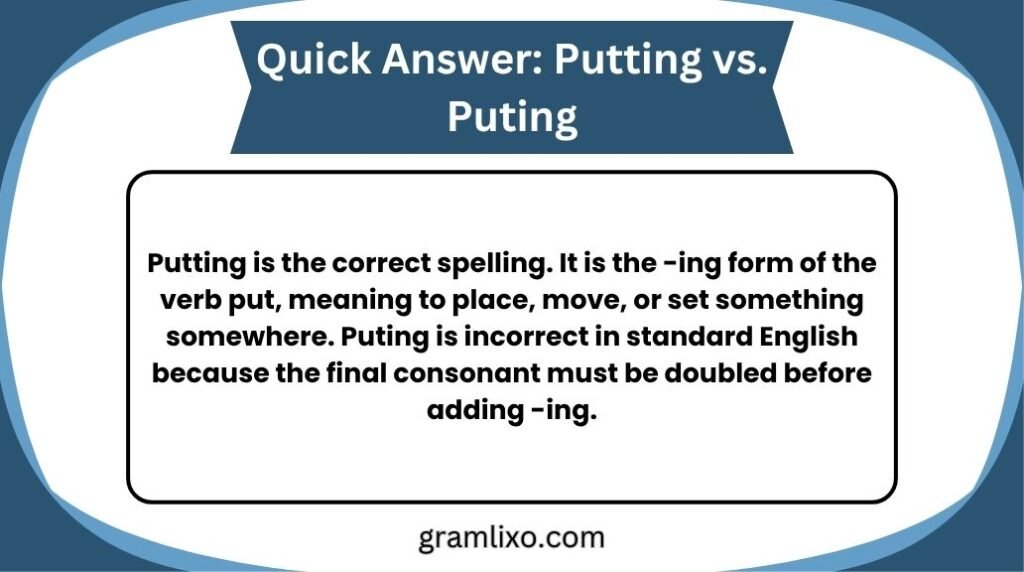
Putting is the correct spelling. It is the -ing form of the verb put, meaning to place, move, or set something somewhere. Puting is incorrect in standard English because the final consonant must be doubled before adding -ing.
- Correct: She is putting the books on the shelf.
- Incorrect: She is puting the books on the shelf.
Remember: Put + ing = Putting. ✅
Understanding the Basics of Putting vs. Puting
The difference between these two spellings comes down to one letter. Although puting may look reasonable at first glance, it does not follow the standard spelling rule for the verb put.
What Does Putting Mean?
Putting is the present participle or gerund of put. The base verb generally means to move something to a particular place or position.
Examples include:
- I am putting my phone on the desk.
- He is putting his shoes away.
- Putting your ideas into words can be difficult.
- They are putting together a new business plan.
In each example, putting describes an action or functions as a noun-like word.
What Does Puting Mean?
Puting is not the standard spelling of the -ing form of put. You should not use it in ordinary English sentences when describing the action of placing something somewhere.
For example:
- Incorrect: I am puting the groceries away.
- Correct: I am putting the groceries away.
The missing second t makes the first sentence misspelled.
Putting vs. Puting: Comparison Table
| Form | Type | Meaning | Example | Correct/Incorrect |
|---|---|---|---|---|
| Putting | Present participle | Performing the action of placing something | She is putting the keys down. | Correct |
| Putting | Gerund | The action or process of placing something | Putting things away saves space. | Correct |
| Put | Base verb | To place something | Put the bag here. | Correct |
| Puting | Misspelling | Intended to mean the -ing form of put | He is puting the bag down. | Incorrect |
The key point is straightforward: Always write putting with two t’s when using the -ing form of put.
Correct Meanings and Uses of Putting
The word putting can appear in several grammatical situations. Although its spelling remains the same, its function depends on how it is used in a sentence.
1. Putting as a Present Participle
A present participle is the -ing form of a verb. It can help form continuous verb tenses or describe an action happening alongside another action.
Examples:
- Maria is putting the dishes in the cabinet.
- The teacher was putting the assignments on the students’ desks.
- I will be putting the final touches on the presentation tomorrow.
Sentence breakdown:
Consider this sentence:
Maria is putting the dishes in the cabinet.
- Maria: The subject performing the action.
- Is: The helping verb.
- Putting: The present participle of put.
- The dishes: The object being moved.
- In the cabinet: The destination.
The word putting helps form the present continuous tense. It tells us that Maria is performing the action.
2. Putting as a Gerund
A gerund is a verb ending in -ing that functions as a noun. It can act as the subject or object of a sentence.
Examples:
- Putting your phone away helps you concentrate.
- She enjoys putting puzzles together.
- I appreciate you putting everything in order.
Sentence breakdown:
Putting your phone away helps you concentrate.
The phrase putting your phone away acts as the subject of the sentence. The sentence explains how this action helps someone focus.
Notice that the spelling remains putting, even when the word functions as a noun rather than part of a verb phrase.
3. Putting in Everyday Instructions
People frequently use putting when discussing household tasks, organizing belongings, cooking, and other daily activities.
Examples include:
- I am putting the milk back in the refrigerator.
- He is putting clean clothes in the drawer.
- We are putting the chairs around the table.
- She is putting sugar in her coffee.
- They are putting the groceries away.
In each sentence, putting describes the action of moving something into a position or condition.
The incorrect spelling puting would be a spelling error in all these examples.
4. Putting in Expressions and Phrasal Verbs
The verb put appears in many common English expressions. When it takes the -ing ending, the correct spelling is still putting.
Here are some examples:
| Expression | Meaning | Example |
|---|---|---|
| Putting off | Delaying something | I keep putting off my homework. |
| Putting on | Wearing something or applying something | She is putting on her jacket. |
| Putting away | Returning something to its proper place | He is putting away his tools. |
| Putting together | Assembling or organizing things | We are putting together a presentation. |
| Putting up with | Tolerating something | She is putting up with unnecessary noise. |
| Putting down | Placing something down or criticizing someone | He is putting down his bag. |
| Putting forward | Suggesting an idea | They are putting forward a new proposal. |
| Putting aside | Saving something or temporarily ignoring it | I am putting aside money for a trip. |
These expressions show why learning the correct spelling matters. One small spelling mistake can appear in many different types of sentences.
5. Putting in Sports, Especially Golf
The word putting also has a special use in golf. It refers to hitting a golf ball toward the hole on the green, usually with a putter.
Examples:
- Her putting has improved this season.
- He is practicing putting before the tournament.
- Good putting can make a major difference in a golf game.
In this context, putting is a recognized sports term. It does not use a different spelling from the everyday verb.
Important: Whether you are putting a book on a shelf or putting a golf ball toward a hole, the correct spelling has two t’s.
A Simple Test Tip to Remember the Correct Spelling
If you are unsure about putting vs. puting, use this quick test:
- Write the base verb: put.
- Add the ending: -ing.
- Double the final consonant: put + t + ing = putting.
You can also compare it with these familiar words:
- Sit → sitting
- Run → running
- Stop → stopping
- Plan → planning
- Put → putting
The extra consonant helps preserve the expected short-vowel sound in these words.
Test tip: If you are writing about the action of placing something somewhere, use putting. If you see puting in an ordinary sentence, check and correct it.
Case Study: Putting vs. Puting in a Workplace Email
Imagine that an employee named Alex is preparing an email to a manager about organizing office supplies.
The incorrect email
Subject: Office Organization
Hi Sarah,
I am puting the new supplies in the storage room today. I will also be puting the labels on the boxes so everyone can find things easily.
Best,
Alex
The email is understandable, but the word puting is misspelled twice. In a professional setting, repeated spelling errors can make a message appear rushed or poorly proofread.
The corrected email
Subject: Office Organization
Hi Sarah,
I am putting the new supplies in the storage room today. I will also be putting the labels on the boxes so everyone can find things easily.
Best,
Alex
What changed?
Only one letter was added to each misspelled word, but the corrected email follows standard English spelling conventions.
This example highlights three useful lessons:
- Accuracy: Check verb endings before sending professional messages.
- Consistency: Use the correct spelling every time the word appears.
- Proofreading: Read your message once before sending it, even if the meaning seems obvious.
The lesson applies to school assignments, job applications, reports, customer emails, and everyday written communication.
Grammar Rules: Why Is Putting Correct?
The difference between putting and puting comes from a standard English spelling rule: some verbs ending in a single consonant double that consonant before adding -ing.
The verb put follows this rule.
The Consonant-Doubling Rule
In many short verbs, the final consonant doubles when the verb ends in a consonant-vowel-consonant pattern and the final syllable is stressed.
For example:
- Sit → sitting
- Run → running
- Get → getting
- Stop → stopping
- Put → putting
The base verb put has one vowel letter between two consonants: p-u-t. When the -ing suffix is added, the final t doubles.
Therefore:
\[ \text{put}+\text{ing}=\text{putting} \]
Writing puting skips the required doubling.
Does Every Verb Double Its Final Consonant?
No. English spelling depends on the word’s structure and stress pattern. Some verbs take -ing without doubling their final consonant.
Compare these examples:
| Base verb | Correct -ing form | Why? |
|---|---|---|
| Put | Putting | Doubles the final t |
| Sit | Sitting | Doubles the final t |
| Run | Running | Doubles the final n |
| Help | Helping | Does not double the final p |
| Read | Reading | Does not double the final d |
| Play | Playing | Does not double the final y |
| Open | Opening | Does not double the final n in standard usage |
These examples show why you should not add an extra consonant to every verb. You need to apply the appropriate spelling rule to each word.
What Do Dictionaries Say?
Merriam-Webster’s Scrabble word finder lists the standard verb forms as put, putting, and puts, supporting the spelling with two t’s.
Scrabble
Collins Dictionary also lists putting as the present participle of put.
Collins English Dictionary
These references agree with standard English usage: putting is the correct form, while puting is a misspelling when intended as the -ing form of put.
Is Putting a Grammar Issue or a Spelling Issue?
It is primarily a spelling issue. Both putting and puting may look like attempts to form a verb ending, but only putting follows the standard spelling rule.
Grammar determines how the word functions in a sentence. Spelling determines how the word is written.
For example:
- Correct spelling and grammar: She is putting the cup on the table.
- Incorrect spelling: She is puting the cup on the table.
- Correct spelling but incorrect sentence structure: She putting the cup on the table.
The third sentence needs a helping verb in standard written English. You would write She is putting the cup on the table.
This distinction is useful because a sentence can have the right spelling but still contain a grammatical error, or it can have correct grammar but an incorrectly spelled word.
Common Mistakes When Writing Putting vs. Puting
Spelling mistakes often happen because people rely on how a word looks rather than remembering the rule behind it. Since put is a very short verb, writers may think they only need to attach -ing to the end.
However, this approach produces puting, which is incorrect in standard English.
Why Do People Write Puting Instead of Putting?
There are three common reasons.
1. Fast typing
When people type quickly, they may leave out a repeated letter without noticing. Since the missing letter does not usually change how the sentence is pronounced, the error can be easy to overlook.
Example:
- Incorrect: I am puting everything in the box.
- Correct: I am putting everything in the box.
2. Autocorrect and spell-check limitations
Digital writing tools are helpful, but you should not depend on them completely. Different applications may handle errors differently, and a missed mistake can remain in your text.
Always review important messages, even when your device provides automatic spelling corrections.
3. Lack of knowledge of spelling rules
Some writers know that verbs take -ing but do not know when the final consonant must double. Learning the basic rule helps prevent similar errors in other words.
Similar Spelling and Grammar Confusions
Putting vs. puting is one example of a broader problem in English writing. Other word pairs and forms can also confuse readers.
| Confusing forms | Correct usage | Example |
|---|---|---|
| Putting / Puting | Putting | He is putting the book away. |
| Running / Runing | Running | She is running outside. |
| Sitting / Siting | Sitting for the action of sitting | I am sitting near the window. |
| Planning / Planing | Planning for making arrangements | We are planning a trip. |
| It’s / Its | It’s = it is; its = possessive | It’s a dog with its toy. |
| Your / You’re | Your = possessive; you’re = you are | You’re holding your bag. |
| Their / There / They’re | Possession, place, and they are | They’re leaving their bags there. |
| Writing / Writting | Writing | He is writing a letter. |
| Beginning / Begining | Beginning | The meeting is beginning now. |
Some pairs, such as sitting and siting, contain two correctly spelled words with different meanings. Others, such as putting and puting, contrast a standard spelling with a misspelling.
The best approach is to learn the spelling and meaning of each word instead of assuming that similar-looking words follow identical rules.
Usage in Different Contexts
Knowing the correct spelling is useful in every type of writing. Here is how putting appears in everyday conversation, professional communication, creative work, and digital messages.
1. Everyday Conversation
In casual conversations, people often describe actions using the present continuous tense.
Examples:
- “I’m putting my shoes on.”
- “Are you putting the food away?”
- “She’s putting her phone on silent.”
- “We’re putting the chairs outside.”
Although people may not notice a spelling mistake in spoken conversation, they will see it when these sentences are written in a message or note.
Remember that the spelling remains putting even when the sentence is informal.
2. Professional Writing
In business emails, workplace reports, and presentations, correct spelling helps communicate attention to detail.
Examples:
- “We are putting the updated policy into effect on Monday.”
- “The team is putting together a project timeline.”
- “I am putting the final figures into the spreadsheet.”
- “Management is putting new procedures in place.”
A misspelling does not automatically make a professional document unreliable, but frequent errors can distract readers from the message.
Best practice: Use spell-checking tools, proofread the final version, and pay extra attention to repeated words.
3. Creative Writing
Authors use putting to describe movement, actions, and emotional changes.
Examples:
- She was putting the old letters into a wooden box.
- Putting his worries aside, Daniel stepped into the room.
- The character kept putting off the difficult conversation.
- He was putting his trust in someone he barely knew.
In fiction, the word may appear in dialogue, narration, or descriptions of a character’s actions. The spelling rule does not change because the writing is creative.
4. Social Media and Texting
Online communication often encourages quick typing and informal language. Even so, correct spelling makes posts easier to read.
Examples:
- “I’m putting together a birthday surprise!”
- “Putting my phone away and enjoying the weekend.”
- “We’re putting the finishing touches on our new project.”
- “Putting in the work every day!”
A casual post does not need to sound formal, but using standard spelling helps readers understand it immediately.
Why Correct Spelling Matters
You might wonder whether one extra letter really makes a difference. In most cases, readers can understand puting from context. However, correct spelling still matters for several reasons.
Clarity in Communication
Correct spelling reduces distractions. Readers can focus on the information instead of mentally correcting mistakes.
For example, “I am putting the files in the folder” looks clear and professional. The misspelled version may cause readers to pause, even though the intended meaning is obvious.
Professionalism and Credibility
In a résumé, client email, school assignment, or business proposal, spelling errors can make a document look unfinished. A single typo is rarely the whole story, but careful proofreading creates a better impression.
Accuracy in Digital Communication
Search engines, workplace software, and digital documents rely on text. Correct spelling helps users search for information, maintain consistent records, and communicate clearly.
Using putting correctly also supports better writing habits that apply to many other verbs.
A Short Quote to Remember
“Small details make a big difference.”
This is a general reminder, not a quotation attributed to a specific author. In writing, a single letter can distinguish a correct word from a spelling error.
Special Exceptions: Is Puting Ever Correct?
For ordinary English writing, there is no standard spelling exception that changes the -ing form of put to puting. When you mean placing something somewhere, the correct word is always putting.
There are a few details worth understanding, though.
What About Names, Brands, or Usernames?
A person, company, product, or online account might use Puting as a chosen name or stylized label. In that case, the spelling may be intentional as a proper name.
That does not make puting a correct alternative to putting in a normal English sentence.
For example:
- Standard verb: “She is putting the books away.”
- Hypothetical username: “Puting123 posted a comment.”
The second example treats Puting123 as an account name, not as a verb.
What About Golf?
Golf uses the word putting to describe a particular part of the game. This is not an exception to the spelling rule. It is simply another use of the same correctly spelled word.
Example: “His putting improved after several weeks of practice.”
What About British and American English?
There is no US-versus-UK spelling difference for this word. Both American and British English use putting.
You do not need to memorize separate regional versions.
Quick Recap Checklist: Putting vs. Puting
Use this checklist whenever you are unsure about the correct spelling.
| Question | If Yes → Use |
|---|---|
| Are you describing the action of placing something? | Putting |
| Are you forming the -ing version of the verb put? | Putting |
| Are you describing the act of putting something somewhere? | Putting |
| Are you writing the word as puting in an ordinary sentence? | Correct it to putting |
| Are you using a person’s or brand’s chosen name? | Preserve its official spelling, if verified |
Practice Examples
Choose the correct spelling for each sentence before checking the answers.
1. She is ___ the groceries in the refrigerator.
- A. Puting
- B. Putting
2. ___ your phone away during class can help you focus.
- A. Putting
- B. Puting
3. We are ___ together a presentation for tomorrow’s meeting.
- A. Puting
- B. Putting
Check your answers
1. She is ___ the groceries.PutingPutting
2. ___ your phone away helps you focus.PuttingPuting
3. We are ___ together a presentation.PutingPutting
Check answers
Frequently Asked Questions (FAQs)
1. Is it putting or puting?
Putting is correct. It is the -ing form of the verb put. The spelling puting is incorrect when used to describe the action of placing something somewhere.
Example: “I am putting my books on the desk.”
2. Why does putting have two t’s?
The verb put doubles its final consonant before taking the -ing ending. This follows a common English spelling rule for short verbs with a consonant-vowel-consonant pattern.
The correct formation is put + ing = putting.
3. Is puting ever an acceptable spelling in English?
Not as the standard -ing form of put. It could appear as an intentionally chosen name, username, or brand spelling, but that is different from using it as an ordinary English verb.
4. Is putting a gerund or a present participle?
It can be either, depending on the sentence. In “She is putting the bag down,” it is a present participle used in a continuous verb phrase. In “Putting things away saves time,” it is a gerund functioning as the subject.
5. What is the past tense of put?
The past tense of put is put. The word does not change its spelling in the simple past tense.
Examples:
- Present: “I put the keys on the table every day.”
- Past: “I put the keys on the table yesterday.”
- Present continuous: “I am putting the keys on the table now.”
6. Does putting have the same spelling in American and British English?
Yes. Both American and British English use putting. There is no regional spelling difference between these varieties for this word.
Conclusion: Putting vs. Puting
The difference between putting and puting is simple, but understanding it can improve your spelling and writing accuracy. Putting is the only standard spelling of the -ing form of the verb put. It means placing something somewhere, and it can function as either a present participle or a gerund depending on the sentence. The spelling puting is incorrect when used with this intended meaning.
The reason is the consonant-doubling rule: the final t in put doubles before the -ing ending is added. The same pattern appears in words such as sitting, running, and stopping.
Whenever you write an email, complete an assignment, prepare a report, or post on social media, take a moment to check your spelling. Remember the simple formula: put + ing = putting.
One small spelling habit can make your writing clearer, more accurate, and more professional. Keep the extra t, and you will get it right every time.

Hi, I’m Lisa Jones, a grammar enthusiast and writer at Gramlixo. I enjoy making English grammar simple, clear, and easy to apply in everyday writing.

[…] |Putting vs. Puting: Which Spelling Is Correct? […]