Have you ever stopped in the middle of writing a sentence because you could not decide whether to use who vs. whom? You are not alone.
These two words look similar, sound similar in everyday American English, and are often confused in emails, conversations, academic papers, and professional writing. However, they serve different grammatical purposes.
Knowing when to use who and when to use whom can make your sentences clearer and more accurate. I often find that the easiest way to understand this grammar rule is to think about the difference between subjects and objects.
Who refers to the person performing an action, while whom refers to the person receiving an action or following a preposition. Although modern speakers sometimes use who in situations where traditional grammar expects whom, understanding both forms will help you communicate confidently.
In this guide, you will learn the meanings, grammar rules, examples, common mistakes, and practical tricks that make choosing the correct word much easier.
|To vs Too vs Two: What’s the Difference? (Meaning, Rules, and Examples)
|Input vs Imput: Which Is Correct? Meaning, Usage, and Examples
|Who Else vs Whom Else: Which One Is Correct?
Quick Answer: Who vs. Whom
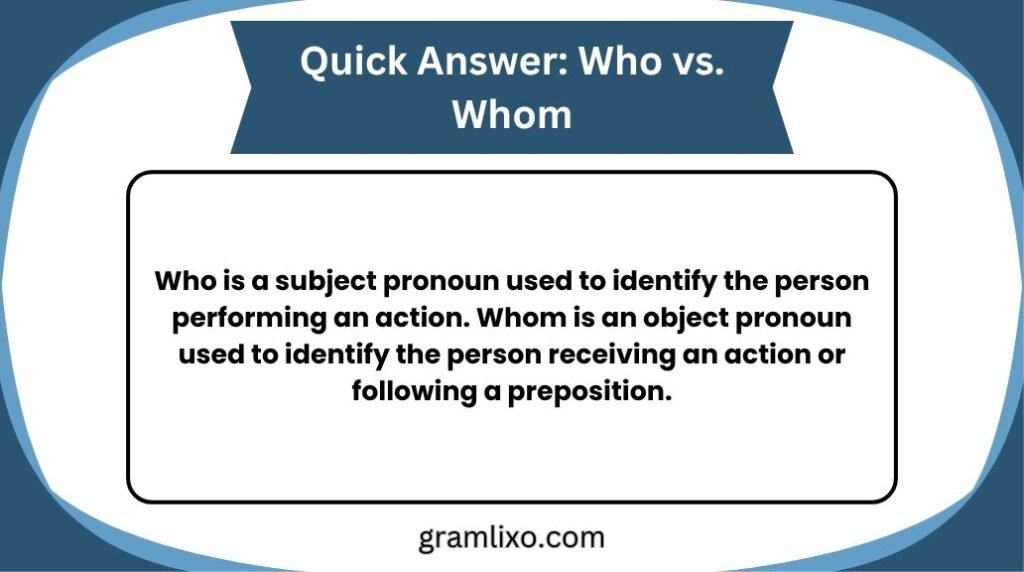
Who is a subject pronoun used to identify the person performing an action. Whom is an object pronoun used to identify the person receiving an action or following a preposition.
- Who: Who called you yesterday?
- Whom: Whom did you call yesterday?
Easy trick: If you can answer with he or she, use who. If you can answer with him or her, use whom.
Understanding the Basics of Who vs. Whom
The main difference between who and whom comes down to their grammatical roles in a sentence.
Both words are interrogative pronouns, meaning they help ask questions about people. They can also introduce relative clauses that provide additional information about someone.
However, they do not perform the same grammatical function.
What Does Who Mean?
Who is a pronoun used to ask about or identify the person performing an action.
It usually functions as the subject of a verb.
For example:
- Who is coming to dinner?
- Who wrote this article?
- Who wants to join our team?
- Who opened the door?
In each example, who identifies the person responsible for the action.
Sentence breakdown:
Consider this sentence:
“Who sent you the message?”
- Who = subject.
- Sent = verb.
- You = indirect object.
- The message = direct object.
The question asks about the person who performed the action of sending the message.
What Does Whom Mean?
Whom is a pronoun used to ask about or identify the person receiving an action or serving as the object of a preposition.
For example:
- Whom did you invite?
- Whom are you waiting for?
- To whom should I address this letter?
- Whom did the manager select?
In these sentences, whom does not perform the main action. Instead, it receives the action or follows a preposition.
Sentence breakdown:
Consider this sentence:
“Whom did you invite?”
- You = subject.
- Did invite = verb phrase.
- Whom = direct object.
The question asks about the person who received the invitation.
Who vs. Whom: Comparison Table
| Form | Type | Meaning | Example | Correct/Incorrect |
|---|---|---|---|---|
| Who | Subject pronoun | Person performing an action | Who called me? | Correct |
| Whom | Object pronoun | Person receiving an action | Whom did you call? | Correct |
| Who | Subject pronoun | Person performing an action | Who is your teacher? | Correct |
| Whom | Object pronoun | Object of a preposition | To whom did you speak? | Correct |
| Whom | Object pronoun | Person receiving an action | Whom called you? | Incorrect in standard grammar |
| Who | Subject pronoun | Used as an object | Whom did you invite? | Incorrect in formal standard grammar |
Remember: Who acts like he or she, while whom acts like him or her.
Correct Meanings and Uses of Who vs. Whom
Understanding the definitions is a good starting point, but learning how these pronouns work in different sentence structures will help you use them correctly.
Let’s explore their most important uses.
When to Use Who as a Subject Pronoun
Use who when asking about the person performing the action of a verb.
The subject is the person or thing that performs the action or is described by the verb.
Examples:
- Who teaches you English?
- Who lives in that house?
- Who made this delicious cake?
- Who wants to watch a movie?
- Who knows the answer?
Sentence explanation:
“Who made this delicious cake?”
The person identified by who performed the action of making the cake. Therefore, who is the correct choice.
More examples in everyday English:
- Who is your best friend?
- Who helped you with your homework?
- Who works at the front desk?
- Who broke the window?
- Who invited everyone to the party?
All these sentences ask about the person performing an action or occupying the subject position.
When to Use Whom as an Object Pronoun
Use whom when the person being identified receives an action.
An object pronoun usually appears after a verb or preposition.
Examples:
- Whom did you meet yesterday?
- Whom should we contact?
- Whom did the company hire?
- Whom are they supporting?
- Whom did Sarah choose?
Sentence explanation:
“Whom did you meet yesterday?”
The subject is you because you performed the action of meeting someone. The person you met is the object.
Therefore, whom is traditionally correct in formal standard English.
When to Use Who After a Preposition
Who is generally not used as the object of a preposition in traditional formal grammar.
Prepositions include:
- To
- With
- For
- About
- From
- By
- At
When one of these prepositions directly introduces a person-related question or relative clause, whom is traditionally used.
Examples:
- To whom should I send the documents?
- With whom are you traveling?
- For whom did you purchase this gift?
- About whom are you talking?
- From whom did you receive this email?
Sentence breakdown:
“With whom are you working?”
- With = preposition.
- Whom = object of the preposition.
- Are working = verb phrase.
- You = subject.
The pronoun follows the preposition with, so whom is correct in traditional formal grammar.
When to Use Who in Indirect Questions
Indirect questions are questions included within another sentence.
They often sound more natural than direct questions in professional conversations and formal writing.
Examples:
- I wonder who is responsible for this project.
- Can you tell me who called earlier?
- She knows who manages the department.
- Do you remember who organized the event?
- Please explain who made this decision.
Notice that who remains the subject of its clause.
Important: The presence of an indirect question does not automatically mean you should use who. Its grammatical role still determines the correct pronoun.
For example:
- I wonder who invited you.
- I wonder whom you invited.
The first sentence asks about the person performing the invitation. The second asks about the person receiving it.
When to Use Whom in Indirect Questions
Use whom when it functions as the object inside an indirect question.
Examples:
- I don’t know whom she invited.
- Please tell me whom you contacted.
- We need to determine whom the committee selected.
- He asked whom they had hired.
- She knows whom the manager trusts.
In each example, the person identified by whom receives the action of the verb.
Who vs. Whom in Relative Clauses
Who and whom also appear in relative clauses. These clauses provide additional information about a person.
Use who when the pronoun functions as the subject of the relative clause.
Examples:
- The woman who lives next door is a doctor.
- I know someone who speaks five languages.
- The student who won the competition is my brother.
Use whom when the pronoun functions as the object.
Examples:
- The woman whom I met yesterday is a doctor.
- The student whom the teacher praised received an award.
- The person whom we hired starts Monday.
In everyday American English, who is also widely used instead of whom in many object relative clauses.
For example:
“The person who I met yesterday was friendly.”
This construction is common and generally acceptable in informal usage, although whom may be preferred in more formal writing.
Who vs. Whom at the Beginning of a Sentence
The position of a pronoun at the beginning of a sentence does not determine whether it should be who or whom.
Its grammatical function matters.
Examples:
- Who did you invite?
- Whom did you invite?
The first is common in everyday English. The second follows traditional formal grammar.
However:
- Who invited you?
- Whom invited you?
Here, who is the correct standard subject form because the person performs the action of inviting.
The He/Him Trick: An Easy Way to Remember
One of the easiest ways to distinguish who from whom is to replace the pronoun with he or him.
Use this simple method:
- If the answer is he or she, choose who.
- If the answer is him or her, choose whom.
Example 1:
“Who/whom called you?”
Answer: He called you.
Because he is correct, use who.
Correct sentence: “Who called you?”
Example 2:
“Who/whom did you call?”
Answer: You called him.
Because him is correct, use whom in traditional grammar.
Correct formal sentence: “Whom did you call?”
Test Tip: When you feel confused, temporarily rewrite the sentence using he or him. This simple substitution usually reveals the correct choice.
Case Study: Who vs. Whom in a Professional Workplace
Imagine that you work for a company and need to send an email to your manager about a new employee recruitment project.
You want to ask which person the hiring team selected and which person will be responsible for managing the project.
Here is how the two pronouns work in a realistic professional situation.
Example of a Workplace Email
EmailQuestions About the Recruitment Project
Questions About the Recruitment Project
Hello Sarah,
I have a few questions about the recruitment process.
- Who is responsible for reviewing the applications?
- Whom did the hiring committee select for the final interview?
- Who will manage the new employee’s training?
- To whom should I send the completed documents?
I would appreciate your guidance so I can make sure everything is handled correctly.
Best regards,
James
Why Are These Examples Correct?
Let’s examine each question.
Who is responsible for reviewing the applications?
Who is the subject of the sentence. It identifies the person responsible for reviewing applications.
Whom did the hiring committee select for the final interview?
The hiring committee performs the action. The person selected receives that action, so whom is traditionally correct.
Who will manage the new employee’s training?
Who performs the role of the subject because the question asks about the person who will manage the training.
To whom should I send the completed documents?
Whom follows the preposition to. Therefore, it is correct in formal writing.
This example demonstrates why understanding grammatical roles is more useful than memorizing sentence patterns.
Grammar Rules Explanation: Who vs. Whom
The difference between who and whom is based on subject and object pronoun rules in English grammar.
Let’s look at the main rules.
Rule 1: Use Who for Subjects
A subject performs an action or is described by a verb.
Examples:
- Who is speaking?
- Who prepared the report?
- Who wants to participate?
- Who understands the instructions?
In these examples, who identifies the subject.
Rule 2: Use Whom for Direct Objects
A direct object receives the action of a transitive verb.
Examples:
- Whom did you see?
- Whom did she invite?
- Whom did the teacher praise?
- Whom are they interviewing?
The subject performs the action, while whom identifies the person receiving it.
Rule 3: Use Whom for Indirect Objects
An indirect object identifies the person who receives something or benefits from an action.
Examples:
- To whom did you give the book?
- Whom did she send the invitation to?
- For whom did they prepare dinner?
The exact construction determines the pronoun’s role. In formal English, whom is appropriate when it functions as an object.
Rule 4: Use Whom After a Preposition
When the pronoun is the object of a preposition, traditional formal grammar requires whom.
Examples:
- With whom are you going?
- To whom does this letter belong?
- By whom was the building designed?
- For whom is this package intended?
In conversational English, speakers often place the preposition at the end and use who instead.
For example:
- Formal: With whom are you speaking?
- Conversational: Who are you speaking with?
Both are commonly used, but the first follows the traditional formal rule.
Rule 5: The Role Matters More Than Word Order
Do not decide between who and whom simply by looking at where the word appears.
Consider these sentences:
- Who do you think will win?
- Whom do you think the judges will choose?
In the first example, who is the subject of will win.
In the second example, whom is the object of choose.
This is why examining the complete clause is important.
What Does Merriam-Webster Say About Who and Whom?
According to the traditional grammatical distinction explained in dictionaries such as Merriam-Webster , who functions as a subject pronoun, while whom functions as an object pronoun.
However, actual English usage has changed over time.
In modern American English, who is frequently used in place of whom, especially in everyday conversation and informal writing.
Whom has not disappeared. It remains useful in formal writing, especially after prepositions and in constructions where the object role is clear.
The practical lesson is simple: understand the traditional rule, then choose a level of formality that suits your audience.
Common Mistakes When Using Who vs. Whom
Even people who understand English grammar sometimes confuse who and whom. The problem usually occurs when a sentence contains multiple verbs, indirect questions, or prepositions.
Let’s examine the most common mistakes and how to avoid them.
Mistake 1: Using Who Instead of Whom in Formal Writing
Incorrect: Whom did you invite to the wedding? (Incorrect according to the traditional subject-object distinction? Wait this is actually correct.)
Correct: Whom did you invite to the wedding?
The subject is you, and the person invited is the object. Therefore, whom is the traditional formal choice.
In everyday American English, however, “Who did you invite?” is also widely accepted.
Mistake 2: Using Whom Instead of Who
Incorrect: Whom is coming to the party?
Correct: Who is coming to the party?
The person coming performs the action described by the verb. Therefore, who is required.
Mistake 3: Forgetting the Preposition
Incorrect: To who should I send the application? (Traditional formal grammar)
Correct: To whom should I send the application?
The pronoun is the object of the preposition to. This makes whom the traditional formal choice.
Mistake 4: Choosing Based on Sentence Position
Incorrect reasoning: The pronoun comes after the verb, so it must be whom.
Correct reasoning: Examine the grammatical role of the pronoun in its own clause.
For example:
- Who do you think is responsible?
- Whom do you think the company hired?
The first uses who because the person is responsible for an action or situation. The second uses whom because the company hired that person.
Mistake 5: Using Whom in Everyday Conversation When It Sounds Unnatural
Traditional grammar may favor whom, but modern speakers frequently use who in informal questions.
For example:
- Formal: Whom are you waiting for?
- Conversational: Who are you waiting for?
Both are common. The second sounds more natural in many everyday American conversations.
Why Do People Make These Mistakes?
Several everyday habits contribute to confusion:
- Fast typing: People often choose the first word that sounds natural without checking its grammatical function.
- Autocorrect: Predictive keyboards may suggest one form without considering the sentence’s grammatical structure.
- Lack of knowledge: Many English speakers learn vocabulary and sentence patterns without studying subject and object pronouns.
- Changing language habits: Modern conversation increasingly favors who over whom.
- Complex sentences: Multiple verbs and clauses make it harder to identify the correct grammatical role.
Similar Grammar Confusions
Who vs. whom is not the only pair that creates problems for English learners and native speakers.
| Confusing Words | Correct Difference | Example |
|---|---|---|
| Who vs. Whom | Subject vs. object pronoun | Who called? / Whom did you call? |
| Its vs. It’s | Possession vs. it is | The dog wagged its tail. / It’s raining. |
| Your vs. You’re | Possession vs. you are | Your book is here. / You’re welcome. |
| Their vs. There | Possession vs. place or existence | Their house is large. / There is a problem. |
| Then vs. Than | Time or sequence vs. comparison | Eat first, then leave. / She is taller than me. |
| Affect vs. Effect | Usually verb vs. noun | Noise can affect sleep. / The effect was noticeable. |
| Who’s vs. Whose | Who is/who has vs. possession | Who’s coming? / Whose bag is this? |
Helpful reminder: Whenever two words look or sound similar, focus on their grammatical functions rather than their pronunciation.
Usage of Who vs. Whom in Different Contexts
The choice between who and whom can change depending on the situation, audience, and level of formality.
Both forms have a place in modern American English.
1. Everyday Conversation
In casual conversations, Americans frequently use who instead of whom.
For example:
- Who are you talking to?
- Who did you meet?
- Who are you waiting for?
- Who do you want to invite?
These sentences are natural and widely understood.
Although traditional grammar prefers whom in certain object positions, using who in casual speech does not usually create confusion.
Recommendation: Use who naturally in everyday conversation unless you have a specific reason to use a more formal construction.
2. Professional Writing
Professional communication often requires greater attention to grammar, clarity, and tone.
Whom can be useful in formal emails, reports, business letters, and official documents.
Examples:
- To whom it may concern.
- Whom should we contact regarding this matter?
- With whom will the department collaborate?
- The candidate whom we selected has accepted the position.
However, professional writing does not require using whom in every possible object position.
For example:
“Who should we contact regarding this matter?”
This is also natural and acceptable in modern professional English.
Recommendation: Use whom when it improves formality and fits the grammatical structure. Do not force it into sentences where who sounds clearer.
3. Creative Writing
Writers can use both pronouns depending on their characters, narrative style, and dialogue.
For example:
“Who are you?” the detective asked.
“Whom do you seek?” the mysterious stranger replied.
The first question sounds conversational. The second creates a more formal or dramatic tone.
Creative writers may also use whom to establish a character’s personality, education, or speaking style.
Recommendation: Choose the pronoun that supports the voice and atmosphere of your writing while maintaining grammatical accuracy.
4. Social Media and Texting
Social media conversations are usually informal. People prioritize speed, simplicity, and natural expression.
Examples:
- Who’s coming tonight?
- Who did you meet?
- Who are you going with?
- Who wants free coffee?
Using whom in casual messages can sometimes sound unnecessarily formal.
However, whom is still appropriate when the sentence structure calls for it and the writer wants a more formal tone.
Recommendation: Use natural conversational English in texts and social media posts. Save more formal constructions for situations where they are useful.
Why Does the Difference Between Who and Whom Matter?
You may wonder whether this small grammatical distinction really makes a difference.
The answer is yes, especially when you write for different audiences or communicate in professional environments.
Here are several reasons why understanding who vs. whom is valuable.
1. Clarity in Communication
Correct pronoun usage helps readers understand who performs an action and who receives it.
Consider these questions:
- Who questioned the manager?
- Whom did the manager question?
The first asks about the person who asked the question. The second asks about the person receiving the question.
Understanding the distinction helps readers interpret sentences correctly.
2. Professionalism and Credibility
Grammar is one part of professional communication.
When writing business emails, academic assignments, reports, or applications, using appropriate grammar demonstrates attention to detail.
Knowing when to use whom can help you create a more polished and formal impression.
However, professionalism is not about using complicated words. Clear and natural writing is always important.
3. Writing Accuracy
English grammar contains several pronoun rules, and understanding them improves your overall writing skills.
Learning the difference between subject and object pronouns also helps with other words, including:
- I vs. me
- He vs. him
- She vs. her
- They vs. them
- We vs. us
These distinctions make sentence construction easier.
4. Better Digital Communication
Digital communication includes emails, website content, social media posts, online applications, and business messages.
Even a short sentence can influence how readers understand your message.
Using the appropriate pronoun helps maintain clarity, especially in formal digital communication.
“Clear writing is not about using bigger words; it is about choosing the right words.”
The goal is not to make every sentence sound formal. The goal is to make every sentence easy to understand.
Special Exceptions and Important Edge Cases
The traditional difference between who and whom is straightforward, but modern English includes several situations that deserve special attention.
Who Is Commonly Used Instead of Whom in Informal English
One important feature of modern American English is the increasing use of who as an object pronoun.
For example:
- Traditional formal: Whom did you see?
- Common informal: Who did you see?
Both communicate the same question, although the first follows the traditional subject-object distinction.
In many everyday situations, the second sounds more natural.
Who at the End of a Sentence
When a preposition appears at the end of a question, who is common in conversational English.
Examples:
- Who are you speaking with?
- Who is this gift for?
- Who did she send the invitation to?
- Who are you thinking about?
Traditional formal grammar favors whom in these constructions:
- With whom are you speaking?
- For whom is this gift?
- To whom did she send the invitation?
- About whom are you thinking?
The meaning remains the same. The difference is primarily grammatical formality and style.
The Expression “To Whom It May Concern”
“To whom it may concern” is a traditional formal expression used at the beginning of letters and documents when the recipient’s identity is unknown.
For example:
- Employment verification letters
- Formal complaints
- Recommendation letters
- Official business correspondence
The phrase uses whom because it is the object of the preposition to.
Example:
“To whom it may concern, I am writing to request additional information about the application process.”
This expression remains widely recognized in formal correspondence.
Who’s vs. Whom
Another common confusion involves who’s and whom.
Who’s is a contraction of who is or who has.
Examples:
- Who’s coming to dinner?
- Who’s responsible for this project?
- Who’s already completed the assignment?
Whom is an object pronoun.
Examples:
- Whom did you invite?
- To whom should I speak?
- Whom are they interviewing?
Important: Who’s and whom are not interchangeable.
Whomever vs. Whoever
You may also encounter whoever and whomever.
These words follow the same basic grammatical distinction:
- Whoever functions as a subject.
- Whomever functions as an object.
Examples:
- Whoever finishes first will receive a prize.
- Give the invitation to whomever you choose.
The second example uses whomever because it is the object of the preposition to and the object within the clause you choose.
However, in more complicated sentences, identify the role inside the relevant clause rather than relying only on the word’s position.
Quick Recap Checklist: Who vs. Whom
Use the following checklist whenever you are unsure which pronoun belongs in a sentence.
| Question | If Yes → Use |
|---|---|
| Is the person performing the action? | Who |
| Does the pronoun function as the subject? | Who |
| Can you replace the word with he or she? | Who |
| Is the person receiving the action? | Whom |
| Does the pronoun function as an object? | Whom |
| Can you replace the word with him or her? | Whom |
| Does it directly follow a preposition in formal writing? | Whom |
Three Easy Practice Examples
Test your understanding with these sentences.
Example 1:
_____ is your favorite teacher?
- A. Who
- B. Whom
Correct answer: Who
Explanation: The pronoun functions as the subject of the sentence. The person is being identified as the favorite teacher.
Example 2:
_____ did you invite to your birthday party?
- A. Who
- B. Whom
Traditional formal answer: Whom
Explanation: You perform the action of inviting. The person receiving the invitation is the object. Who is also common in informal American English.
Example 3:
With _____ are you traveling?
- A. Who
- B. Whom
Correct answer: Whom
Explanation: The pronoun is the object of the preposition with.
Frequently Asked Questions (FAQs)
Here are answers to common questions about who vs. whom that can help you understand the difference quickly.
1. What Is the Main Difference Between Who and Whom?
The main difference is their grammatical function. Who is a subject pronoun used for the person performing an action, while whom is an object pronoun used for the person receiving an action or following a preposition.
Example:
- Who called you?
- Whom did you call?
2. Is It Correct to Say “Who Did You Call” or “Whom Did You Call”?
Both forms are used in modern English, but they differ in formality.
“Whom did you call?” follows the traditional grammatical rule because the pronoun is the object of the verb call.
“Who did you call?” is widely accepted in everyday American English and sounds more conversational.
3. How Can I Easily Remember When to Use Who or Whom?
Use the he/him trick.
- If he or she fits the answer, use who.
- If him or her fits the answer, use whom.
For example, “Who called you?” can be answered with “He called me.” Therefore, who is correct.
4. Should I Use Whom in Professional Emails?
You can use whom in professional emails when the pronoun functions as an object, especially after a preposition.
For example:
- To whom should I send the report?
- Whom should we contact?
However, using who in conversational professional emails is also common. Choose the construction that sounds clear and appropriate for your audience.
5. Is Whom Becoming Outdated in Modern English?
Whom is less common in everyday conversation than it once was, but it is not completely outdated.
It remains useful in formal writing, academic communication, and expressions such as “To whom it may concern.”
Who is increasingly used in informal situations where traditional grammar would favor whom.
6. Is “Who” Correct at the End of a Sentence?
Yes. In modern conversational English, who is commonly used at the end of a sentence when it functions as the object of a preposition.
Example:
“Who are you talking to?”
This is natural and widely accepted in everyday English.
The more formal traditional construction is:
“To whom are you talking?”
Both sentences communicate the same meaning.
Conclusion: Who vs. Whom
Understanding who vs. whom becomes much easier when you focus on the role each pronoun plays in a sentence. Who is the subject pronoun used for the person performing an action, while whom is the object pronoun used for the person receiving an action or following a preposition.
The simplest way to remember the difference is the he/him trick. If he or she fits, choose who. If him or her fits, choose whom. Although whom is becoming less common in everyday American English, it remains valuable in formal writing and professional communication.
Practice these rules with everyday sentences, emails, and conversations to improve your grammar naturally. Remember, good writing is not about making sentences complicated; it is about making every word count.
Master the difference between who and whom, and you will write with greater confidence and clarity.

I’m Robert Williams, an English grammar writer at Gramlixo. I focus on breaking down confusing grammar rules into simple explanations and useful examples.
[…] |Who vs Whom: What’s the Difference and How to Use Them Correctly? […]