Totaling vs totalling is a common spelling confusion in English. If you have ever wondered which spelling is correct, the answer depends on your audience. Totaling is the standard American English spelling, while totalling is commonly used in British English.
Both words have the same meaning: adding amounts together or calculating a final sum. Understanding this small spelling difference can help you write more clearly and professionally.
Whether you are preparing a school assignment, writing a business report, or publishing an article for a US audience, choosing the correct spelling matters.
In this guide, you will learn the difference between totaling and totalling, explore practical examples, and discover simple grammar rules to help you use each form correctly.
|Sundays vs Sundays: Correct Spelling, Meaning, and Usage
|Disloyal vs Unloyal: Which Word Is Correct?
Quick Answer: Totaling vs. Totalling
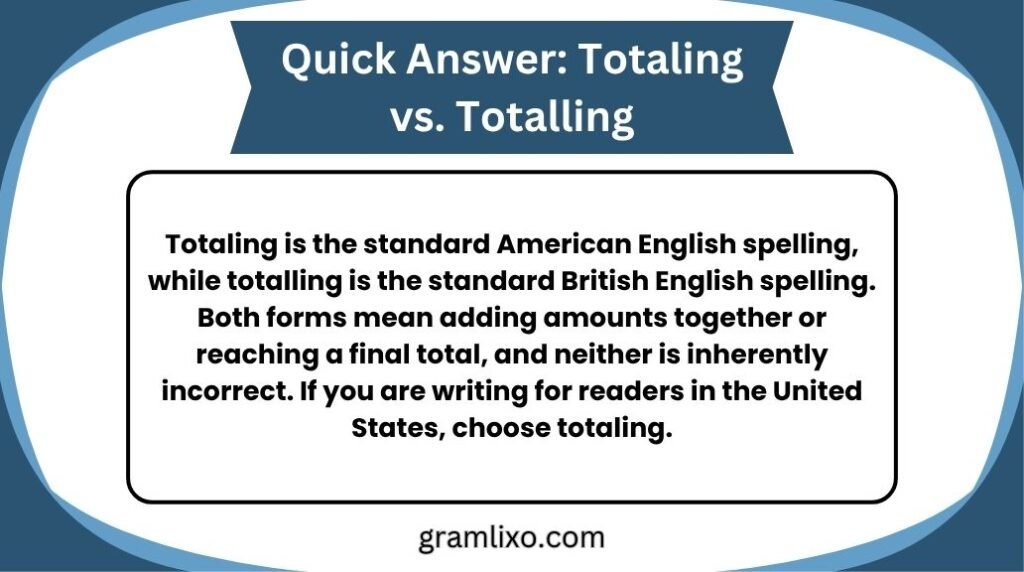
Totaling is the standard American English spelling, while totalling is the standard British English spelling. Both forms mean adding amounts together or reaching a final total, and neither is inherently incorrect. If you are writing for readers in the United States, choose totaling.
Examples:
- American English: The expenses are totaling $500.
- British English: The expenses are totalling £500.
The meaning remains the same in both sentences. Only the spelling convention changes.
Understanding the Basics of Totaling vs. Totalling
The difference between totaling and totalling is based on regional spelling rules. Both words are forms of the verb total, which means to add numbers or amounts together to determine a final sum.
When the verb total takes the ending -ing, American English generally keeps one l, producing totaling. British English commonly doubles the final l, producing totalling.
This difference is similar to other American and British spelling pairs, such as traveling and travelling or canceled and cancelled.
Totaling vs. Totalling Comparison Table
| Form | Type | Meaning | Example | Correct/Incorrect |
|---|---|---|---|---|
| Totaling | American English spelling | Adding amounts to find a sum | The purchases are totaling $200. | Correct in US English |
| Totalling | British English spelling | Adding amounts to find a sum | The purchases are totalling £200. | Correct in British English |
| Total | Base verb | To add amounts or calculate a sum | Please total the receipts. | Correct |
| Totaled | American English past tense | Added up or reached a total | We totaled the expenses. | Correct in US English |
| Totalled | British English past tense | Added up or reached a total | We totalled the expenses. | Correct in British English |
The key rule: Use totaling for American English and totalling for British English. Both spellings communicate the same idea.
Why Does the Spelling Change?
English has different spelling conventions in different regions. American English often keeps a single l in words such as totaling, traveling, and modeling. British English commonly doubles the final l, giving totalling, travelling, and modelling.
Here is the pattern to remember:
| American English | British English |
|---|---|
| Totaling | Totalling |
| Totaled | Totalled |
| Traveling | Travelling |
| Traveled | Travelled |
| Modeling | Modelling |
| Modeled | Modelled |
| Canceling | Cancelling |
| Canceled | Cancelled |
These pairs show why the two spellings can both be correct. The choice depends on the spelling system you follow, not on a difference in meaning.
Correct Meanings and Uses of Totaling vs. Totalling
The words totaling and totalling have the same basic meaning. They can describe the action of adding figures, the process of calculating a sum, or an amount made up of several individual values.
Let’s examine their most common uses.
1. Using Totaling to Add Numbers
In American English, totaling can describe the process of adding numbers to find a final sum.
For example:
I am totaling the expenses before submitting my report.
Sentence breakdown:
- I is the subject.
- Am totaling describes an action in progress.
- The expenses identifies what is being added.
The sentence tells us that the speaker is currently calculating the combined expense amount.
Here are more examples:
- The accountant is totaling the monthly bills.
- I spent the morning totaling the receipts.
- She is totaling the scores from each round.
- We are totaling the donations before announcing the result.
- The manager is totaling the department’s expenses.
All these examples use totaling correctly in American English.
In British English, you would write totalling in the same sentences.
2. Using Totaling to Describe a Combined Amount
The word can also describe a collection of items whose combined value reaches a particular amount.
For example:
The company received donations totaling $12,000.
In this sentence, totaling $12,000 explains the combined value of the donations.
The sentence does not necessarily describe someone adding the donations at that exact moment. Instead, it tells readers the final amount represented by those donations.
Consider these additional examples:
- The repairs cost $3,500, totaling more than we expected.
- The store received five payments totaling $800.
- The charity collected contributions totaling $25,000.
- The project included expenses totaling $7,200.
- The three invoices were totaling approximately $4,000.
The final example is grammatically possible when describing an ongoing or past situation, although a more natural sentence in many contexts would be, “The three invoices totaled approximately $4,000.”
Writing tip: When you simply want to report the combined value of completed transactions, totaled is often clearer than were totaling.
3. Using Totalling in British English
British English uses totalling for the same purposes.
For example:
The accountant is totalling the expenses before sending the report.
This sentence has the same meaning as its American English equivalent. Only the spelling changes.
More examples include:
- She is totalling the receipts from the business trip.
- The donations are totalling more than £10,000.
- The invoices, totalling £2,500, were sent to the client.
- The project has several expenses totalling thousands of pounds.
- He spent the afternoon totalling the scores.
These forms are appropriate when following British spelling conventions.
4. Using Totaling as a Gerund
A gerund is a verb ending in -ing that functions as a noun.
For example:
Totaling the expenses takes less than ten minutes.
Here, totaling the expenses functions as the subject of the sentence. It identifies an activity that takes less than ten minutes.
Other examples include:
- Totaling the receipts is part of my daily routine.
- Accurate totaling helps prevent accounting errors.
- Totaling the scores determines the winner.
- Totaling the costs before purchasing supplies helps us stay within budget.
In American English, the spelling is totaling. In British English, the equivalent gerund is totalling.
5. Using Totaling in Professional and Financial Writing
The word frequently appears in financial reports, invoices, budgets, and business emails.
For example:
The department approved expenses totaling $18,450 for the third quarter.
The phrase expenses totaling $18,450 provides a concise description of the total approved amount.
Other professional examples include:
- The audit identified transactions totaling $45,000.
- The company reported losses totaling $200,000.
- The client submitted invoices totaling $6,750.
- The project includes equipment costs totaling $14,000.
- The department processed refunds totaling $2,300.
These sentences are suitable for American English business writing. A British publication may use totalling instead.
Test Tip: How to Choose the Correct Spelling
Use this simple test whenever you are unsure:
- Identify your target audience.
- If you are writing in American English, choose totaling.
- If you are following British English, choose totalling.
- Check related words, such as traveled/travelled, to keep the same spelling style throughout your document.
Remember that the number of l letters does not change the word’s meaning.
Case Study: Totaling vs. Totalling in a Workplace
Imagine that an employee named Sarah works in the finance department of a company based in New York. She must prepare a monthly expense report for her manager.
She reviews several receipts and writes the following sentence:
I am totalling the department’s expenses, which currently exceed $8,000.
The sentence is understandable, but the company follows American English conventions. Therefore, Sarah should write:
I am totaling the department’s expenses, which currently exceed $8,000.
Now imagine that a finance professional in London prepares a similar report. That person could correctly write:
I am totalling the department’s expenses, which currently exceed £8,000.
The two sentences follow different spelling conventions but use the same grammatical structure.
What Can We Learn From This Example?
This workplace example highlights three important lessons:
- Audience matters: American companies generally expect totaling, while British companies generally expect totalling.
- Consistency matters: A document should follow one regional spelling style.
- Meaning stays the same: Both spellings communicate the action of calculating or describing a total.
Neither employee needs to change the sentence’s grammar simply because the spelling differs. The correct choice depends on the English variety used by the organization.
Grammar Rules Explanation: Why Are Both Spellings Correct?
The base word total can function as a noun, an adjective, or a verb. When it functions as a verb, writers can add endings such as -ing and -ed to form related words.
The regional spelling conventions determine whether the final l is doubled.
Rule 1: American English Usually Uses One L
American English generally writes:
- Totaling
- Totaled
Examples:
- The accountant is totaling the figures.
- The damage totaled $5,000.
- The expenses are totaling more than expected.
These forms are appropriate for American school assignments, websites, business reports, and professional correspondence.
Rule 2: British English Commonly Uses Two L’s
British English generally writes:
- Totalling
- Totalled
Examples:
- The accountant is totalling the figures.
- The damage totalled £5,000.
- The expenses are totalling more than expected.
These spellings follow British English conventions.
Rule 3: The Word’s Meaning Does Not Change
The additional l does not create a different word or change its grammatical function.
For example:
- American: The expenses totaled $1,500.
- British: The expenses totalled £1,500.
Both sentences use the past tense of total. The difference is regional spelling.
What Do Dictionaries Say?
Merriam-Webster defines total as a verb that can mean adding numbers or amounts together and reaching a combined sum. Its dictionary and thesaurus entries support the standard American usage of the word.
Merriam-Webster Thesaurus
The distinction between a gerund and a present participle also helps explain how totaling works in a sentence. Merriam-Webster’s grammar guidance explains that an -ing form can function as a noun or as part of a verb phrase, depending on how it is used.
Merriam-Webster
For your American English article, the practical rule is straightforward: write totaling and totaled, with one L.
Common Mistakes With Totaling vs. Totalling
Even though the difference is small, writers can make several mistakes when choosing between these spellings.
1. Assuming Totalling Is Always Wrong
A writer accustomed to American English may think that totalling is a spelling error.
That assumption is incorrect. The double-L spelling is standard in British English.
Incorrect assumption: Totalling is never a real word.
Correct understanding: Totalling is correct in British English, while totaling is preferred in American English.
2. Mixing American and British Spellings
A document might contain color, travelled, and totalling in unrelated sections. Each spelling may be valid in a particular regional variety, but mixing conventions can make the writing look inconsistent.
For an American audience, use color, traveled, and totaling.
3. Relying Entirely on Autocorrect
A spellchecker may flag totalling when its language setting is American English. A British English spellchecker may prefer the opposite form.
The tool is usually checking against a selected regional dictionary, not proving that the alternative spelling is universally incorrect.
4. Making Mistakes While Typing Quickly
When typing quickly, you may add an extra letter or follow the spelling of a word you recently read.
For example, you might write totalling in an American report because you recently read a British article.
Proofreading helps you catch these inconsistencies.
5. Not Knowing the Regional Rule
English learners often memorize a word’s spelling without learning whether it belongs to American or British English. Learning the regional distinction makes the choice much easier.
Similar Grammar and Spelling Confusions
| Word pair | Correct usage |
|---|---|
| Totaling / Totalling | American / British spelling |
| Traveling / Travelling | American / British spelling |
| Canceled / Cancelled | American / British spelling |
| Color / Colour | American / British spelling |
| Organize / Organise | Both occur in different spelling conventions; follow your chosen style |
| It’s / Its | It’s means “it is” or “it has”; its shows possession |
| Your / You’re | Your shows possession; you’re means “you are” |
| Their / There | Their shows possession; there refers to a place or introduces a statement |
Notice that the first five pairs involve regional spelling conventions, while the final three involve differences in meaning or grammatical function. That distinction matters because totaling and totalling mean the same thing, whereas your and you’re do not.
Usage in Different Contexts
The best spelling depends on your audience and the type of writing you are producing.
1. Everyday Conversation
In everyday conversation, people usually say the word rather than spell it. The pronunciation of totaling and totalling is essentially the same.
Examples:
- “I’m totaling the cost of our groceries.”
- “The bills are totaling more than we expected.”
- “Can you total these numbers for me?”
When writing these sentences in American English, use totaling.
2. Professional Writing
Professional writing benefits from consistent spelling because documents often pass through several reviewers.
Use totaling in American English when preparing:
- Business emails
- Financial reports
- Expense summaries
- Invoices and budgets
- Workplace presentations
- Corporate website content
Example:
The proposed improvements involve expenses totaling $32,000.
This sentence is concise, professional, and appropriate for a US audience.
3. Creative Writing
In creative writing, the spelling should match the setting, narrator, or publication’s style.
An American character might say:
“The damages were totaling thousands of dollars.”
A British narrator might write:
“The damages were totalling thousands of pounds.”
However, natural wording is important, too. If you are describing a completed amount, “The damages totaled thousands of dollars” may sound more natural than “The damages were totaling thousands of dollars.”
4. Social Media and Texting
Social media posts, captions, and text messages are informal, but consistent spelling still improves readability.
Examples:
- “Totaling my expenses before payday!”
- “These shopping costs are totaling more than I planned.”
- “Just finished totaling the donations for our fundraiser.”
If your content targets American readers, choose totaling. For British readers, choose totalling.
5. Academic Writing
Students should follow the spelling conventions required by their school, teacher, or citation style.
For an American English assignment, write:
The combined sample values were totaling 250 units.
A clearer alternative is:
The combined sample values totaled 250 units.
The second sentence is generally more direct when reporting a completed calculation.
Why the Difference Matters
A single letter may seem insignificant, but spelling choices affect how readers experience a piece of writing.
Clarity in Communication
Consistent spelling helps readers focus on your message rather than wondering whether a word is a typo.
Although most readers will understand both forms, using the expected regional spelling makes your writing easier to process.
Professionalism
A report containing inconsistent spellings can look insufficiently edited. In financial or business communication, even small details contribute to a polished presentation.
For US companies, totaling is the natural choice. For British organizations, totalling is generally more appropriate.
Accuracy in Digital Communication
Websites, online articles, product descriptions, and social media posts reach readers from different countries. Selecting a consistent spelling convention helps establish a clear editorial style.
It also helps writers configure proofreading tools correctly and avoid unnecessary spelling warnings.
“Consistency makes good writing easier to trust.”
This is a practical writing principle, not a quotation attributed to a specific author.
Special Exceptions and Edge Cases
There is no major exception to the regional spelling distinction for the ordinary verb total, but a few situations deserve attention.
1. Writing for an International Audience
If your article targets readers worldwide, either form may be understood. However, it is best to select one regional standard rather than switching between totaling and totalling.
For a website aimed primarily at the United States, use totaling.
2. Following a Company Style Guide
Some organizations require a particular style guide. If your employer, school, or publisher specifies British English, use totalling, even if you personally prefer American spelling.
The same principle applies when a publication requires American English.
3. Quoting Original Text
If you quote a source that uses totalling, preserve the original spelling when accuracy requires a faithful quotation. Do not silently change a quoted writer’s spelling unless the editing guidelines permit it.
4. Describing a Wrecked Vehicle
The verb total can also mean to damage a vehicle so severely that repairing it is impractical or uneconomical.
Example in American English:
The accident totaled her car.
The related British spelling is totalled. The spelling distinction remains the same even when the verb refers to vehicle damage rather than calculating a sum.
Quick Recap Checklist: Totaling vs. Totalling
Use this checklist whenever you need to decide which spelling belongs in your sentence.
| Question | If Yes → Use |
|---|---|
| Are you writing for a US audience? | Totaling |
| Are you following British English conventions? | Totalling |
| Does your American sentence describe a completed calculation? | Totaled |
| Does your British sentence describe a completed calculation? | Totalled |
| Are you following a company’s specific style guide? | Use the spelling it requires |
| Are you unsure which spelling to choose? | Check the document’s existing spelling style |
Practice Examples
Test your understanding with these three questions.
1. The accountant is ______ the monthly expenses for the report.
- A. totaling
- B. totalling
Answer: A or B, depending on the regional spelling convention. For American English, choose totaling.
2. The company’s expenses ______ $15,000 last month. Which spelling is correct for US English?
- A. totaled
- B. totalled
Answer: A. Totaled is the standard American English spelling.
3. A British writer is preparing a report about invoices. Which sentence follows British spelling conventions?
- A. The invoices are totaling £4,000.
- B. The invoices are totalling £4,000.
Answer: B. Totalling is the standard British English spelling.
Frequently Asked Questions (FAQs)
1. Is totaling or totalling correct?
Both spellings are correct. Totaling is standard in American English, while totalling is standard in British English. Both words have the same meaning and grammatical function.
2. Is totaling American or British English?
Totaling is the standard American English spelling. It uses one l before the -ing ending. For example: “The expenses are totaling $2,000.”
3. Is totalling a misspelling?
No. Totalling is a correct British English spelling. It is not a universal spelling error. However, American English generally prefers totaling.
4. Should I use totaling or totalling in formal writing?
Use totaling for formal American English writing and totalling for formal British English writing. Follow your organization’s style guide when one is provided.
5. What is the past tense of totaling?
The past tense in American English is totaled. In British English, it is usually spelled totalled.
Examples:
- American: The expenses totaled $900.
- British: The expenses totalled £900.
6. Do totaling and totalling have different meanings or pronunciations?
No. They have the same basic meaning and essentially the same pronunciation. Both refer to adding amounts together or describing a combined total. The difference is regional spelling.
Conclusion
The difference between totaling vs. totalling is simple once you understand American and British English spelling conventions. Totaling, with one l, is the standard American English spelling, while totalling, with two l letters, is the standard British English spelling. Both forms are correct, and neither changes the meaning of the word.
When writing for a US audience, choose totaling and totaled. When following British English conventions, choose totalling and totalled. Keep your spelling consistent throughout your article, email, report, or other document.
Remember that the purpose of correct spelling is to communicate clearly and meet your readers’ expectations. You do not need to memorize a complicated rule for this particular word. Simply identify your target audience and follow its spelling conventions.
One L for American English, two L’s for British English. Choose your style, stay consistent, and write with confidence!

I’m Robert Williams, an English grammar writer at Gramlixo. I focus on breaking down confusing grammar rules into simple explanations and useful examples.
[…] |Totaling vs Totalling: Which Spelling Is Correct? […]