Have you ever paused while writing and wondered about its-self vs itself? You are not alone! This small grammar confusion can make even confident English writers stop and double-check their sentence.
The good news is that the rule is simple: itself is the correct standard form in modern US English, while its-self is not normally used as the reflexive pronoun.
I know these forms can look confusing because English uses several reflexive pronouns ending in “-self,” including myself, yourself, himself, and herself. In this guide, we’ll break down its-self vs itself in clear, simple language.
You’ll learn what itself means, when to use it, why the hyphenated form is incorrect, and how to avoid similar mistakes such as its vs. it’s.
By the end, choosing the correct form will feel completely natural. 😊
|Imbed vs Embed: What’s the Difference and Which One Should You Use?
|Brite vs Bright: What’s the Difference and Which One Is Correct?
Quick Answer: Its-Self vs. Itself
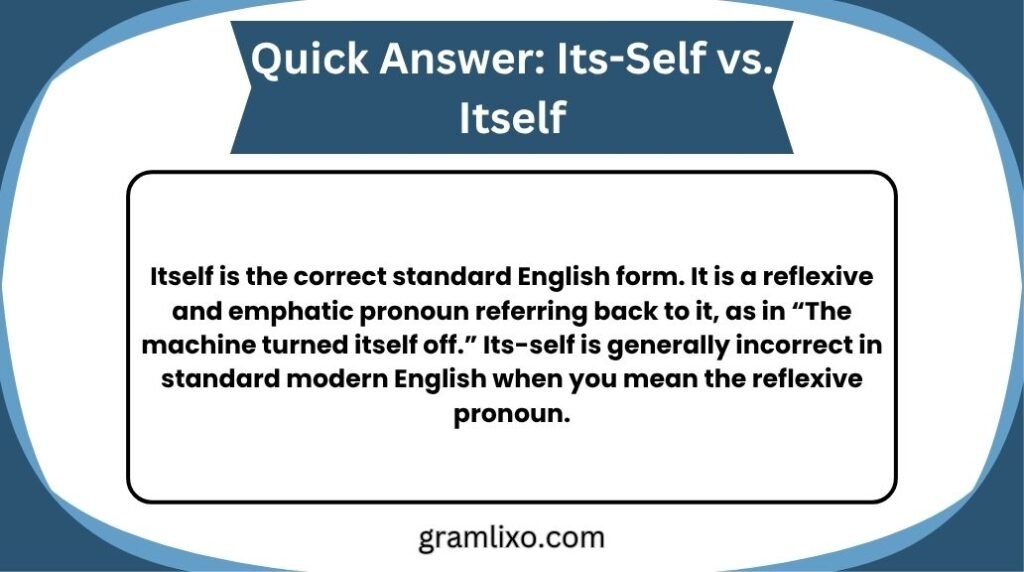
Itself is the correct standard English form. It is a reflexive and emphatic pronoun referring back to it, as in “The machine turned itself off.” Its-self is generally incorrect in standard modern English when you mean the reflexive pronoun.
Correct: The computer repaired itself.
Incorrect: The computer repaired its-self.
The key point is simple: write “itself” as one word, without a hyphen.
Understanding the Basics of Its-Self vs. Itself
The difference between its-self and itself is primarily a matter of standard spelling and grammar.
Itself is a single pronoun formed historically from it + self. Modern English treats it as one established word, just as it treats himself, herself, and themselves as established pronouns.
Comparison Table
| Form | Type | Meaning | Example | Correct/Incorrect |
|---|---|---|---|---|
| itself | Reflexive/emphatic pronoun | The same thing, animal, idea, or situation | The dog hurt itself. | ✅ Correct |
| its-self | Nonstandard spelling of itself | Intended to mean “itself” | The device fixed its-self. | ❌ Incorrect |
| its | Possessive determiner | Belonging to it | The device lost its power. | ✅ Correct |
| it’s | Contraction | “It is” or “it has” | It’s working again. | ✅ Correct |
Merriam-Webster describes itself as a pronoun used reflexively and for emphasis. Cambridge similarly explains that itself refers to a thing, animal, situation, or idea when the subject and object are the same, and it can also emphasize the subject.
Why “Itself” Is One Word
English contains many reflexive pronouns built with -self or -selves:
- myself
- yourself
- himself
- herself
- itself
- ourselves
- yourselves
- themselves
Notice the pattern. We do not normally write:
- ❌ my-self
- ❌ your-self
- ❌ him-self
- ❌ her-self
- ❌ its-self
Instead, the standard forms are:
- ✅ myself
- ✅ yourself
- ✅ himself
- ✅ herself
- ✅ itself
So, if you are choosing between its-self vs. itself, the standard answer is straightforward: itself.
What Does “Itself” Mean?
Itself is the reflexive form of the pronoun it. It usually refers back to a thing, animal, situation, organization, or idea already mentioned.
For example:
The cat cleaned itself.
Here, the cat is the subject, while itself refers back to the same cat.
The sentence essentially means:
The cat cleaned the cat.
Because repeating the cat would sound awkward and unnatural, English uses the reflexive pronoun itself.
Oxford defines itself as the reflexive form of it and gives examples involving animals, computers, companies, and teams.
Correct Meanings and Uses of “Itself”
1. Itself as a Reflexive Pronoun
The most common use is reflexive.
A reflexive pronoun is used when the subject and object refer to the same thing.
Example:
The dog scratched itself.
Breakdown:
- The dog = subject
- scratched = verb
- itself = object referring back to the dog
Another example:
The machine shut itself down.
Breakdown:
- The machine = subject
- shut down = verb
- itself = the same machine
Cambridge explains that itself is used when the subject of the verb is it and the object is the same thing, animal, situation, or idea.
2. Itself for Emphasis
Itself can also emphasize a noun.
Consider:
The company itself announced the changes.
The word itself emphasizes the company. It tells the reader that the company—not merely an employee, spokesperson, or outside source—made the announcement.
Another example:
The building itself is beautiful.
Here, itself adds emphasis to the building.
Merriam-Webster specifically identifies this emphatic use of itself.
3. “By Itself”
The expression by itself can mean alone or without help.
Examples:
The puppy stayed by itself.
The door opened by itself.
The software updated by itself.
Depending on context, by itself can mean that something is alone or that it operates without outside assistance.
Oxford lists both meanings: being alone and happening automatically or without someone doing it.
4. “In Itself”
The phrase in itself means something considered separately or according to its own nature.
For example:
The idea is not bad in itself.
This means the idea is not inherently bad. The speaker is considering the idea independently from other circumstances.
Another example:
The mistake was not serious in itself.
The mistake may have caused problems because of its consequences, but the mistake itself was not inherently serious.
Oxford recognizes in itself as an established expression.
5. Itself for Organizations and Groups
Although companies and organizations contain people, English commonly treats them as singular entities when using it.
For example:
The company has established itself as a market leader.
Here, itself refers to the company.
Another example:
The team prepared itself for the final match.
The reflexive pronoun refers to the team as a single unit.
Test Tip: How Can You Check “Itself”?
Try replacing itself with it.
If the sentence is referring back to the same thing, itself may be appropriate.
Example
The robot repaired itself.
Ask:
Who repaired the robot?
The robot did.
So the subject and object refer to the same thing:
The robot repaired the robot.
Therefore:
✅ The robot repaired itself.
But do not blindly apply this test to every sentence. Itself can also be used for emphasis:
The robot itself was expensive.
Here, itself is not functioning as the object of was. It emphasizes the robot.
Case Study: “Itself” in the Workplace
Imagine a company employee writing an email about a software problem.
Incorrect
The application should update its-self automatically after the restart.
The writer has probably added the hyphen because self looks like a separate word.
Correct
The application should update itself automatically after the restart.
The second sentence follows standard English spelling and grammar.
Now imagine a manager writing:
The software itself is not the problem.
Here, itself emphasizes the software.
This distinction is useful in professional writing because small spelling mistakes can distract readers from the actual message.
In a Workplace Conversation
Employee:
“Will the system restart itself?”
Manager:
“Yes. It should restart itself after the update.”
That sounds natural and grammatically correct.
Grammar Rules: Why Is “Itself” Correct?
The most important rule is this:
The standard reflexive pronoun corresponding to “it” is “itself.”
Reflexive pronouns are established grammatical forms. They are not normally created by independently combining a possessive word with self.
Merriam-Webster classifies itself as a pronoun and explains that it can be used reflexively and for emphasis.
The word its, by contrast, is a possessive form meaning “of or relating to it.” Merriam-Webster gives examples such as “its kennel” and “on its own.”
That distinction explains an important point:
- its = possessive form
- itself = reflexive/emphatic pronoun
Therefore, its-self is not the normal modern spelling of the reflexive pronoun.
Think of the Pattern This Way
| Personal Pronoun | Reflexive Form |
|---|---|
| I | myself |
| you | yourself |
| he | himself |
| she | herself |
| it | itself |
| we | ourselves |
| they | themselves |
The pattern makes the answer easy to remember.
Its-Self vs. Itself: Why Do People Make This Mistake?
There are several reasons writers may type its-self.
1. Fast Typing
When people type quickly, they sometimes divide unfamiliar words into pieces.
Because self is clearly recognizable as a separate word, a writer may instinctively insert a hyphen.
2. Pattern Confusion
English has many compounds containing self, including:
- self-control
- self-esteem
- self-care
- self-made
- self-service
Seeing these words may make its-self appear reasonable.
But itself is not functioning as a newly created it + self compound. It is an established pronoun.
3. Autocorrect and Spellcheck
Technology can sometimes create confusion, especially when a writer is switching between languages, using unusual dictionaries, or typing quickly.
However, a good spellchecker should normally flag its-self as nonstandard.
4. Lack of Grammar Knowledge
Someone who has never studied reflexive pronouns may naturally assume that itself can be written as its-self.
Learning the pronoun pattern eliminates much of this confusion.
Similar Grammar Confusions
The its-self vs. itself confusion belongs to a larger family of commonly confused English forms.
| Confusing Forms | Correct Distinction | Example |
|---|---|---|
| its / it’s | possession vs. “it is/it has” | The dog wagged its tail. / It’s happy. |
| your / you’re | possession vs. “you are” | Your phone is here. / You’re early. |
| their / they’re / there | possession / “they are” / location | Their car is there. / They’re waiting. |
| whose / who’s | possession / “who is” | Whose book is this? / Who’s calling? |
| then / than | time/result vs. comparison | We left then. / She is taller than me. |
| affect / effect | usually verb / usually noun | Stress can affect sleep. / The effect was noticeable. |
| its-self / itself | nonstandard spelling / standard reflexive pronoun | The device fixed itself. |
Cambridge specifically distinguishes its from it’s, explaining that it’s is a contraction of it is or it has, while its expresses possession.
Itself vs. Its vs. It’s
These three forms are particularly easy to mix up.
Itself
Use itself as a reflexive or emphatic pronoun.
The phone restarted itself.
Its
Use its to show possession or association.
The phone lost its connection.
It’s
Use it’s when you mean it is or it has.
It’s working again.
You can use the expansion test:
It’s = it is / it has
If neither expansion works, you probably need its or itself.
Merriam-Webster confirms this distinction and recommends using it’s only for it is or it has.
Using “Itself” in Different Contexts
Everyday Conversation
In casual speech, itself is extremely common.
Examples:
The door closed itself.
The baby’s toy turned itself on.
The dog washed itself.
These sentences sound completely natural.
Professional Writing
Professional writing requires accuracy because readers may interpret small errors as signs of poor proofreading.
Examples:
The system will automatically restart itself.
The company has positioned itself for future growth.
The device can protect itself from overheating.
These sentences are appropriate for reports, emails, manuals, websites, and business documents.
Creative Writing
Writers can use itself to create emphasis or personality.
For example:
The old house seemed to breathe by itself.
Or:
The forest itself appeared to be watching them.
Here, itself can strengthen imagery and make a sentence feel more dramatic.
Social Media and Texting
Informal communication may contain spelling mistakes, but itself remains the standard form.
My laptop fixed itself 😂
The app updated itself overnight.
The Wi-Fi somehow repaired itself!
Even in casual writing, there is no reason to use its-self when you mean itself.
Why Correct Usage Matters
At first glance, the difference between its-self and itself may seem tiny. After all, readers can probably understand what you mean.
But accuracy still matters.
1. Clarity
Correct grammar makes sentences easier to process.
The system repaired itself.
is immediately recognizable.
2. Professionalism
A correctly written sentence looks polished and trustworthy.
This matters in:
- Business emails
- Resumes
- Reports
- Academic papers
- Websites
- Marketing copy
- Technical documentation
3. Digital Communication
Online writing is often read quickly. Correct word forms reduce distractions and prevent readers from stopping to question your meaning.
4. Language Confidence
Knowing the correct form means you can write naturally without second-guessing yourself.
“Small details create big impressions.”
That principle applies especially well to grammar.
Special Exception: Is “Its-Self” Ever Possible?
For ordinary modern English, itself is the form you should use.
However, historical texts, dialect writing, quotations, or deliberately stylized language may occasionally contain unusual spellings or constructions involving self. That does not make its-self the standard modern spelling.
Merriam-Webster does record itsel as a dialectal variant of itself, showing that English has historical and dialectal variation.
There can also be a hyphenated self- in compounds, such as:
- self-directed
- self-powered
- self-cleaning
- self-service
But that is a different grammatical construction.
So, for normal US English writing, use:
✅ itself
not:
❌ its-self
Quick Recap Checklist
Use this checklist whenever you are unsure.
| Question | If Yes → Use |
|---|---|
| Am I referring back to “it”? | itself |
| Is the subject and object the same thing? | itself |
| Am I emphasizing a thing or organization? | itself |
| Do I mean “belonging to it”? | its |
| Can I replace the word with “it is” or “it has”? | it’s |
| Am I writing the standard reflexive pronoun? | itself |
Practice Example 1
The computer repaired ______ after the error.
Answer: itself
The computer repaired itself after the error.
Practice Example 2
The company launched ______ new website.
Answer: its
The company launched its new website.
Practice Example 3
______ going to rain tonight.
Answer: It’s
It’s going to rain tonight.
These three examples show the difference clearly:
itself = reflexive/emphasis
its = possession
it’s = it is/it has
Common Questions About Its-Self vs. Itself
Is “its-self” grammatically correct?
No. Its-self is not the standard modern English spelling when you mean the reflexive pronoun. The correct form is itself, written as one word.
Is “itself” one word or two?
Itself is one word. Do not normally insert a space or hyphen between it and self.
Correct:
The machine turned itself off.
Incorrect:
The machine turned its-self off.
What is the difference between “its” and “itself”?
Its is a possessive form meaning something belongs to or is associated with it. Itself is a reflexive or emphatic pronoun.
The dog wagged its tail.
The dog scratched itself.
Cambridge identifies its as a possessive determiner, while itself is the reflexive form of it.
Can “itself” refer to a person?
Usually, itself refers to things, animals, situations, ideas, or entities treated grammatically as it. For people, English normally uses himself, herself, themselves, or another appropriate pronoun.
The boy taught himself.
The company defended itself.
Can “itself” be used for emphasis?
Yes. This is one of its standard uses.
The president herself announced the decision.
For an entity referred to as it:
The company itself announced the decision.
Merriam-Webster explicitly includes emphatic use among the meanings of itself.
What is the easiest way to remember “itself”?
Remember the reflexive-pronoun pattern:
myself → yourself → himself → herself → itself → ourselves → themselves
When you mean the reflexive form of it, choose itself—one word, no hyphen.
Conclusion
The its-self vs. itself question has a simple answer: itself is the correct standard form in modern US English. It is a reflexive and emphatic pronoun used when referring back to it or emphasizing a thing, animal, organization, situation, or idea. Merriam-Webster and Cambridge both recognize itself as the appropriate reflexive form.
Remember the three forms that cause the most confusion: itself means the same thing or emphasizes it; its shows possession; and it’s means it is or it has. Once you recognize those roles, choosing the right word becomes much easier.
So, whenever you find yourself wondering whether to write “its-self” or “itself,” choose the simple standard form:
✅ Itself — one word, no hyphen.
Master the small grammar rules, and your writing becomes clearer, sharper, and more confident. ✨

I’m Michael Williams, an English writer and grammar enthusiast at Gramlixo. I’m passionate about making grammar easier to learn and helping readers write with greater confidence.
[…] |Its-Self vs. Itself: Which Is Correct? A Complete Grammar Guide […]