Have you ever written appal vs appall and suddenly wondered which spelling is correct? You are not alone.
This small spelling difference confuses many English learners and even experienced writers because both words have the same basic meaning: to shock, horrify, or deeply upset someone. The key difference is regional usage.
Appall is the standard spelling in US English, while appal is commonly used in British English. That means neither form is simply a random spelling mistake. The right choice depends largely on the variety of English you are writing.
In this guide, we will explain appal vs appall in simple terms, compare their meanings and grammatical forms, provide practical examples, and show you which spelling to choose when writing for an American audience. 😊
|Loot vs Lute: What’s the Difference? Meaning, Usage, and Examples
|When Can I vs When I Can: Which Is Correct? A Complete Grammar Guide
|Input vs Imput: Which Is Correct? Meaning, Usage, and Examples
Quick Answer: Appal vs Appall
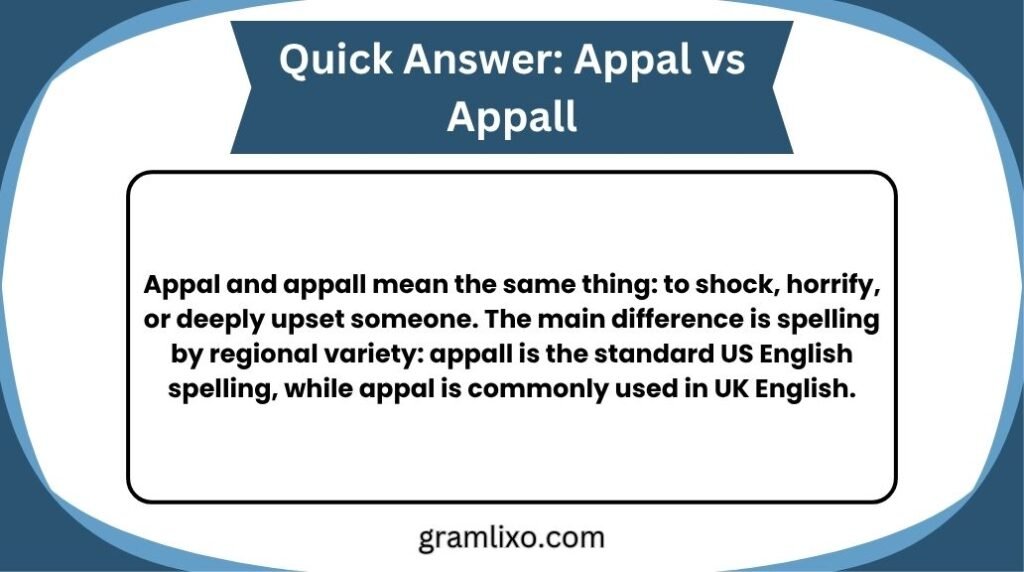
Appal and appall mean the same thing: to shock, horrify, or deeply upset someone. The main difference is spelling by regional variety: appall is the standard US English spelling, while appal is commonly used in UK English.
For American writing, use:
The news appalled everyone in the room.
For British English, you may see:
The news appalled everyone in the room.
Notice something interesting: the difference disappears in the past tense because both forms become “appalled.”
Understanding the Basics of Appal vs Appall
The easiest way to understand appal vs appall is to think of them as regional spelling variants rather than completely different words.
Both forms function as verbs. Both describe causing someone to experience strong feelings of shock, horror, dismay, or disapproval.
Appall
Appall is the preferred spelling in standard US English.
It means:
- to shock someone deeply
- to horrify someone
- to cause strong dismay
- to make someone extremely upset or disturbed
For example:
The cruelty of the situation appalled the investigators.
Here, appalled means that the investigators were deeply shocked and disturbed.
Appal
Appal has the same meaning but is primarily associated with British English.
For example:
The condition of the building appalled the inspectors.
British writers may also use the present-tense form:
The condition of the building appals the inspectors.
The meaning remains unchanged.
Appal vs Appall Comparison Table
| Form | Type | Meaning | Example | Correct/Incorrect |
|---|---|---|---|---|
| appall | Verb | To shock, horrify, or deeply upset | The decision appalled everyone. | Correct in US English |
| appal | Verb | To shock, horrify, or deeply upset | The decision appalled everyone. | Correct, especially in UK English |
| appalled | Past tense/past participle | Shocked or horrified | She was appalled by the news. | Correct |
| appalling | Present participle/adjective | Extremely shocking or terrible | It was an appalling mistake. | Correct |
| appalls | Third-person singular verb | Shocks or horrifies | The behavior appalls me. | Correct |
| appal in US writing | Verb | Same meaning as appall | The news will appal readers. | Acceptable variant, but less standard in US English |
The key point is simple: appal is not a misspelling of appall. It is a recognized spelling variant. However, regional convention determines which form is more natural.
What Does Appall Mean?
Appall is a transitive verb meaning to cause someone to feel intense shock, dismay, horror, or disgust.
Merriam-Webster defines appall as overcoming someone with “consternation, shock, or dismay.” It also lists appal as a variant spelling.
Consider this sentence:
The terrible conditions appalled the visitors.
The sentence can be broken down like this:
- The terrible conditions = subject
- appalled = verb
- the visitors = object
The conditions caused the visitors to feel shocked or horrified.
More Examples of Appall
- The amount of waste appalled the environmental researchers.
- His rude behavior appalled his colleagues.
- The shocking images appalled viewers.
- The decision to ignore the warning appalled the community.
- She was appalled by the condition of the apartment.
In each example, something causes another person or group to experience strong negative emotions.
What Does Appal Mean?
Appal has essentially the same meaning as appall.
Cambridge identifies appal as the UK spelling and defines it as making someone experience strong feelings of shock or disapproval.
For example:
The state of the hospital appalled her.
A British writer could use the same verb without changing the meaning.
The important distinction is therefore not semantic. It is primarily a matter of spelling convention.
Examples of Appal
- The conditions appalled the inspectors.
- The proposal appalled many residents.
- His actions appalled his friends.
- The report appalled the committee.
- The level of pollution appalled the scientists.
In US English, you would normally write appalled in all of these sentences too. Because the past tense contains two l’s, the regional difference is often invisible.
Appal vs Appall in American English
If your goal is to write standard US English, choose appall.
For example:
The decision will appall many Americans.
The evidence appalled the jury.
Her behavior appalls me.
The conditions were appalling.
The spelling appall is especially useful in:
- academic writing
- business communication
- US journalism
- American websites
- school assignments
- professional reports
- formal correspondence
Merriam-Webster’s main dictionary entry is appall, with appal listed as a variant or less common form.
Why Does American English Prefer Appall?
English spelling varies between American and British traditions. This is not unusual.
You can see similar regional patterns in words such as:
- color / colour
- honor / honour
- center / centre
- realize / realise
- traveled / travelled
The difference between appall vs appal fits into the same broad pattern of regional variation.
If your website targets readers in the United States, consistency matters more than trying to use every possible English variant.
Appal vs Appall in British English
British English commonly uses appal.
Cambridge explicitly marks appal as UK usage and appall as US usage.
A British writer might therefore write:
The news appalled the public.
Interestingly, the past tense remains appalled, even though the infinitive is spelled appal.
That means you may not notice the regional distinction in many sentences.
British English Example
The condition of the roads appalled local residents.
This is completely natural in British English.
If the same sentence appears in an American publication, appalled still looks exactly the same.
This is one reason the appal vs appall distinction can be confusing for learners.
Appal vs Appall: What Happens to the Other Forms?
Understanding the word family makes this topic much easier.
Present Form
US:
appall
UK:
appal
Third-Person Singular
US:
appalls
UK:
appals
Past Tense
Both:
appalled
Past Participle
Both:
appalled
Present Participle
Both:
appalling
Adjective
Both:
appalling
For example:
The story was appalling.
This form is spelled the same in both American and British English.
Merriam-Webster defines appalling as something that inspires horror, dismay, or disgust.
Why Is Appalled Spelled With Two L’s?
This is one of the most useful spelling questions connected to appal vs appall.
Although British English uses appal, the past tense is normally appalled, with two l’s.
Why?
The standard inflectional spelling is established as appalled, and both major spelling traditions use it.
For example:
I was appalled by what I saw.
Not:
I was appaled by what I saw. ❌
The single-l version is incorrect.
The same principle applies to:
appalling
not:
apalling ❌
Easy Memory Trick
Think:
Appall → appalled → appalling
The base form has the double ll, and the related forms keep it.
For US English, remember:
APPALL = American spelling
For UK English:
APPAL = British spelling
Grammar Rules for Appal vs Appall
The most important grammar rule is that both forms are verbs.
The object of the verb is the person or group affected by the shocking event.
For example:
The discovery appalled the researchers.
Here:
- The discovery performs the action.
- appalled expresses the action.
- the researchers receive the emotional effect.
You can also use the passive construction:
The researchers were appalled by the discovery.
This changes the sentence structure but not the basic meaning.
Active Voice
The shocking report appalled the manager.
Passive Voice
The manager was appalled by the shocking report.
Both are grammatically correct.
Merriam-Webster lists appall as a transitive verb, meaning it can take an object.
Test Tip
When deciding whether appall works, ask:
“Does this subject cause someone to feel shocked, horrified, or deeply dismayed?”
If yes, appall is probably the right verb in US English.
For example:
The shocking evidence appalled the jury.
What caused the jury’s reaction?
The shocking evidence.
Therefore, appalled works naturally.
Appal vs Appall: Sentence Examples
Seeing the words in context is one of the fastest ways to learn them.
Example 1
The news appalled the entire community.
Meaning: The news shocked and deeply disturbed the community.
Example 2
I was appalled by his behavior.
Meaning: His behavior shocked or disgusted me.
Example 3
The condition of the building appalled the inspectors.
Meaning: The condition was so bad that the inspectors were deeply disturbed.
Example 4
The proposal will appall many voters.
Meaning: Many voters will find the proposal extremely shocking or unacceptable.
Example 5
The level of waste was appalling.
Here, appalling is an adjective describing something extremely bad, shocking, or disturbing. Cambridge also gives appalling meanings related to something being very bad or shocking.
A Real-Life Workplace Case Study
Imagine that a manager receives a report showing that employees have been working in unsafe conditions.
The manager writes an email:
“I was appalled to learn that these safety procedures were not being followed. We need to address this issue immediately.”
This is a natural use of appalled in professional communication.
Why is it effective?
The word communicates more than simple surprise. It indicates strong emotional disapproval.
Compare:
I was surprised by the report.
with:
I was appalled by the report.
The first expresses surprise.
The second communicates shock, dismay, or strong disapproval.
What If the Manager Uses Appal?
A British manager might write:
“The report appalled me.”
An American manager would normally write:
“The report appalled me.”
Notice that both sentences use appalled, so the spelling difference disappears.
This is an excellent example of why regional spelling can be difficult to identify in real-world communication.
Appal vs Appall in Everyday Conversation
In everyday American conversation, appall is the natural base form.
You might hear:
That kind of behavior appalls me.
Or:
It would appall my parents.
Or:
I was absolutely appalled.
The word is relatively strong. It usually communicates more than mild annoyance.
If someone says:
“Your decision appalls me.”
they are expressing serious shock, disapproval, or disgust.
Softer Alternatives
Depending on the situation, you might instead use:
- surprise
- disappoint
- concern
- upset
- bother
- disturb
For example:
The decision disappointed me.
is much milder than:
The decision appalled me.
Appal vs Appall in Professional Writing
Professional writing requires consistency.
If you are writing for an American audience, use appall.
Examples:
The findings appall many industry experts.
The report appalled the review committee.
The lack of transparency is appalling.
The word can be useful in professional writing when you want to express strong disapproval, but avoid overusing it.
For example, saying:
“I am appalled by every minor delay.”
can sound exaggerated.
In a workplace email, a more measured phrase may be better:
“I am concerned about the repeated delays.”
Use appall when the emotional intensity is genuinely strong.
Appal vs Appall in Creative Writing
Creative writers have more freedom.
An author might write:
The sight of the abandoned house appalled him.
This immediately tells the reader that the character experienced intense shock or horror.
Writers can also use the adjective:
The hallway had an appalling smell.
Or:
The conditions inside were appalling.
Because creative writing often aims to create emotional intensity, appall, appalled, and appalling can be powerful choices.
Appal vs Appall in Social Media and Texting
Social media is more flexible about spelling.
You might see:
“That video literally appalled me.”
or:
“The comments were appalling 😳.”
In casual communication, people may also make accidental spelling errors.
For professional or public-facing content, however, it is still better to follow the appropriate English standard.
If you are writing for a US audience:
appall
is the safest base spelling.
Common Mistakes With Appal vs Appall
People commonly become confused because the two spellings differ by only one letter.
Mistake 1: Assuming Appal Is Always Wrong
This is incorrect.
Appal is a legitimate English spelling.
It is especially common in British English. Merriam-Webster also recognizes it as a variant of appall.
Mistake 2: Assuming Appall Is Wrong in British English
This is also too simplistic.
English dictionaries recognize variation, and actual English usage is more complicated than a simple “right versus wrong” rule.
However, for a clean regional distinction, Cambridge identifies appal with UK English and appall with US English.
Mistake 3: Writing “Appaled”
Incorrect:
I was appaled by the news. ❌
Correct:
I was appalled by the news. ✅
Mistake 4: Writing “Apalling”
Incorrect:
The situation was apalling. ❌
Correct:
The situation was appalling. ✅
Similar Grammar and Spelling Confusions
The appal vs appall issue belongs to a larger group of commonly confused English forms.
| Confusion | Correct Forms | Main Difference |
|---|---|---|
| it’s / its | it’s, its | contraction vs possessive |
| your / you’re | your, you’re | possessive vs “you are” |
| their / they’re | their, they’re | possessive vs “they are” |
| affect / effect | affect, effect | usually verb vs noun |
| then / than | then, than | time/result vs comparison |
| accept / except | accept, except | receive/agree vs exclusion |
| advice / advise | advice, advise | noun vs verb |
| appal / appall | appal, appall | mainly regional spelling |
These mistakes often happen because:
- people type quickly
- autocorrect changes words
- writers have not learned the regional distinction
- similar-looking words are easy to confuse
- people rely on pronunciation instead of spelling
- writers switch between American and British English
Fast Typing
When people type quickly, an extra letter can easily disappear.
Autocorrect
Autocorrect may also reinforce an unfamiliar spelling or replace a regional variant.
Lack of Knowledge
Many writers simply do not realize that appal and appall are both established forms.
The solution is simple: learn the distinction and choose one English variety consistently.
Why the Appal vs Appall Difference Matters
At first glance, one extra letter may seem unimportant.
But spelling choices communicate information about your intended English variety.
Clarity
Correct spelling helps readers understand your writing without distraction.
Professionalism
Consistent spelling makes professional content look polished.
Digital Communication
Online content is read by people from many English-speaking regions. Choosing a consistent style helps your writing feel intentional.
SEO and Content Quality
For online publishers, consistency also matters because your content should establish a clear language style.
If your website primarily targets Americans, appall is generally the better choice.
If your audience primarily uses British English, appal may be more appropriate.
A short quote worth remembering is:
“Consistency makes correct writing easier to recognize.”
The specific spelling matters less than using the appropriate form consistently for your audience.
Special Exception: Appal Is Not Simply a Misspelling
There is an important exception to the idea that one spelling is “correct” and the other is “wrong.”
Appal is a recognized variant.
Merriam-Webster’s entry for appall explicitly identifies appal as a variant or less common spelling.
Cambridge goes further by identifying the regional pattern:
- US: appall
- UK: appal
Therefore, marking appal as universally incorrect would be misleading.
For a US English grammar article, however, the practical recommendation is straightforward:
Use appall when writing standard US English.
Appal vs Appall and the Word “Appalling”
One useful shortcut is to remember that appalling has the same spelling in both varieties.
Examples:
The weather conditions were appalling.
The behavior was appalling.
The working conditions were appalling.
Here, appalling functions as an adjective meaning extremely bad, shocking, or horrifying.
Merriam-Webster defines appalling as inspiring horror, dismay, or disgust.
This makes appalling particularly useful in both American and British English.
Appal vs Appall: Synonyms You Can Use
Sometimes you may want a different word.
Useful synonyms include:
- shock
- horrify
- disgust
- alarm
- disturb
- upset
- dismay
- stun
- frighten
- outrage
Merriam-Webster’s thesaurus lists words such as shock, horrify, stun, frighten, dismay, and disgust among related terms.
However, these words are not always perfect replacements.
For example:
The news shocked me.
is not necessarily identical in emotional intensity to:
The news appalled me.
Appall usually suggests a particularly strong reaction involving shock, dismay, horror, or disapproval.
Quick Recap Checklist for Appal vs Appall
Use this checklist whenever you are unsure.
| Question | If Yes → Use |
|---|---|
| Am I writing standard US English? | appall |
| Am I writing standard UK English? | appal |
| Do I mean “shock or horrify someone”? | appall/appal |
| Am I using the past tense? | appalled |
| Am I describing something shocking or terrible? | appalling |
| Do I need a US spelling for a professional article? | appall |
Practice Example 1
Choose the correct US English form:
The shocking discovery will ___ the public.
Answer:
The shocking discovery will appall the public.
Practice Example 2
Choose the correct form:
I was ___ by the condition of the building.
Answer:
I was appalled by the condition of the building.
Practice Example 3
Choose the correct adjective:
The treatment of the animals was ___.
Answer:
The treatment of the animals was appalling.
Frequently Asked Questions About Appal vs Appall
1. Is “appal” a correct word?
Yes. Appal is a legitimate spelling of the verb meaning to shock, horrify, or deeply upset someone. It is especially associated with British English, while American English generally uses appall.
2. Is “appall” the American spelling?
Yes. Appall is the standard US English spelling. Cambridge labels appall as US usage, while Merriam-Webster gives appall as the main entry and lists appal as a variant.
3. Do appal and appall have different meanings?
No. They have the same basic meaning. Both mean to cause someone to feel strong shock, dismay, horror, or disapproval. The primary distinction is regional spelling.
4. Is “appaled” correct?
No. The correct spelling is appalled, with two l’s.
Correct:
She was appalled by the news.
Incorrect:
She was appaled by the news.
5. Is “appalling” spelled with two l’s?
Yes. The correct spelling is appalling.
Example:
The conditions were appalling.
The word means extremely shocking, terrible, or disturbing.
6. Which should I use: appal or appall?
If you are writing US English, use appall. If you are following British English conventions, appal is appropriate. When writing for a specific audience, consistency is the most important consideration.
Final Thoughts on Appal vs Appall
The appal vs appall confusion is much easier once you realize that the two forms are not competing words with different meanings. They are regional spelling variants of the same verb. Appall is the standard choice for US English, while appal is commonly used in British English. Merriam-Webster recognizes both forms, and Cambridge clearly identifies their US/UK distinction.
For American readers, remember the simple rule: use appall, appalled, and appalling. For British readers, appal, appalled, and appalling may be the preferred pattern.
Most importantly, do not assume that appal is a spelling mistake. It is a valid English variant. The real question is which variety of English you are using.
When in doubt, match your spelling to your audience—and remember that one extra “l” can tell readers which English standard you follow.

I’m Sarah Martinez, a writer and English language enthusiast at Gramlixo. I love explaining grammar concepts in a clear and practical way that anyone can understand.

[…] |Appal vs Appall: What’s the Difference and Which Spelling Is Correct? […]
[…] |Appal vs Appall: What’s the Difference and Which Spelling Is Correct? […]