Have you ever stopped while writing a sentence and wondered whether you should use giving vs given? You are not alone. These two forms come from the same verb, give, but they do very different jobs in English grammar. Choosing the wrong one can make a sentence sound awkward or even grammatically incorrect.
The confusion usually happens because giving and given are both forms of the verb give. However, giving is the present participle and gerund form, while given is the past participle. Their meanings and grammatical functions depend heavily on the words around them.
For example, we say, “She is giving me advice,” but “She has given me advice.” The first sentence describes an action that is happening or continuing, while the second uses the past participle with has to form the present perfect tense.
In this guide, we will explore giving vs given in detail, including their meanings, grammar rules, sentence structures, common mistakes, professional uses, and practical examples. By the end, you will know exactly when to use each form. 😊
|Day Off vs Off Day: What’s the Difference?
|Patron vs Benefactor: What’s the Difference?
|When Can I vs When I Can: Which Is Correct? A Complete Grammar Guide
Quick Answer: Giving vs Given
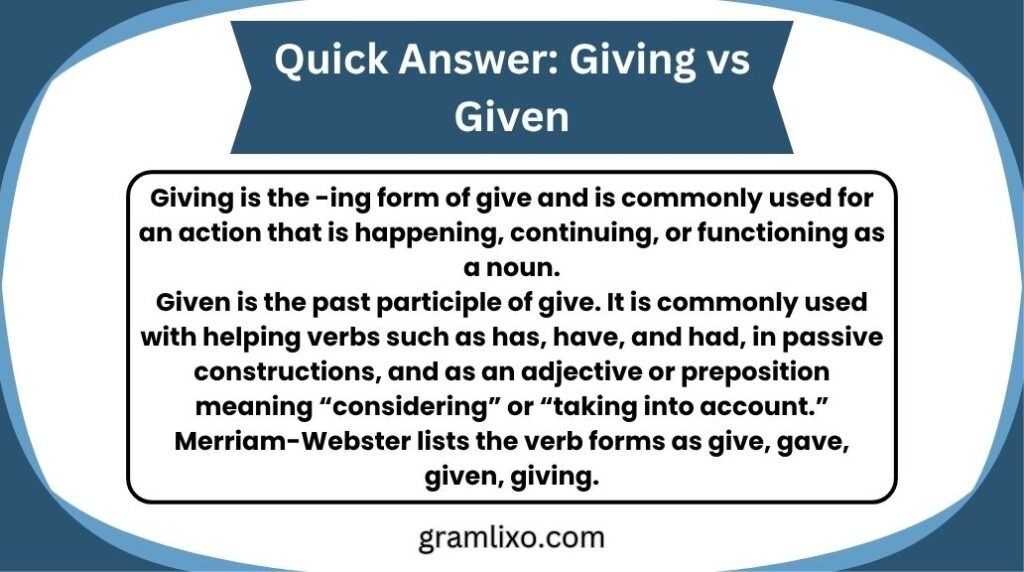
Giving is the -ing form of give and is commonly used for an action that is happening, continuing, or functioning as a noun.
Given is the past participle of give. It is commonly used with helping verbs such as has, have, and had, in passive constructions, and as an adjective or preposition meaning “considering” or “taking into account.” Merriam-Webster lists the verb forms as give, gave, given, giving.
Simple rule
- Giving → an action in progress or the act of providing something
- Given → an action completed, a passive construction, or something assumed/considered
Example:
- She is giving me a book.
- She has given me a book.
Understanding the Basics of Giving vs Given
The easiest way to understand giving vs given is to look at their grammatical forms.
The base verb is give.
Its main forms are:
- Give → base form
- Gave → simple past
- Given → past participle
- Giving → present participle / gerund
Merriam-Webster specifically gives the verb forms as “gave,” “given,” and “giving” under the entry for give.
Comparison Table
| Form | Type | Meaning | Example | Correct/Incorrect |
|---|---|---|---|---|
| Giving | Present participle / gerund | Providing or performing an action | She is giving me advice. | ✅ Correct |
| Given | Past participle | Provided, supplied, or completed | She has given me advice. | ✅ Correct |
| Giving | Gerund | The act of providing | Giving is important. | ✅ Correct |
| Given | Passive form | Something was provided | The award was given to Sarah. | ✅ Correct |
| Giving | After certain verbs/prepositions | Continuing or performing an action | He enjoys giving advice. | ✅ Correct |
| Given | After has/have/had | Completed action | They had given their answer. | ✅ Correct |
The key is not to ask, “Which word is correct?” Instead, ask:
“What grammatical job does this word need to perform in my sentence?”
That question usually makes the answer obvious.
Correct Meanings and Uses of Giving
1. Giving as an Action in Progress
Giving is commonly used with forms of be to describe an action that is happening now or around the present time.
Examples:
- She is giving a presentation.
- They are giving free samples.
- I am giving him another opportunity.
- We are giving the project more time.
In these sentences, giving describes an ongoing activity.
Sentence Breakdown
Consider:
She is giving me a gift.
- She = subject
- is = helping verb
- giving = present participle
- me = indirect object
- a gift = direct object
The structure is:
Subject + be + giving + object
This construction commonly describes something happening now.
2. Giving as a Gerund
Giving can also function as a noun. When an -ing form acts as a noun, it is called a gerund.
For example:
Giving makes people happy.
Here, giving is not describing what someone is doing at this exact moment. Instead, it represents the general activity or concept of giving.
More examples include:
- Giving is better than receiving.
- Giving to charity can help communities.
- Giving someone honest feedback requires care.
- Giving your time can be valuable.
In each case, giving functions as the subject of the sentence.
3. Giving After Certain Verbs
Some verbs are naturally followed by an -ing form.
Examples:
- She enjoys giving advice.
- He avoids giving unnecessary details.
- They considered giving him another chance.
- I appreciate you giving me enough time.
The important point is that giving is appropriate because of the grammatical structure that comes before it.
4. Giving in Everyday Expressions
The word giving appears in many common expressions.
Examples include:
- giving advice
- giving permission
- giving support
- giving feedback
- giving someone a chance
- giving a speech
- giving a presentation
- giving an explanation
- giving an answer
- giving someone directions
For example:
The manager is giving the team useful feedback.
Here, giving describes an action currently taking place.
Correct Meanings and Uses of Given
1. Given as the Past Participle of Give
Given is the past participle of give.
It is commonly used with has, have, or had.
Examples:
- She has given me the report.
- They have given us permission.
- He had given his answer.
- We have given the issue careful consideration.
The basic structure is:
Subject + has/have/had + given + object
For example:
She has given me the information.
Here, has given forms the present perfect tense.
Merriam-Webster confirms given as the past participle form of give.
2. Given in Passive Constructions
Given is also common in passive sentences.
Examples:
- The award was given to Maria.
- Permission was given yesterday.
- The students were given extra time.
- The instructions were given clearly.
The basic passive structure is:
Subject + be + given + object
For example:
The employees were given new instructions.
The employees receive the action rather than perform it.
3. Given as an Adjective
Given can function as an adjective meaning something like specified, particular, or assumed.
Examples:
- At a given time, the store becomes busy.
- The project must be completed within a given period.
- We need to consider the given circumstances.
Merriam-Webster defines given as an adjective meaning “particular” or “specified,” among other senses.
4. Given Meaning “Considering”
One particularly important use is given as a preposition meaning considering or taking into account.
Examples:
Given the weather, we decided to stay home.
This means:
Considering the weather, we decided to stay home.
Another example:
Given his experience, he is a strong candidate.
This means:
Considering his experience, he is a strong candidate.
Merriam-Webster recognizes this use of given as a preposition meaning “in view of” or “considering.”
Giving vs Given in Tense
One of the easiest ways to understand the difference is to compare their use in verb tenses.
Present Continuous
She is giving a speech.
This describes an action in progress.
Present Perfect
She has given a speech.
This describes a completed action connected to the present.
Past Perfect
She had given a speech before I arrived.
The action happened before another past action.
Passive Voice
She was given an award.
She receives the action.
So remember:
is/are/am + giving
but
has/have/had + given
and often:
was/were + given
Test Tip: How to Choose Between Giving and Given
When you are unsure, look at the helping verb.
Use “giving” when you see:
- am
- is
- are
- was
- were
when the construction describes an ongoing action.
Examples:
- I am giving.
- She is giving.
- They are giving.
Use “given” after:
- has
- have
- had
when forming perfect tenses.
Examples:
- She has given.
- They have given.
- He had given.
Also use given in many passive constructions:
- was given
- were given
- is given
- are given
Quick test
Ask:
Is the sentence describing the act of giving as ongoing?
If yes, giving may be appropriate.
Ask:
Does the sentence require a past participle or passive construction?
If yes, given may be appropriate.
Case Study: Giving vs Given in the Workplace
Imagine that a manager is preparing an email for employees.
Incorrect sentence
The manager has giving the team new instructions.
Why is this incorrect?
Because has requires the past participle given, not the present participle giving.
Correct sentence
The manager has given the team new instructions.
Now the grammatical structure is correct:
has + given
Suppose the manager wants to describe what is happening right now.
Correct sentence
The manager is giving the team new instructions.
Here:
is + giving
describes an ongoing action.
Workplace email example
The supervisor is giving the team updated instructions for the new project. She has given everyone a copy of the revised schedule.
Notice the difference:
- is giving → action happening now
- has given → action already completed
This distinction can make professional writing much clearer.
Grammar Rules for Giving vs Given
The most important rule is simple:
Rule 1: Giving is the -ing form
Giving is the present participle of give and can also function as a gerund.
Examples:
- I am giving you the information.
- Giving advice requires patience.
- She enjoys giving presentations.
Rule 2: Given is the past participle
Given is the past participle of give.
Examples:
- I have given you the information.
- She had given her answer.
- They were given additional time.
Rule 3: Do not use giving after has, have, or had
Incorrect:
She has giving me the answer.
Correct:
She has given me the answer.
The perfect construction requires the past participle.
Rule 4: Do not automatically replace given with giving
Incorrect:
He was giving an award yesterday.
This sentence is not necessarily grammatically wrong, but it has a different meaning. It suggests that he was handing out an award.
If you mean that he received an award, use:
He was given an award yesterday.
This is an important distinction.
Merriam-Webster Support
Merriam-Webster lists the principal forms of the verb as give, gave, given, giving. Its definitions also show that give can mean to provide, grant, offer, or transfer something to another person.
This confirms that giving and given are both legitimate forms of the same verb, but their grammatical functions differ.
Giving vs Given: A Crucial Meaning Difference
Consider these two sentences:
John was giving the students awards.
John was given an award.
They look similar, but they mean completely different things.
“John was giving the students awards.”
John was performing the action. He was handing awards to other people.
“John was given an award.”
John received an award.
This is why understanding giving vs given matters. The choice can change who performs the action and who receives it.
Common Mistakes With Giving vs Given
People commonly confuse these words because they come from the same verb.
Mistake 1: Using “giving” after “has”
❌ She has giving me a chance.
✅ She has given me a chance.
Mistake 2: Using “given” for an ongoing action
❌ She is given me advice.
✅ She is giving me advice.
Mistake 3: Confusing active and passive meaning
❌ The teacher was giving extra time to the students.
This can be grammatical, but it means the teacher was actively providing extra time.
If the intended meaning is that the students received extra time:
✅ The students were given extra time.
Why Do These Mistakes Happen?
Several everyday factors contribute to grammar mistakes.
Fast typing
When people type quickly, they may choose a familiar form without checking the entire sentence.
Autocorrect
Autocorrect can sometimes change words or encourage users to accept a form that does not fit the sentence.
Lack of grammar knowledge
Many writers know that give, gave, given, and giving are related but may not understand when each form is required.
Pronunciation
In rapid speech, the difference between forms can be less noticeable than it is in writing.
Similar Grammar Confusions
| Confusion | Correct Forms | Main Difference |
|---|---|---|
| Giving vs given | giving / given | Present participle vs past participle |
| It’s vs its | it’s / its | Contraction vs possessive |
| Your vs you’re | your / you’re | Possession vs “you are” |
| Their vs they’re | their / they’re | Possession vs “they are” |
| Then vs than | then / than | Time/order vs comparison |
| Affect vs effect | affect / effect | Usually verb vs noun |
| Who’s vs whose | who’s / whose | “Who is” vs possession |
| There vs their | there / their | Place/existence vs possession |
The larger lesson is important: similar-looking words can perform completely different grammatical functions.
Giving vs Given in Different Contexts
Everyday Conversation
In casual speech, giving often describes an action happening now.
Examples:
I’m giving you one more chance.
She’s giving me directions.
They’re giving away free samples.
Given commonly appears in perfect or passive constructions:
She has given me good advice.
I was given a free ticket.
Professional Writing
Professional writing benefits from precise verb forms.
Examples:
The company is giving employees additional training.
The company has given employees additional training.
Employees were given additional training.
These sentences have related meanings, but the grammatical structures emphasize different aspects of the action.
In business communication, choosing the correct form helps readers understand whether something is happening now, has already happened, or was received by someone.
Creative Writing
Writers may use giving to create a sense of movement or ongoing action.
She was giving him one last chance to explain.
Given can create a sense of completed action or establish a condition.
Given the circumstances, there was little he could do.
Both forms are useful, but they create different effects.
Social Media and Texting
Informal digital communication often contains shortened sentences and casual grammar.
For example:
Giving my friend another chance 😂
This is informal but understandable.
A complete sentence might be:
I am giving my friend another chance.
Similarly:
Given everything that happened, I understand.
This is grammatically complete even though it sounds conversational.
For professional posts, emails, resumes, and public content, it is better to use the correct grammatical form.
Why Giving vs Given Matters
Grammar is not simply about following rules for the sake of rules. It helps readers understand your meaning quickly.
1. Clarity
Compare:
She is giving the students books.
with:
She was given the books.
The first sentence describes someone handing books to students. The second describes someone receiving books.
One small word changes the meaning significantly.
2. Professionalism
Correct grammar makes professional writing look more polished.
Emails, reports, applications, presentations, and business documents all benefit from accurate verb forms.
3. Digital Communication
Online communication moves quickly. Readers often scan rather than carefully analyze every sentence.
Correct grammar makes your meaning easier to understand at a glance.
4. Better Confidence
Knowing why you use giving or given helps you write with confidence instead of relying on what “sounds right.”
“Good grammar makes meaning easier to see.”
That is the real purpose of understanding distinctions like giving vs given.
Special Exceptions and Edge Cases
There is no major exception in which giving suddenly becomes the past participle of give. The standard verb forms remain:
give → gave → given → giving
However, given has uses beyond its role as a past participle.
For example:
Given the circumstances, we decided to leave.
Here, given means considering.
Another example:
At a given time, the system may process thousands of requests.
Here, given functions as an adjective meaning something like specified or particular.
Merriam-Webster also lists given as a noun in expressions such as “it is a given,” meaning something accepted as a basic condition or assumption.
For example:
Her success is a given.
So while given is commonly known as the past participle of give, it can have additional grammatical roles.
Quick Recap Checklist
| Question | If Yes → Use |
|---|---|
| Is the action happening now? | Giving |
| Is “-ing” acting like a noun? | Giving |
| Does the sentence use has/have/had for a completed action? | Given |
| Is the sentence passive? | Often given |
| Does “given” mean considering? | Given |
| Does “given” mean specified or particular? | Given |
| Are you describing someone handing something to another person? | Giving |
| Are you describing someone receiving something? | Often given |
Practice Examples
1. She is ______ a presentation right now.
Answer: giving
She is giving a presentation right now.
2. She has ______ three presentations this week.
Answer: given
She has given three presentations this week.
3. The employees were ______ extra time.
Answer: given
The employees were given extra time.
Giving vs Given: Easy Memory Trick
Here is a simple way to remember the difference:
Think “-ING = happening”
When you see giving, think of an action in progress.
She is giving advice.
Think “-EN = completed/received”
When you see given, think of a completed action, passive construction, or an established condition.
She has given advice.
He was given advice.
Given the situation, we left.
This trick will not solve every possible sentence automatically, but it works for many everyday grammar decisions.
More Examples of Giving vs Given
Giving
- I am giving you my full attention.
- She is giving a speech.
- They are giving away old furniture.
- He enjoys giving helpful advice.
- Giving is an important part of the holiday season.
- We are giving the team more time.
- The teacher is giving the students feedback.
Given
- I have given you my answer.
- She has given a speech.
- They had given him enough time.
- He was given a second chance.
- The students were given new assignments.
- Given the circumstances, we stayed home.
- At a given time, the machine shuts down.
FAQs About Giving vs Given
1. What is the difference between giving and given?
Giving is the present participle or gerund form of give, while given is the past participle. “Giving” commonly describes an ongoing action, while “given” is used with perfect tenses, passive constructions, and in other roles such as an adjective or preposition.
2. Is “giving” the present tense of give?
Not exactly. Giving is the present participle, not the simple present form. The simple present forms are give and gives. For example, “I give advice” is simple present, while “I am giving advice” is present continuous.
3. Is given the past tense of give?
No. The simple past of give is gave. Given is the past participle.
The forms are:
- Present: give
- Past: gave
- Past participle: given
- Present participle: giving
4. Should I say “has given” or “has giving”?
You should say has given.
Correct:
She has given me the information.
Incorrect:
She has giving me the information.
The word has requires the past participle given in this structure.
5. Should I say “is giving” or “is given”?
Both can be correct, but they have different meanings.
Is giving usually describes someone performing an action:
She is giving me a book.
Is given is commonly passive:
The award is given to the winner.
The surrounding context determines the correct choice.
6. Can “given” mean “considering”?
Yes. Given can function as a preposition meaning considering or taking into account.
Example:
Given the weather, we canceled the event.
This means:
Considering the weather, we canceled the event.
Merriam-Webster recognizes this use of given.
Conclusion
Understanding giving vs given becomes much easier once you remember that both words are forms of the verb give, but they perform different grammatical jobs. Giving is the present participle and can also function as a gerund. It commonly describes an action in progress or the general act of providing something. Given, on the other hand, is the past participle and is frequently used with has, have, or had, in passive constructions, and in expressions where it means “considering” or “specified.”
Remember the basic patterns:
- is/am/are + giving
- has/have/had + given
- was/were + given for many passive constructions
- given + noun when it means specified or particular
- given + situation/fact when it means considering
Merriam-Webster confirms the standard forms give, gave, given, and giving, supporting this distinction.
The easiest memory trick is simple: giving usually shows the action, while given usually shows a completed, received, passive, or considered idea.
When in doubt, look at the words surrounding the verb. The right form is the one that matches the grammar and meaning of the sentence.

I’m Michael Williams, an English writer and grammar enthusiast at Gramlixo. I’m passionate about making grammar easier to learn and helping readers write with greater confidence.
[…] |Giving vs Given: Understanding the Difference With Clear Examples […]