Have you ever typed a sentence and suddenly wondered whether the correct word is ingrained vs engrained? You are not alone. These two spellings look almost identical, sound the same in ordinary speech, and can appear in similar contexts. That makes the choice surprisingly confusing, especially when you are writing an essay, email, article, report, or professional message.
The good news is that the main rule is simple: ingrained is the standard and preferred spelling in modern English, while engrained is a less common variant that can still be found in dictionaries and real-world writing. Both forms can refer to something that is deeply fixed, established, or embedded.
In this guide, we will examine ingrained vs engrained, explain their meanings, compare their grammar and usage, explore common mistakes, and provide practical examples. By the end, you will know exactly which spelling to choose when accuracy and clarity matter.
|City vs Town vs Village: What Is the Difference?
|Tear vs Tare: Meaning, Differences, Uses, and Examples
|When Can I vs When I Can: Which Is Correct? A Complete Grammar Guide
Quick Answer: Ingrained vs Engrained
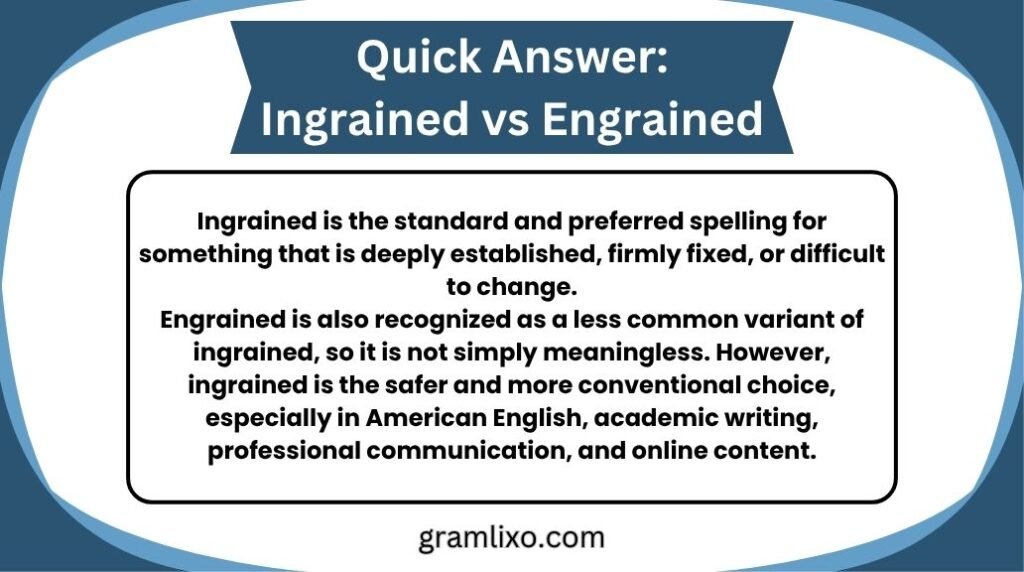
Ingrained is the standard and preferred spelling for something that is deeply established, firmly fixed, or difficult to change.
Engrained is also recognized as a less common variant of ingrained, so it is not simply meaningless. However, ingrained is the safer and more conventional choice, especially in American English, academic writing, professional communication, and online content.
Best choice: ✅ ingrained
Less common variant: ⚠️ engrained
For example:
- Her habit of checking her work is ingrained.
- His fear of failure is deeply ingrained.
- These traditions are ingrained in the culture.
If you are unsure which spelling to use, choose ingrained.
Understanding the Basics of Ingrained vs Engrained
The central difference between ingrained vs engrained is not usually meaning. Instead, it is standard usage and frequency.
What Does “Ingrained” Mean?
Ingrained is an adjective and can also function as the past participle of the verb ingrain. It describes something that has become deeply established or firmly fixed.
It commonly refers to:
- habits
- beliefs
- attitudes
- behaviors
- traditions
- values
- fears
- cultural practices
- prejudices
- ways of thinking
It can also describe physical substances such as dirt or oil that have become embedded in a surface and are difficult to remove. Cambridge Dictionary specifically gives both the figurative and physical senses of ingrained.
Examples:
Her morning routine is deeply ingrained.
Respect for others was ingrained in him from childhood.
The dirt was ingrained in the fabric.
In each case, the central idea is depth and persistence.
What Does “Engrained” Mean?
Engrained can be found as a less common variant of ingrained. In contexts where it is used as a variant, it carries essentially the same meaning: something that is deeply fixed, established, or embedded.
For example:
The tradition was deeply engrained in the community.
The sentence is understandable, and engrained has a documented history of use. However, most modern writers would normally choose:
The tradition was deeply ingrained in the community.
That second version is the better choice for polished modern writing.
Comparison Table
| Form | Type | Meaning | Example | Correct/Incorrect |
|---|---|---|---|---|
| ingrained | Adjective / past participle | Deeply fixed or established | The habit is deeply ingrained. | ✅ Preferred |
| engrained | Less common variant | Same basic meaning as ingrained | The habit is deeply engrained. | ⚠️ Recognized but less common |
| ingrain | Verb | To establish deeply | Parents can ingrain good habits. | ✅ Correct |
| engrained | Not a separate modern meaning | Variant of ingrained | The belief was engrained over time. | ⚠️ Variant |
| engraved | Past participle of engrave | Carved or marked onto a surface | Her name was engraved on the ring. | ✅ Correct, but different word |
The most important point is this:
Ingrained and engrained can express the same idea, but ingrained is the standard spelling you should normally use.
Why “Ingrained” Is the Preferred Spelling
The word ingrained comes from the verb ingrain. The basic idea is that something becomes deeply fixed or embedded.
Modern English strongly favors the in- form in this word.
Over time, the figurative meaning expanded beyond physical material. Instead of describing something deeply fixed in fabric or another substance, speakers began using ingrained for things that are deeply fixed in the mind, personality, culture, or behavior.
That explains expressions such as:
- ingrained habits
- ingrained beliefs
- ingrained attitudes
- ingrained values
- ingrained traditions
- deeply ingrained fears
- deeply ingrained behavior
- culturally ingrained practices
Cambridge defines ingrained as describing beliefs that are firmly held and unlikely to change, as well as dirt that has gotten beneath a surface and is difficult to remove.
Example: Ingrained Habit
Checking her calendar every morning is an ingrained habit.
Sentence breakdown:
- Checking her calendar = the behavior
- every morning = frequency
- is = linking verb
- an ingrained habit = a habit that has become firmly established
The word ingrained tells us that the habit is not merely something she does occasionally. It has become a regular and deeply established part of her routine.
Example: Ingrained Belief
His belief in hard work is deeply ingrained.
Here, ingrained means that the belief is firmly established and difficult to change.
Example: Ingrained Culture
The practice is deeply ingrained in the company’s culture.
This means the practice has become a firmly established part of how the company operates.
How to Use “Ingrained” Correctly
Ingrained is especially useful when you want to emphasize that something has developed over time and is now difficult to change.
Ingrained Habits
Habits are one of the most common things described as ingrained.
Examples:
- Her exercise routine is deeply ingrained.
- His habit of arriving early is ingrained.
- Good study habits can become ingrained through repetition.
- Checking emails first thing in the morning became an ingrained routine.
The idea is that repetition has made the behavior automatic or strongly established.
Ingrained Beliefs
You can also use ingrained for beliefs.
Examples:
- That belief is deeply ingrained in society.
- Her values were ingrained from childhood.
- Some cultural beliefs become ingrained over generations.
- His assumptions were so ingrained that he rarely questioned them.
Ingrained Attitudes
Attitudes can also become ingrained.
The organization had an ingrained attitude toward risk.
This suggests that the attitude was not temporary. It had become part of the organization’s established way of thinking.
Ingrained Traditions
Traditions may become ingrained when they are repeated for a long time.
The holiday tradition is deeply ingrained in the community.
This means the tradition has become a strong and established part of community life.
Ingrained Fears
Fears can also be deeply ingrained.
Her fear of public speaking was deeply ingrained.
This suggests that the fear had become deeply established and was not easy to overcome.
Ingrained Dirt
The physical meaning is important because many learners only know the figurative meaning.
The carpet was covered with ingrained dirt.
Here, ingrained means that the dirt has worked into the material and is difficult to remove. Cambridge Dictionary specifically recognizes this physical sense.
“Ingrained In” vs “Ingrained Into”
Both ingrained in and ingrained into can occur, but ingrained in is particularly common when discussing beliefs, habits, cultures, systems, and attitudes. Cambridge lists constructions such as ingrained in someone, ingrained in something, and ingrained into someone or something.
Ingrained in
The tradition is deeply ingrained in the culture.
Her values are ingrained in her personality.
The habit is ingrained in his daily routine.
Ingrained into
The values were ingrained into the children from an early age.
The choice can depend on sentence structure and emphasis. If you are unsure, ingrained in is often the natural choice for describing an established condition.
Test Tip
Try replacing ingrained with:
- deeply established
- firmly fixed
- deeply rooted
- embedded
If the sentence still makes sense, ingrained is probably appropriate.
For example:
The tradition is deeply ingrained in the culture.
Replace it:
The tradition is deeply established in the culture.
The meaning remains clear.
Is “Engrained” Wrong?
This is where the answer needs some nuance.
It is too absolute to say that engrained is always wrong.
Dictionaries and usage sources recognize engrained as a variant or less common form of ingrained. Merriam-Webster is reported to list engrained as a less common variant, while other major dictionaries also recognize the form.
However, recognizing a variant does not mean that both spellings are equally useful.
Think of it this way:
Ingrained = standard and preferred
Engrained = recognized but less common
Therefore, if you are writing something that needs to look polished, modern, and conventional, use ingrained.
This is especially important for:
- school assignments
- college essays
- business reports
- professional emails
- websites
- SEO articles
- resumes
- formal documents
- journalism
- educational content
Using engrained may not make your sentence incomprehensible, but it can make the spelling look unusual to readers.
Ingrained vs Engrained: Real-Life Case Study
Imagine that a manager is writing an email to a team.
Less preferred version
Our old reporting process is deeply engrained in the company, so changing it may take time.
The sentence is understandable. Engrained is functioning as the less common variant.
Preferred version
Our old reporting process is deeply ingrained in the company, so changing it may take time.
The second version is more conventional and is the better choice for professional communication.
Why the second version works better
A workplace email should generally prioritize:
- Familiar vocabulary
- Standard spelling
- Clear communication
- Professional appearance
- Easy readability
Because ingrained is the dominant modern spelling, it creates less friction for the reader.
The goal of professional writing is not to demonstrate that you know every possible variant. The goal is to communicate clearly.
Grammar Rules: Why “Ingrained” Is the Safe Choice
The grammar itself is relatively simple.
Ingrained can work as an adjective:
It is an ingrained habit.
It can also function as the past participle of ingrain:
Years of repetition had ingrained the behavior in her.
In the second sentence, ingrained is part of a verb construction.
Compare:
Practice ingrained the technique in his mind.
Here, ingrained means that practice caused the technique to become deeply established.
Cambridge defines ingrain as a transitive verb meaning to establish something such as a belief so firmly that it is unlikely to change.
Adjective vs Verb Use
Adjective:
The habit is ingrained.
Verb construction:
Years of training ingrained the habit.
This distinction is useful because it shows that ingrained is not merely a fixed adjective. It is also connected directly to the verb ingrain.
Ingrained vs Engrained vs Engraved
One of the biggest reasons people choose engrained may be its visual similarity to engraved.
But these words are not interchangeable.
Ingrained
Means deeply fixed or established.
The habit is ingrained in her.
Engrained
A less common variant of ingrained.
The habit is engrained in her.
Engraved
Means carved, cut, or marked into a surface.
Her initials were engraved on the bracelet.
Cambridge defines engrave as cutting words, pictures, or patterns into a surface such as metal or stone.
Easy Memory Trick
Think:
Ingrained = deeply fixed
Engraved = physically carved
Do not let the visual similarity between engrained and engraved confuse you.
Common Mistakes With Ingrained vs Engrained
Mistake 1: Assuming “engrained” is always completely wrong
Some people say:
“Engrained is not a word.”
That is too strong.
It is recognized as a less common variant. The better advice is to use ingrained as the normal modern form.
Mistake 2: Using “engraved” for a habit
Incorrect:
Her fear was engraved in her personality.
Better:
Her fear was ingrained in her personality.
Engraved normally refers to physical marking or carving.
Mistake 3: Writing “ingrain” instead of “ingrained”
Incorrect:
She has an ingrain habit.
Correct:
She has an ingrained habit.
The adjective requires the past-participle form ingrained.
Mistake 4: Choosing the unusual spelling automatically
Some writers believe that because engrained looks more familiar, it must be correct.
That is not how English spelling works.
The most intuitive-looking spelling is not always the standard spelling.
Mistake 5: Overthinking the choice
If you are writing quickly and stop at ingrained vs engrained, remember one simple rule:
Choose ingrained.
You can move on without worrying.
Why Do People Confuse Ingrained and Engrained?
There are several reasons.
1. They Sound the Same
In normal speech, the distinction is not obvious.
Both forms are pronounced approximately like:
in-GRAYND
Because pronunciation does not provide a useful clue, writers must rely on spelling knowledge.
2. The Words Look Similar
Only one letter changes:
- ingrained
- engrained
That makes the two forms easy to mix up.
3. “Engraved” Creates Confusion
The word engraved is common and has a similar visual pattern.
A writer may unconsciously connect:
engraved → engrained
But that association does not make engrained the preferred spelling.
4. Fast Typing
When people type quickly, they often select the spelling that feels familiar.
5. Autocorrect
Spell-checking software may handle uncommon variants differently depending on its dictionary. A word can be understandable but still be flagged because the software expects the more common form.
6. Lack of Knowledge
English learners may encounter both spellings and assume they have completely different meanings.
In reality, when engrained is being used as the recognized variant, the distinction is mainly one of spelling preference.
Similar Grammar and Spelling Confusions
The confusion between ingrained vs engrained is part of a much larger pattern in English.
| Confusing Pair | Correct/Preferred Form | Main Difference |
|---|---|---|
| it’s / its | Depends on meaning | It’s = it is; its = possessive |
| your / you’re | Depends on meaning | Your = possessive; you’re = you are |
| their / there / they’re | Depends on meaning | Possession, place, or they are |
| affect / effect | Depends on function | Usually verb vs noun |
| accept / except | Different meanings | Receive vs exclude |
| than / then | Different meanings | Comparison vs sequence |
| advice / advise | Different word types | Noun vs verb |
| lose / loose | Different meanings | Misplace vs not tight |
| lead / led | Different forms | Present verb vs past form |
| ingrained / engrained | Same basic meaning in variant usage | Standard vs less common spelling |
These pairs show why spelling and grammar can be difficult even for fluent English speakers.
Usage in Different Contexts
Everyday Conversation
You can comfortably use ingrained in ordinary conversation.
Examples:
It’s an ingrained habit.
That reaction is deeply ingrained in him.
Being polite is ingrained in her.
Because ingrained is common, it sounds natural in everyday speech.
Professional Writing
Professional writing strongly favors ingrained.
Example:
The company has an ingrained culture of customer service.
Another example:
These procedures are deeply ingrained in the organization’s workflow.
Using the standard spelling reduces distractions and keeps the writing polished.
Academic Writing
Academic writing should normally use ingrained.
Example:
Social attitudes can become deeply ingrained through repeated cultural exposure.
Another:
These assumptions may become ingrained during childhood.
Academic readers expect conventional spelling, so there is little reason to select the less common variant.
Creative Writing
Creative writing gives authors more flexibility.
A writer reproducing an older style, preserving historical spelling, or intentionally reflecting a particular source may encounter or retain engrained.
However, if you simply want to describe a deeply established habit or belief in modern fiction, ingrained remains the natural choice.
Social Media and Texting
Informal writing is more flexible, but ingrained is still the easiest choice.
For example:
That habit is so ingrained 😂
or:
My morning coffee routine is deeply ingrained at this point.
Social media users may not care about the distinction, but standard spelling still improves readability.
Why It Matters
Choosing the standard form matters because good writing should be easy to understand.
Clarity in Communication
Readers should not have to pause and wonder whether an unusual spelling is intentional.
Ingrained is familiar, so it communicates the intended meaning immediately.
Professionalism
In professional writing, small spelling choices contribute to the overall impression of accuracy.
Compare:
Our old procedures are deeply engrained.
with:
Our old procedures are deeply ingrained.
The second looks more conventional to most readers.
Digital Communication
Online content is scanned quickly. Standard spelling helps readers process information without unnecessary distractions.
This matters for:
- blogs
- websites
- emails
- educational pages
- social media
- business communication
- SEO content
A Useful Principle
Clear writing is reader-friendly writing.
When two forms communicate the same idea but one is much more familiar, the familiar form is usually the better practical choice.
Special Exception: When “Engrained” May Appear
There is an important exception to the simple “always use ingrained” advice.
You may encounter engrained in:
- quotations
- older texts
- historical writing
- published material preserving original wording
- dictionaries as a variant
- literary contexts
- sources where the original spelling must be retained
If you are quoting someone directly, you should not silently change the spelling merely because you prefer ingrained.
For example, if an original document says:
“The tradition was engrained in the community.”
and you are quoting it exactly, preserving the original wording may be appropriate.
But if you are writing your own sentence, the better choice is:
The tradition was ingrained in the community.
This distinction between preserving a source and writing new content is important.
Is “Engrained” an American vs British English Difference?
No. You should not treat ingrained vs engrained as a simple American-versus-British spelling difference.
Ingrained is widely used in both American and British English.
The practical issue is primarily standard versus less common variant usage, not a regional spelling rule. Cambridge’s American English entry also uses ingrained for established beliefs, attitudes, or habits.
Therefore, American writers should not assume:
British = engrained
That is not a reliable rule.
For US English, the safest choice remains:
ingrained
Synonyms for “Ingrained”
Sometimes the best way to avoid repetition is to use a synonym.
Depending on context, alternatives include:
- deeply rooted
- deep-seated
- embedded
- entrenched
- established
- fixed
- rooted
- inherent
- firmly established
- deeply established
Example
Original:
His fear was deeply ingrained.
Alternative:
His fear was deeply rooted.
Or:
His fear was deeply embedded.
However, these synonyms are not always perfect replacements. Ingrained has its own nuance, especially when something has become established through repetition, experience, or long-term development.
How to Remember “Ingrained”
Here is a simple memory trick:
Think: “IN + GRAIN”
Imagine a substance becoming fixed in the grain of a material.
That gives you:
IN + GRAIN → INGRAIN → INGRAINED
Then connect the physical idea to the figurative meaning:
Something is ingrained when it is deeply fixed.
So:
- ingrained habit = habit deeply fixed
- ingrained belief = belief deeply fixed
- ingrained tradition = tradition deeply established
- ingrained dirt = dirt deeply embedded
This memory trick is much more useful than trying to remember the spelling letter by letter.
Quick Recap Checklist
Use this checklist whenever you are deciding between ingrained vs engrained.
| Question | If Yes → Use |
|---|---|
| Do you mean deeply established? | ingrained |
| Are you describing a deeply fixed habit? | ingrained |
| Are you describing a firmly held belief? | ingrained |
| Are you writing a professional email? | ingrained |
| Are you writing an academic assignment? | ingrained |
| Are you writing SEO or website content? | ingrained |
| Are you reproducing an original quotation? | Preserve the original spelling |
| Did you encounter “engrained” in a source? | Understand it as a less common variant |
| Are you unsure which spelling to choose? | ingrained |
Practice Example 1
Choose the better form:
Her morning routine is deeply ______.
Answer:
✅ ingrained
Full sentence:
Her morning routine is deeply ingrained.
Practice Example 2
The tradition is deeply ______ in the community.
Answer:
✅ ingrained
Full sentence:
The tradition is deeply ingrained in the community.
Practice Example 3
His name was ______ on the trophy.
Answer:
✅ engraved
This example is different because the sentence describes carving or marking a physical surface.
Ingrained vs Engrained: Quick Comparison
Here is the entire lesson in one table:
| Feature | Ingrained | Engrained |
|---|---|---|
| Meaning | Deeply fixed or established | Same basic meaning as a variant |
| Standard modern form | Yes | No |
| Common usage | Very common | Less common |
| Professional writing | Preferred | Usually avoid |
| Academic writing | Preferred | Usually avoid |
| Everyday writing | Preferred | Possible but unusual |
| American English | Preferred | Recognized variant |
| Can describe habits? | Yes | Yes, as a variant |
| Can describe beliefs? | Yes | Yes, as a variant |
| Can describe dirt? | Yes | Can occur as a variant |
| Safest spelling | Yes | No |
| Easy recommendation | Use it | Recognize it, but normally don’t choose it |
FAQs About Ingrained vs Engrained
1. Which is correct: ingrained or engrained?
Ingrained is the standard and preferred spelling in modern English. Engrained is recognized as a less common variant, so it can appear in real English, but ingrained is the safer choice for most writing.
2. Is “engrained” a real word?
Yes. Engrained is recognized as a less common variant of ingrained. It generally carries the same basic meaning when used in this way. However, most writers should use ingrained because it is much more familiar and conventional.
3. What does ingrained mean?
Ingrained means deeply established, firmly fixed, or difficult to change. It can describe habits, beliefs, attitudes, traditions, values, fears, and cultural practices. It can also describe physical substances such as dirt that have become deeply embedded in a surface.
4. Is it “deeply ingrained” or “deeply engrained”?
Deeply ingrained is the preferred and more familiar expression. Although deeply engrained can be encountered because engrained exists as a less common variant, deeply ingrained is the better choice for standard modern writing.
5. Is ingrained an adjective?
Yes. Ingrained commonly functions as an adjective.
For example:
She has an ingrained habit of checking her work.
It can also function as the past participle of the verb ingrain:
Years of practice had ingrained the technique in his mind.
6. What is the difference between ingrained and engraved?
Ingrained means deeply fixed, established, or embedded.
Engraved normally means carved, cut, or marked onto a physical surface.
For example:
His habit was ingrained.
but:
His name was engraved on the trophy.
These are different words with different meanings.
Conclusion
When deciding between ingrained vs engrained, the safest answer is straightforward: use ingrained. It is the standard and preferred spelling in modern English, and it is the form most readers expect in American English, professional writing, academic work, websites, and everyday communication.
Engrained is not simply meaningless or automatically wrong. It exists as a recognized, less common variant of ingrained. That explains why you may occasionally see it in books, articles, quotations, or other published material.
The word ingrained describes something deeply established, firmly fixed, or difficult to change. You can use it for habits, beliefs, attitudes, traditions, fears, cultural practices, and even physical dirt embedded in a surface.
So, when you are writing your own sentence and hesitate over the spelling, remember the simple rule:
When in doubt, choose “ingrained.”
That one choice will keep your writing clear, conventional, and polished.

I’m Sarah Martinez, a writer and English language enthusiast at Gramlixo. I love explaining grammar concepts in a clear and practical way that anyone can understand.
[…] |Ingrained vs Engrained: Which Spelling Is Correct? […]