Have you ever typed a sentence like “I don’t want the hastle” and then wondered whether the word looked right? You are not alone. Hassle vs hastle is a common spelling confusion because both forms look similar, and the pronunciation can make the incorrect spelling feel natural.
However, there is a simple rule to remember: hassle is the standard English word, while hastle is generally a misspelling when you mean inconvenience, trouble, or annoyance. The word hassle can function as both a noun and a verb.
You can say that something is “a hassle,” or you can say that someone is “hassling” you. Understanding this small spelling difference matters because a single misplaced letter can make otherwise polished writing look careless.
In this guide, we will explain hassle vs hastle, their meanings, correct usage, common mistakes, examples, grammar rules, and practical ways to remember the correct spelling.
|Ingrained vs Engrained: Which Spelling Is Correct?
|Who Else vs Whom Else: Which One Is Correct?
|In the Street vs On the Street: Which Is Correct?
Quick Answer: Hassle vs Hastle
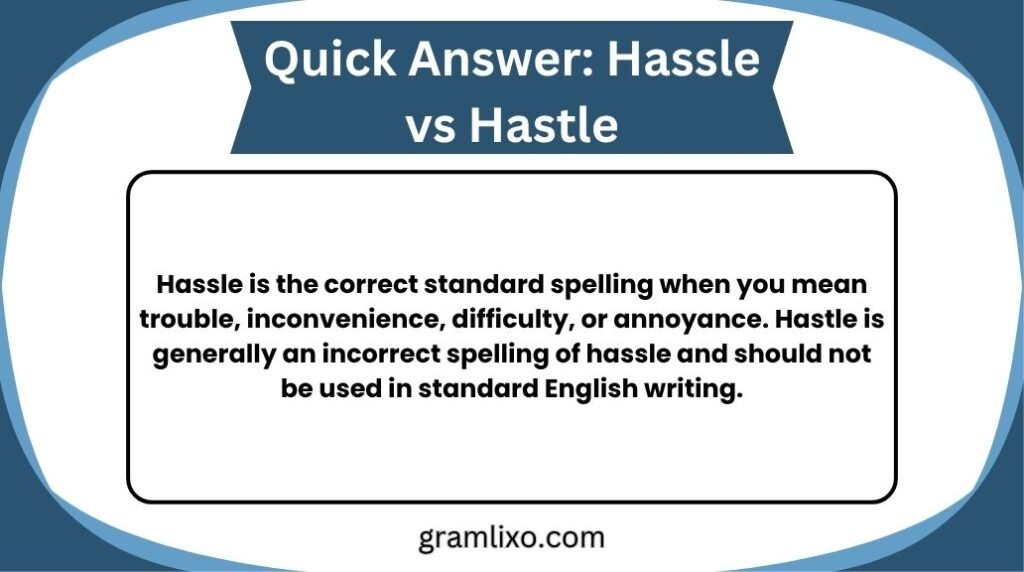
Hassle is the correct standard spelling when you mean trouble, inconvenience, difficulty, or annoyance. Hastle is generally an incorrect spelling of hassle and should not be used in standard English writing.
Correct: “Getting a refund was such a hassle.”
Incorrect: “Getting a refund was such a hastle.”
So, when you mean trouble or inconvenience, always choose “hassle.” ✅
Understanding the Basics of Hassle vs Hastle
The difference between hassle and hastle is primarily a matter of spelling.
Hassle is an established English word. It can be used as a noun or a verb.
- As a noun, hassle means an annoying problem, inconvenience, or difficult situation.
- As a verb, hassle means to annoy, bother, or cause difficulties for someone.
Hastle, on the other hand, is not the standard spelling of this word in ordinary English. If you are writing about inconvenience or annoyance, hastle is considered a misspelling.
Hassle vs Hastle Comparison Table
| Form | Type | Meaning | Example | Correct/Incorrect |
|---|---|---|---|---|
| hassle | Noun | An annoying difficulty or inconvenience | “Moving can be a hassle.” | ✅ Correct |
| hassle | Verb | To bother, annoy, or cause difficulty | “The salesperson kept hassling me.” | ✅ Correct |
| hastle | — | Usually intended as hassle | “The paperwork was a hastle.” | ❌ Incorrect |
| hastle | — | Nonstandard spelling in ordinary usage | “I hate this hastle.” | ❌ Incorrect |
The Simple Rule
If you want to describe something as annoying, inconvenient, troublesome, or difficult, spell it:
H-A-S-S-L-E → hassle
Not:
H-A-S-T-L-E → hastle
The double s is the key.
What Does Hassle Mean?
The word hassle has several closely related uses, but they all involve some form of difficulty, inconvenience, annoyance, or unwanted effort.
Hassle as a Noun
As a noun, hassle refers to something that causes inconvenience or annoyance.
For example:
“Finding parking downtown is a hassle.”
Here, hassle means that finding parking is difficult, inconvenient, or frustrating.
Another example:
“I don’t want the hassle of returning the product.”
In this sentence, the speaker does not want to deal with the effort or inconvenience involved in returning the product.
Common Noun Patterns
You will often see hassle used in phrases such as:
- a hassle
- a big hassle
- a major hassle
- a needless hassle
- a lot of hassle
- without the hassle
- avoid the hassle
- deal with the hassle
- save yourself the hassle
More Examples
“Traveling with too much luggage can be a hassle.”
Breakdown:
- Traveling with too much luggage = the situation
- can be = linking verb
- a hassle = an inconvenience
Another example:
“Online banking saves me the hassle of visiting a branch.”
Here, hassle means the inconvenience and effort involved in going to a bank branch.
Hassle as a Verb
Hassle can also function as a verb.
As a verb, it means to bother, annoy, pressure, or cause difficulty for someone.
For example:
“The salesperson kept hassling me.”
This means the salesperson repeatedly bothered or pressured the speaker.
Another example:
“My coworkers were hassling him about his mistake.”
Here, hassling means repeatedly bothering or teasing him.
Common Verb Forms
The verb can appear in several forms:
- hassle
- hassles
- hassled
- hassling
Notice the spelling carefully.
Hassling has a double s:
hassle → hassling
Hassled also retains the double s:
hassle → hassled
Examples
“Stop hassling me.”
“The reporters hassled the actor with questions.”
“She was hassled by aggressive salespeople.”
These are all standard uses of hassle.
Why Is “Hastle” Incorrect?
The problem with hastle is that it looks like a logical spelling, especially because English contains many words where a single consonant appears between vowels or consonants.
However, spelling is not always predictable from pronunciation.
The standard English word is hassle, with two s letters.
The incorrect spelling hastle may occur because writers hear the word and try to spell it phonetically. Since the middle consonant sound can be perceived quickly in ordinary speech, someone may accidentally write t instead of the second s.
But if the intended meaning is inconvenience, trouble, or annoyance, standard writing requires hassle.
Correct
“The paperwork was a hassle.”
Incorrect
“The paperwork was a hastle.”
The meaning is clear in both sentences, but only the first spelling is appropriate in standard English.
How to Remember the Correct Spelling
A simple memory trick can make hassle vs hastle much easier.
Remember: “Hassle Has Two S’s”
Think:
HASSLE = Hassle Has Two S’s
The word itself contains the clue.
H A S S L E
There are two S’s next to each other.
If you are writing about something annoying or inconvenient, remember:
No T in hassle.
Memory Sentence
Try remembering:
“A hassle has two S’s.”
This gives you a quick spelling check whenever you hesitate.
Test Tip: Replace Hassle With “Inconvenience”
Here is an easy test.
When you are unsure about hassle vs hastle, replace the word with inconvenience.
If the sentence still makes sense, you probably need hassle.
For example:
“Getting a visa can be a hassle.”
Replace hassle:
“Getting a visa can be an inconvenience.”
The meaning works.
Therefore:
“Getting a visa can be a hassle.” ✅
But remember that this test checks meaning, not spelling. Once you know the meaning is right, use the standard spelling hassle.
Case Study: Hassle in a Workplace Email
Imagine an employee needs to explain why a particular process is inefficient.
Incorrect Email
“The current approval process creates a lot of hastle for our team.”
The meaning is understandable, but hastle is misspelled.
Correct Email
“The current approval process creates a lot of hassle for our team.”
This version is correct and professional.
Why the Difference Matters
In casual conversation, a spelling mistake may go unnoticed. In a workplace email, report, proposal, or presentation, however, spelling errors can affect how professional the writing appears.
Consider another example:
“Could we simplify the process to avoid unnecessary hassle?”
This sentence is concise, natural, and professional.
It communicates the problem without sounding overly emotional.
Grammar Rules for Hassle
According to standard dictionary usage, hassle is an established English word that can function as both a noun and a verb. Major dictionaries such as Merriam-Webster recognize hassle with meanings involving annoying difficulty, trouble, or bothering someone.
Hassle as a Noun
When hassle refers to a difficult or annoying situation, it is a noun.
“The paperwork is a hassle.”
Here:
- The paperwork = subject
- is = linking verb
- a hassle = noun phrase
Hassle as a Verb
When hassle describes an action directed toward someone, it functions as a verb.
“Don’t hassle the customer.”
Here:
- Don’t = auxiliary verb
- hassle = main verb
- the customer = object
Why Hastle Does Not Work
When you mean the standard word for inconvenience or annoyance, hastle is not the accepted spelling.
It does not become correct simply because it may appear online or in informal user-generated writing.
A useful rule is:
Meaning trouble or inconvenience? Use “hassle.”
Common Mistakes With Hassle vs Hastle
Why do people write hastle when the correct spelling is hassle?
There are several common reasons.
1. Fast Typing
When people type quickly, they may accidentally press T instead of repeating S.
This is especially common when someone is writing casually or sending a quick message.
For example:
“What a hastle!”
The writer may know the correct word but simply type it incorrectly.
2. Pronunciation Confusion
English spelling does not always match pronunciation perfectly.
When a word is spoken quickly, individual sounds can become less distinct. A person who has mainly heard hassle rather than seen it written may have difficulty remembering its spelling.
3. Autocorrect
Autocorrect does not catch every spelling error.
Sometimes an incorrectly typed word can survive because it resembles another possible word or because the device’s dictionary does not flag it.
Always proofread important writing instead of relying completely on autocorrect.
4. Lack of Familiarity
Someone who has rarely encountered the written word hassle may naturally guess its spelling.
This is especially common for English learners.
The solution is simple: learn the standard spelling and practice using it in context.
Similar Grammar and Spelling Confusions
Hassle vs hastle is part of a much larger group of commonly confused English forms.
| Confusing Forms | Correct Form | Main Difference |
|---|---|---|
| its / it’s | Both can be correct | Possessive vs. “it is” or “it has” |
| your / you’re | Both can be correct | Possessive vs. “you are” |
| their / there / they’re | All can be correct | Possession, place, or “they are” |
| affect / effect | Both can be correct | Usually verb vs. noun |
| definitely / definately | definitely | Standard spelling |
| separate / seperate | separate | Standard spelling |
| receive / recieve | receive | Standard spelling |
| hassle / hastle | hassle | Standard spelling |
These mistakes happen because English has many words whose spelling cannot always be predicted from pronunciation.
Hassle vs Hastle in Different Contexts
Understanding how hassle works in different situations makes it easier to use naturally.
Everyday Conversation
Hassle is very common in casual speech.
Examples:
“I don’t want the hassle.”
“Parking here is such a hassle.”
“Why go through all that hassle?”
“It was a hassle to get everything ready.”
These sentences sound natural in everyday American English.
Professional Writing
Hassle can also appear in professional writing, especially when the tone is conversational.
Examples:
“The new system reduces the hassle of manual data entry.”
“Our goal is to make the registration process simple and hassle-free.”
“Customers can complete the process online without the hassle of mailing documents.”
For formal academic writing, you might sometimes choose more precise alternatives such as:
- inconvenience
- difficulty
- complication
- burden
- administrative challenge
However, hassle is not inherently unprofessional.
Creative Writing
Writers often use hassle to create a natural, conversational voice.
For example:
“She wanted a quiet weekend without the hassle of answering emails.”
The word gives the sentence an informal and relatable feeling.
A more formal alternative would be:
“She wanted a quiet weekend without the inconvenience of responding to emails.”
Both are grammatically correct, but the tone differs.
Social Media and Texting
Hassle is extremely natural in casual digital communication.
Examples:
“Moving apartments is such a hassle 😩”
“No hassle, no stress!”
“I don’t need that hassle today.”
“Avoid the hassle and order online.”
But even in texting, hastle remains the incorrect spelling when you mean hassle.
Common Phrases With Hassle
Learning common phrases is one of the easiest ways to remember the word.
“A hassle”
“Getting there by public transportation is a hassle.”
“Without the hassle”
“You can renew your membership online without the hassle of visiting the office.”
“Avoid the hassle”
“Book early to avoid the hassle.”
“Go through the hassle”
“I don’t want to go through the hassle of returning it.”
“Worth the hassle”
“The savings were worth the hassle.”
“Hassle-free”
“We offer hassle-free returns.”
Notice that hassle-free also contains the double s.
Hassle-Free: An Important Related Expression
One of the most common expressions derived from hassle is hassle-free.
It means without inconvenience, difficulty, or annoyance.
Examples:
“We provide hassle-free service.”
“The website offers a hassle-free checkout process.”
“I want a hassle-free vacation.”
The spelling remains:
H-A-S-S-L-E
Not:
H-A-S-T-L-E
Therefore, you should write:
hassle-free ✅
rather than:
hastle-free ❌
Why Correct Spelling Matters
It may seem like one small letter should not matter much. But accurate spelling plays an important role in communication.
1. Clarity
Correct spelling helps readers understand your intended meaning immediately.
A misspelled word can make readers pause or wonder whether you meant something else.
2. Professionalism
Correct spelling creates a more polished impression in:
- emails
- resumes
- reports
- websites
- business documents
- academic assignments
- applications
3. Digital Communication
Online writing is often permanent and highly visible.
A spelling error on a website, social media post, product description, or professional profile can be seen by many people.
4. Searchability
Correct spelling also matters for search engines.
People are more likely to search for the standard spelling hassle than the misspelling hastle. Using the correct form makes your content easier to understand and classify.
A Simple Reminder
Clear writing begins with correct words.
Special Exception: Can “Hastle” Ever Appear?
There can be rare situations where an unusual spelling appears as a proper name, username, brand, surname, fictional term, or other specialized name.
For example, someone might intentionally use “Hastle” as part of a company name or online identity.
In such a case, the spelling may be correct for that specific name.
However, this does not change the standard English spelling.
If you are trying to describe:
- inconvenience
- annoyance
- trouble
- difficulty
- unwanted effort
the standard word is:
hassle
So unless Hastle is being used as a specific proper name or intentional stylization, do not use it in place of hassle.
Hassle vs Hastle: Quick Recap Checklist
Use this checklist whenever you are unsure.
| Question | If Yes → Use |
|---|---|
| Do you mean inconvenience? | hassle |
| Do you mean an annoying problem? | hassle |
| Do you mean trouble or difficulty? | hassle |
| Do you mean to bother or annoy someone? | hassle |
| Are you writing the standard English word? | hassle |
| Is “Hastle” a specific brand or proper name? | Hastle, only if officially spelled that way |
Practice Example 1
The long checkout process was a _____.
Answer: hassle ✅
“The long checkout process was a hassle.”
Practice Example 2
Stop _____ me about the deadline.
Answer: hassling ✅
“Stop hassling me about the deadline.”
Practice Example 3
We want to make registration _____.
Answer: hassle-free ✅
“We want to make registration hassle-free.”
Quick Way to Tell Hassle and Hastle Apart
When you see hastle, ask yourself:
Am I talking about trouble, inconvenience, annoyance, or bothering someone?
If the answer is yes, change it to:
HASSLE
Think of the spelling as:
HA + SS + LE
The two S’s are essential.
One-Line Rule
Hassle is correct; hastle is normally a misspelling.
Frequently Asked Questions
Is “hassle” or “hastle” correct?
Hassle is correct when you mean trouble, inconvenience, annoyance, or difficulty. Hastle is normally a misspelling and should not be used for this meaning.
What does hassle mean?
Hassle means an annoying difficulty, inconvenience, or troublesome situation. As a verb, it can mean to bother, annoy, pressure, or cause difficulty for someone.
Is hassle a noun or a verb?
Hassle can be both a noun and a verb. As a noun, it means an inconvenience or annoying problem. As a verb, it means to bother or annoy someone.
Examples:
- “Traveling can be a hassle.” — noun
- “Don’t hassle me.” — verb
Why do people spell hassle as hastle?
The mistake usually happens because of fast typing, pronunciation-based spelling, autocorrect issues, or unfamiliarity with the written form. The correct standard spelling has two S’s and no T: hassle.
Is “hassle-free” spelled correctly?
Yes. Hassle-free is the standard spelling of the common expression meaning “without inconvenience or difficulty.”
Example:
“The service offers hassle-free returns.”
Can “Hastle” ever be correct?
It can appear as an intentional proper name, brand, surname, username, or other specialized name. But when you mean inconvenience or annoyance in ordinary English, hassle is the correct spelling.
Conclusion
The difference between hassle vs hastle is simple once you remember the correct spelling. Hassle is the standard English word for an inconvenience, annoying difficulty, troublesome situation, or unwanted effort. It can also be used as a verb meaning to bother or annoy someone. Hastle, when used with these meanings, is generally a misspelling. The easiest way to remember the distinction is to focus on the two S’s in hassle: H-A-S-S-L-E. Whether you are writing an email, posting on social media, creating website content, or completing an academic assignment, choose hassle when you mean trouble or inconvenience. Once you recognize the pattern, this spelling confusion becomes easy to avoid.
Remember: When life is inconvenient, it is a “hassle”—never a “hastle.”

I’m Christopher Garcia, an English writer and grammar enthusiast at Gramlixo. I enjoy making grammar easy to understand through clear explanations and practical examples.
[…] |Hassle vs Hastle: What’s the Correct Spelling? […]