Have you ever wondered about the difference between worn vs. warn? These two English words are easy to confuse because they look and sound similar, but they have completely different meanings and grammatical uses.
Worn is the past participle of wear and describes something that has been put on, used repeatedly, or damaged through use. Warn, on the other hand, is a verb that means to alert or caution someone about a possible danger, problem, or consequence.
For example, you can say, “I have worn these shoes many times,” but you should say, “I warned him about the slippery floor.”
If you are learning English or trying to improve your writing, knowing the difference between worn vs. warn can help you avoid common spelling and grammar mistakes.
In this guide, we will explain their meanings, pronunciation, grammar rules, sentence patterns, common mistakes, and practical examples in clear, simple US English.
|Hassle vs Hastle: What’s the Correct Spelling?
|Minuet vs Minute: What’s the Difference?
|Company-Wide vs Companywide: Which Is Correct?
Quick Answer: Worn vs Warn
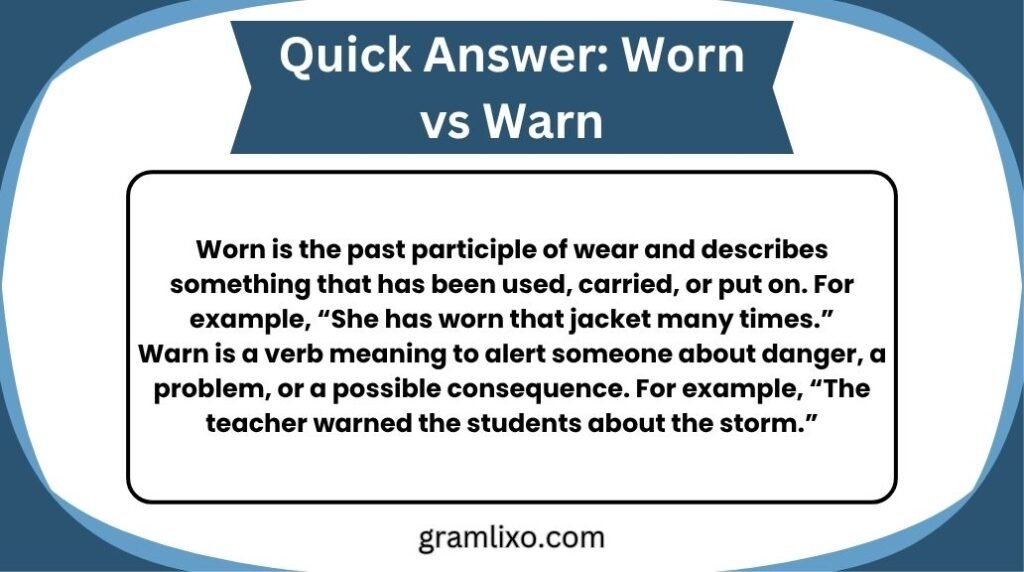
Worn is the past participle of wear and describes something that has been used, carried, or put on. For example, “She has worn that jacket many times.”
Warn is a verb meaning to alert someone about danger, a problem, or a possible consequence. For example, “The teacher warned the students about the storm.”
Simple rule:
👉 Worn = used or put on
👉 Warn = alert or caution
Understanding the Basics of Worn vs. Warn
The easiest way to understand worn vs. warn is to look at what each word does.
Worn comes from the verb wear. It can describe clothing that someone has put on, or an object that has become damaged or less effective because it has been used repeatedly.
Warn is an independent verb. It means to tell someone about a danger, risk, problem, or possible negative result.
Although the words look somewhat similar, they are not interchangeable.
Worn vs. Warn Comparison Table
| Form | Type | Meaning | Example | Correct/Incorrect |
|---|---|---|---|---|
| worn | Past participle of wear | Used, carried, or put on | She has worn this dress before. | ✅ Correct |
| warn | Verb | To alert or caution someone | I warn you to be careful. | ✅ Correct |
| worn | Used for giving a warning | To alert someone | I worn him about the danger. | ❌ Incorrect |
| warn | Past participle of wear | Used or put on | He has warn the shoes. | ❌ Incorrect |
The Core Difference
Think about the two words this way:
- Worn is about wearing or use.
- Warn is about warning or cautioning.
Compare:
My boots are worn from years of hiking.
Here, worn describes the condition of the boots.
I warned my brother about the icy road.
Here, warned describes an action of giving information about danger.
The meanings are completely different.
What Does “Worn” Mean?
Worn is the past participle of wear.
The verb forms are:
- wear — present
- wore — simple past
- worn — past participle
For example:
I wear glasses every day.
I wore glasses yesterday.
I have worn these glasses for years.
The word worn is therefore commonly used with helping verbs such as have, has, had, is, was, or been, depending on the sentence structure.
Worn Meaning: Something Put on the Body
One common meaning of worn is that someone has put on clothing, accessories, or another item.
Examples:
- She has worn that sweater many times.
- He had worn his favorite shoes to work.
- The actor has worn several different costumes.
- I have never worn a suit like that before.
In each sentence, worn is related to the action of wearing something.
Worn Meaning: Damaged by Use
Worn can also describe something that has become damaged, thin, weak, or less effective because of repeated use.
Examples:
- The carpet is badly worn.
- These tires are completely worn.
- The old sofa looks worn.
- His boots were worn after years of work.
Here, worn does not mean “put on.” Instead, it describes the physical condition of something after repeated use.
Worn as an Adjective
Worn can also function as an adjective.
For example:
She sat on a worn leather chair.
The word worn describes the chair.
Another example:
He carried an old, worn backpack.
Again, worn describes the condition of the backpack.
What Does “Warn” Mean?
Warn is a verb that means to tell someone about a possible danger, problem, risk, or consequence.
Examples:
- I warned him about the traffic.
- The doctor warned her about the risks.
- Please warn the children not to touch the stove.
- They warned us about the storm.
The central idea is always giving caution or information before something potentially harmful happens.
Warn Someone About Something
One of the most common structures is:
warn + someone + about + something
Examples:
She warned me about the broken step.
The manager warned us about the deadline.
My friend warned him about the scam.
This structure is useful in both casual and professional English.
Warn Someone Against Something
Another common pattern is:
warn + someone + against + noun/gerund
Examples:
The doctor warned him against smoking.
The teacher warned the students against cheating.
She warned me against making the same mistake.
This structure emphasizes that someone should avoid a particular action.
Warn Someone to Do Something
You can also use:
warn + someone + to + verb
Examples:
I warned him to slow down.
She warned me to be careful.
The officer warned the driver to stop.
This structure gives a direct caution or instruction.
Worn vs. Warn in Sentence Structure
Understanding sentence structure makes this distinction much easier.
Worn With “Have,” “Has,” or “Had”
Because worn is a past participle, it frequently appears in perfect tenses.
Examples:
I have worn this shirt before.
She has worn that necklace many times.
They had worn their uniforms all week.
The word worn works with the auxiliary verb to create the perfect tense.
Warn Changes According to Tense
Because warn is a regular verb, its forms are straightforward:
- warn
- warns
- warned
- warning
Examples:
I warn people about the danger.
She warns everyone to be careful.
He warned me yesterday.
They are warning us about the storm.
This is an important difference between the two words.
Worn vs. Warn: Examples Side by Side
Looking at the words together can make the distinction clearer.
| Worn | Warn |
|---|---|
| She has worn the dress twice. | She warned me about the dress. |
| His shoes are worn. | His father warned him about the road. |
| I have worn these boots for years. | I warned you about the boots. |
| The carpet is badly worn. | The sign warns drivers about the curve. |
| She had worn her uniform all day. | The teacher warned students about the rule. |
Notice how the words have completely different jobs.
Correct Meanings and Uses
Worn as the Past Participle of Wear
The most basic grammatical use of worn is as the past participle of wear.
The basic pattern is:
have/has/had + worn
Examples:
I have worn this coat before.
She has worn the same shoes all week.
He had worn his uniform before the ceremony.
Worn to Describe Damage
Another common use is:
be + worn
Examples:
The tires are worn.
The floor is worn.
The book cover is worn.
In these sentences, worn describes a condition caused by repeated use.
Warn as an Action
Warn describes the act of alerting someone.
Examples:
The police warned drivers about the accident.
My mother always warns me to be careful.
The weather service warned residents about strong winds.
Warn as a Formal Instruction
Warn is especially common in formal communication.
Examples:
The company warned employees about fraudulent emails.
The notice warns visitors about restricted areas.
The manufacturer warns users to follow the instructions carefully.
Test Tip: How to Choose Worn or Warn
When you are unsure, ask yourself one simple question:
Are you talking about wearing or using something?
If yes, use worn.
I have worn these shoes before. ✅
Are you talking about giving someone a caution?
If yes, use warn.
I warned him about the slippery floor. ✅
A useful memory trick is:
WORN → WEAR
Both relate to clothing, use, or deterioration.
WARN → WARNING
Both relate to caution and danger. ⚠️
Case Study: Worn vs. Warn in the Workplace
Imagine an employee sends this email to a manager:
“The safety signs have become worn, so customers may not be able to read them.”
Here, worn is correct because the signs have deteriorated from use, weather, or age.
Now imagine the manager writes:
“I want to warn everyone about the damaged signs.”
Here, warn is correct because the manager is alerting people to a potential problem.
A longer workplace message might say:
“Several warning signs are badly worn. Please replace them before the next inspection. I also want to warn the team that the damaged signs could create a safety issue.”
This example uses both words correctly.
Worn describes the condition of the signs.
Warn describes the act of giving caution.
That distinction is useful in workplace emails, reports, safety notices, and instructions.
Grammar Rules for Worn vs. Warn
The key grammatical rule is simple:
Worn is the past participle of wear, while warn is a regular verb meaning to caution or alert.
Standard dictionaries, including Merriam-Webster, distinguish words by their meanings, grammatical functions, and forms. Merriam-Webster’s pronunciation guidance also illustrates why English spelling and pronunciation can create confusion: spelling does not always provide an obvious guide to how words are spoken.
The Verb “Wear”
The irregular verb wear has these forms:
wear → wore → worn
Examples:
I wear glasses.
I wore glasses yesterday.
I have worn glasses for years.
You cannot replace worn with warn in these sentences.
The Verb “Warn”
The verb warn follows a regular pattern:
warn → warned → warned
Examples:
I warn him.
I warned him.
I have warned him.
Notice that warn does not belong to the wear/wore/worn verb family.
Why “Worn” and “Warn” Are Confused
There are several reasons people mix up these words.
1. Similar Spelling
The two words differ by only one vowel:
- worn
- warn
When someone is typing quickly, the eye may not notice the difference.
2. Similar Pronunciation
In many varieties of American English, worn and warn can sound very similar, and in some accents they may be difficult to distinguish in ordinary speech.
That means context often does more work than pronunciation.
3. Fast Typing
When people type quickly, they often produce words that look or sound right but are not grammatically appropriate.
A person may intend to type:
“I warned him.”
but accidentally type:
“I worn him.”
4. Autocorrect
Autocorrect can also contribute to confusion. If a typing system recognizes both words, it may not always understand the intended meaning from a short sentence.
5. Lack of Knowledge
Some learners simply have not learned that worn is connected to wear.
Once you memorize:
wear → wore → worn
the distinction becomes much easier.
Common Mistakes With Worn vs. Warn
Mistake 1: “I Worn Him”
❌ I worn him about the danger.
This is incorrect because worn does not mean “give a warning.”
✅ I warned him about the danger.
Mistake 2: “I Have Warn This Shirt”
❌ I have warn this shirt before.
This is incorrect because the past participle of wear is worn.
✅ I have worn this shirt before.
Mistake 3: “She Worn Me”
❌ She worn me about the problem.
✅ She warned me about the problem.
Mistake 4: “The Shoes Are Warn”
❌ The shoes are warn.
If you mean the shoes are damaged from use, use worn.
✅ The shoes are worn.
Similar Grammar Confusions
Worn vs. warn belongs to a larger group of commonly confused English words.
| Confusing Words | Correct Distinction |
|---|---|
| its / it’s | its = possession; it’s = it is/it has |
| your / you’re | your = possession; you’re = you are |
| their / they’re / there | possession / they are / place |
| then / than | time or sequence / comparison |
| affect / effect | usually verb / usually noun |
| accept / except | receive or agree / excluding |
| lose / loose | misplace or fail to win / not tight |
| wear / where | put on / location |
| worn / warn | past participle of wear / alert or caution |
These mistakes are common because English contains many words that look or sound similar while serving completely different purposes.
Worn vs. Warn in Different Contexts
Everyday Conversation
In ordinary conversation, both words appear naturally.
Examples with worn:
“These jeans are completely worn out.”
“I’ve worn this jacket all winter.”
Examples with warn:
“I warned you about that dog.”
“She warned me not to go there.”
Professional Writing
Accuracy matters even more in professional communication.
Examples:
“The equipment is visibly worn and should be replaced.”
“The supervisor warned employees about the safety violation.”
Using the wrong word could make a report confusing or unprofessional.
Creative Writing
Writers can use worn to describe physical objects, clothing, or even figurative conditions.
Examples:
“He carried a worn leather suitcase.”
“Her worn boots told the story of years spent traveling.”
Warn can create tension:
“The old man warned them not to enter the forest.”
Social Media and Texting
Informal writing is usually more forgiving, but the meanings still matter.
“These sneakers are so worn 😂”
“I warned you! 😂”
Even in a casual text, changing one letter can completely change the meaning.
Why Worn vs. Warn Matters
You might wonder whether this distinction is worth learning.
It is.
Clarity in Communication
Correct word choice helps readers understand your exact meaning.
Compare:
“The tires are worn.”
with:
“The tires warned us.”
The first sentence makes sense because tires can become worn. The second suggests that the tires somehow gave a warning.
Professionalism
Correct grammar and spelling make your writing appear more careful and reliable.
This matters in:
- Emails
- Resumes
- Reports
- School assignments
- Business documents
- Customer communication
- Safety instructions
Digital Communication
Online communication is often fast. People frequently rely on autocorrect, predictive text, and speech-to-text tools.
That makes it even more important to recognize words by meaning, not just appearance.
A Short Reminder
Use “worn” for wear and “warn” for warning.
That one sentence can prevent most mistakes.
Special Exceptions and Edge Cases
There is no major grammatical exception that makes worn and warn interchangeable. They remain separate words with different meanings.
However, worn has several meanings beyond clothing.
Worn-Out
The compound adjective worn-out means exhausted, used excessively, or no longer effective.
Examples:
I feel completely worn-out after the trip.
We need to replace the worn-out equipment.
Worn as a Figurative Description
Worn can also describe someone’s appearance or emotional condition.
For example:
She looked worn after several difficult weeks.
Here, worn means tired or exhausted-looking.
Warning as a Related Form of Warn
The noun warning comes from warn.
Examples:
The sign gave us a clear warning.
He ignored the warning.
This provides another useful memory connection:
warn → warning
Quick Recap Checklist
Use this checklist whenever you are unsure about worn vs. warn.
| Question | If Yes → Use |
|---|---|
| Am I talking about something being put on? | worn |
| Am I talking about something becoming damaged through use? | worn |
| Am I describing clothing or an object that has been used? | worn |
| Am I alerting someone about danger? | warn |
| Am I telling someone about a possible problem? | warn |
| Am I giving someone caution or advice about a risk? | warn |
Practice Example 1
“I have ___ this jacket many times.”
Answer: worn
“I have worn this jacket many times.”
Practice Example 2
“The doctor ___ him about the risks.”
Answer: warned
“The doctor warned him about the risks.”
Practice Example 3
“The soles of my shoes are badly ___.”
Answer: worn
“The soles of my shoes are badly worn.”
Practice: Can You Choose the Correct Word?
Try these before checking the answers.
- The teacher ___ us about the upcoming storm.
- I have ___ these shoes for three years.
- The old carpet is badly ___.
- She ___ me not to touch the machine.
- He has ___ that coat many times.
- The doctor ___ the patient about the possible side effects.
Answers
- warned
- worn
- worn
- warned
- worn
- warned
The pattern should now be clear.
FAQs About Worn vs. Warn
Is “worn” the past tense of “wear”?
No. Wore is the simple past tense of wear, while worn is the past participle.
- Present: wear
- Past: wore
- Past participle: worn
Example: “I wore the jacket yesterday, and I have worn it many times.”
Is “warn” related to “worn”?
No. They are different words with different meanings. Worn comes from wear, while warn means to alert or caution someone.
Is “I worn him about the danger” correct?
No. The correct sentence is:
“I warned him about the danger.”
Worn cannot mean “warned.”
Is “I have worn this dress” correct?
Yes. Worn is correct because it is the past participle of wear.
“I have worn this dress before.”
What is the easiest way to remember worn vs. warn?
Connect worn with wear and warn with warning.
Wear → wore → worn
Warn → warning
This simple association makes the difference easier to remember.
Can “worn” describe something other than clothing?
Yes. Worn can describe objects that have deteriorated through repeated use.
For example:
“The tires are worn.”
“The carpet is worn.”
It can also describe someone’s tired appearance:
“She looked worn after the long journey.”
Conclusion
Understanding worn vs. warn is much easier when you focus on meaning instead of spelling. Worn is the past participle of wear, and it can describe something that has been put on, used repeatedly, or damaged through use. Warn, meanwhile, is a verb meaning to alert, caution, or tell someone about a possible danger or problem. Remember the simplest rule: worn connects to wear, while warn connects to warning. If you are talking about shoes, clothing, equipment, carpets, or something affected by repeated use, worn is usually the right choice. If you are telling someone to be careful or alerting them to a risk, use warn. Once you connect each word to its meaning and grammatical role, this commonly confused pair becomes easy to handle. When in doubt, remember: wear something, but warn someone.

I’m Michael Williams, an English writer and grammar enthusiast at Gramlixo. I’m passionate about making grammar easier to learn and helping readers write with greater confidence.

[…] |Worn vs Warn: What’s the Difference? […]