Have you ever typed a sentence and suddenly stopped because you were unsure whether to write reorder or re-order? You are not alone. English has many words that use the prefix re-, and deciding whether the prefix should be joined to the main word or separated with a hyphen can be confusing. The question of reorder vs re-order is especially common in workplace emails, online shopping, business writing, editing, and everyday communication.
Both forms can be found in English, but they are not equally common in modern US English. In most situations, reorder is the preferred spelling when you mean to order something again or put things into a different order. The hyphenated form re-order appears in some dictionaries and varieties of English, but it is less common in contemporary American writing.
Understanding this small spelling difference can make your writing cleaner and more professional. Whether you are asking a supplier to send another shipment, changing the sequence of a list, or telling someone to arrange information differently, knowing when to use reorder will help you write with confidence. Let’s break down the rule in simple terms. 📚
|In vs Within: What Is the Difference and How to Use Them Correctly?
|Its-Self vs. Itself: Which Is Correct? A Complete Grammar Guide
|Tortuous vs Torturous: What’s the Difference? Easy Guide With Examples
Quick Answer: Reorder vs Re-Order
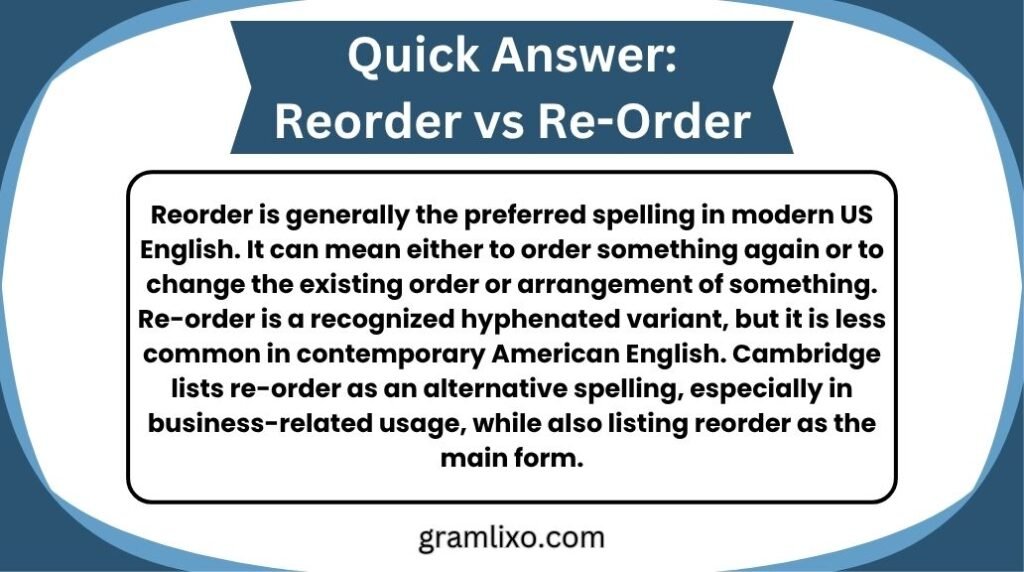
Reorder is generally the preferred spelling in modern US English. It can mean either to order something again or to change the existing order or arrangement of something.
Re-order is a recognized hyphenated variant, but it is less common in contemporary American English. Cambridge lists re-order as an alternative spelling, especially in business-related usage, while also listing reorder as the main form.
Best choice for most US English writing:
✅ reorder
⚠️ re-order — possible variant, but usually unnecessary in standard US writing.
For example:
- Please reorder the supplies before they run out.
- We need to reorder the items alphabetically.
- The manager asked us to reorder the presentation slides.
Understanding the Basics: Reorder vs Re-Order
The difference between reorder and re-order is mainly a matter of spelling and style rather than meaning.
The prefix re- generally means “again” or “back.” When it combines naturally with a base word, English often writes the resulting word as one word.
That is what happens with reorder.
Basic Comparison Table
| Form | Type | Meaning | Example | Correct/Incorrect |
|---|---|---|---|---|
| reorder | Verb | To order again or arrange differently | We need to reorder the products. | ✅ Preferred |
| re-order | Verb | Same basic meaning as reorder | We need to re-order the products. | ⚠️ Variant |
| reordered | Past tense | Ordered again or arranged differently | She reordered the list. | ✅ Preferred |
| re-ordered | Past tense | Same meaning as reordered | She re-ordered the list. | ⚠️ Variant |
| reordering | Present participle | Ordering again or changing arrangement | We are reordering the files. | ✅ Preferred |
| re-ordering | Present participle | Same meaning | We are re-ordering the files. | ⚠️ Variant |
The key point is simple: reorder is normally the better choice in modern US English.
What Does “Reorder” Mean?
The word reorder has two closely related meanings.
First, it can mean to order something again.
For example:
I need to reorder my favorite coffee.
Here, the speaker has purchased the coffee before and wants to order it again.
Second, reorder can mean to change the sequence or arrangement of something.
For example:
Please reorder the paragraphs so the argument flows better.
Here, the speaker is not purchasing anything. Instead, the speaker wants the paragraphs arranged differently.
Cambridge gives both senses: ordering the same goods again and changing the way something is organized.
Correct Meanings and Uses of Reorder
1. Reorder Means “Order Again”
One of the most common meanings of reorder is to purchase or request something again.
Consider this sentence:
We need to reorder printer paper.
The sentence means that the company previously ordered printer paper and now needs another supply.
The word can be broken down like this:
- re- = again
- order = request or purchase something
- reorder = order again
More examples:
- I need to reorder my prescription supplies.
- The restaurant will reorder ingredients tomorrow.
- We should reorder the products that sold out.
- The customer wants to reorder the same item.
- Please reorder the office supplies before Friday.
In each example, reorder means to obtain something again.
2. Reorder Means “Change the Sequence”
The second major meaning is to change the order or arrangement of something.
For example:
Please reorder the names alphabetically.
The names already exist in a list. You are simply changing their sequence.
Other examples include:
- Reorder the steps in the instructions.
- The editor reordered the paragraphs.
- Please reorder the questions from easiest to hardest.
- We need to reorder the slides in the presentation.
- The teacher reordered the activities.
In these examples, reorder does not mean “purchase again.” It means arrange differently.
3. Reorder in Business
Business writing frequently uses reorder when discussing inventory.
For example:
Our system automatically reorders products when inventory becomes low.
This is natural and professional US English.
You may also see:
Customers can reorder products directly from their accounts.
Here, reorder means purchase the same products again.
Business writing often uses related words such as:
- reorder point
- reorder quantity
- reorder level
- reorder request
- reorder form
- reorder process
For example:
The warehouse has reached its reorder point.
This means inventory has fallen to a level at which the company should place another order.
4. Reorder in Writing and Editing
The word can also be used when discussing documents.
For example:
I reordered the sections to improve the article’s flow.
This means the sections were placed in a different sequence.
You might also say:
The editor suggested reordering the paragraphs.
Here, reordering is the gerund or present participle form of reorder.
Cambridge provides examples of reordering in contexts involving changing the organization or sequence of information.
What About Re-Order?
Now we come to the part that causes most of the confusion.
Re-order is not simply a random misspelling. It is a form that appears in dictionaries and real-world English.
Cambridge lists re-order as an alternative spelling of reorder. Its entry also provides examples of the hyphenated form in business contexts.
So, calling re-order completely “wrong” would be too absolute.
However, that does not mean you should automatically use the hyphen.
In contemporary US English, reorder is generally the cleaner and more natural choice.
Why Does the Hyphenated Form Exist?
English spelling has changed over time.
Words containing prefixes are sometimes written in different ways:
- re-do
- redo
- re-enter
- reenter
- re-organize
- reorganize
- re-order
- reorder
Some forms have become firmly established as closed compounds, while others continue to appear with hyphens.
Usage can also differ between dictionaries, publishers, countries, industries, and style guides.
That is why you may encounter re-order even when reorder is your better choice.
Reorder vs Re-Order in American English
For a US English article, business email, academic assignment, website, or professional document, reorder should usually be your first choice.
Preferred US Examples
Please reorder the products before the weekend.
Could you reorder these items alphabetically?
We need to reorder the presentation slides.
The customer would like to reorder the same product.
The editor decided to reorder the paragraphs.
These sentences look natural because reorder functions as an established single word.
What About “Re-Order”?
You may still encounter:
Please re-order the products.
This is understandable and appears in some English usage. However, the hyphen is usually unnecessary in modern US writing.
If you are choosing one spelling for consistent American English content, use:
reorder
Test Tip: How Can You Choose the Right Form?
Here is a simple test.
Test 1: Can You Replace It With “Order Again”?
If yes, reorder is usually appropriate.
I need to reorder the books.
Ask:
I need to order the books again.
The meaning works.
Therefore:
✅ I need to reorder the books.
Test 2: Can You Replace It With “Arrange Differently”?
If yes, use reorder.
We need to reorder the steps.
Ask:
We need to arrange the steps differently.
The meaning works.
Therefore:
✅ We need to reorder the steps.
Test 3: Are You Writing Standard US English?
If yes, prefer the closed form:
✅ reorder
rather than:
⚠️ re-order
This is the easiest rule for everyday writing.
Case Study: Reorder vs Re-Order in a Workplace Email
Imagine that a company has nearly run out of printer cartridges.
An employee writes:
We are almost out of printer cartridges. Please reorder three boxes by Friday.
This is clear, concise, and professional.
Now imagine another employee writes:
We are almost out of printer cartridges. Please re-order three boxes by Friday.
The meaning is still understandable, and the hyphenated form is attested in English. However, if the company follows a modern US English style, reorder would normally be the cleaner choice.
Now consider a different workplace situation.
An editor tells a writer:
Please reorder the second and third sections.
The editor does not want the writer to purchase anything. The editor wants the sections moved into a different sequence.
Again, reorder works naturally.
This illustrates why the meaning of reorder can change slightly depending on context while the spelling remains the same.
Grammar Rules: Why Is “Reorder” Usually Preferred?
The word reorder is formed by adding the prefix re- to order.
The prefix re- commonly expresses the idea of doing something again.
Examples include:
- rebuild
- rewrite
- reread
- reconsider
- reorganize
- reorder
When a prefix combines naturally with a base word and the resulting form is established as a single lexical item, English often writes it without a hyphen.
That is why reorder is a natural closed form.
Cambridge’s dictionary entry treats reorder as the main entry and lists re-order as an alternative.
This distinction is important. The issue is not that English grammar makes the hyphen impossible. Rather, standard modern usage generally favors the closed spelling in this word.
Is Re- a Prefix?
Yes.
In reorder:
- re- is the prefix.
- order is the base word.
- reorder is the resulting verb.
The same pattern occurs in:
rewrite
reread
rebuild
reorder
reorganize
However, English prefixes do not always follow one universal spelling rule. Some words remain hyphenated to avoid confusion or awkward letter combinations.
That is why you should consider established dictionary usage rather than trying to apply a single mechanical rule to every word beginning with re-.
Reorder vs Rearrange
Another common source of confusion is reorder vs rearrange.
These words are related but not always interchangeable.
Reorder
Reorder means to change the sequence or arrangement, or to order something again.
Please reorder the questions.
Rearrange
Rearrange means to change the order, position, or timing of things that have already been arranged. Cambridge defines rearrange in terms of changing existing order, position, or arrangements.
For example:
We need to rearrange the furniture.
This emphasizes physically changing positions.
You could sometimes say:
We need to reorder the furniture.
But rearrange sounds more natural when talking about physically moving furniture.
Compare:
| Word | Typical Meaning | Example |
|---|---|---|
| reorder | Change sequence or order again | Reorder the paragraphs. |
| rearrange | Change positions or arrangements | Rearrange the furniture. |
| reorganize | Change the structure or organization | Reorganize the department. |
| repeat | Do or say something again | Repeat the instructions. |
Choosing the right word makes your writing more precise.
Common Mistakes With Reorder vs Re-Order
Why do people write re-order?
There are several reasons.
1. Fast Typing
When people type quickly, they often insert punctuation based on instinct.
Someone may think:
re + order = re-order
because the prefix feels separate from the base word.
That does not necessarily reflect standard spelling.
2. Autocorrect
Different software tools can behave differently.
A writing application may recognize one form and flag another. An online editor may accept re-order, while another tool prefers reorder.
Therefore, autocorrect should not be treated as the final authority on English spelling.
3. Lack of Familiarity
Some writers know words such as re-enter and re-open, so they assume every re- word should contain a hyphen.
That is not how English spelling works.
The correct spelling depends on the established form of the individual word.
4. British vs American Usage
Regional variation can also cause confusion.
Dictionaries may record both closed and hyphenated forms, and different varieties of English can have different preferences.
Cambridge specifically lists re-order as an alternative to reorder.
Similar Grammar and Spelling Confusions
| Confusion | Preferred Form | Common Mistake |
|---|---|---|
| its vs it’s | its / it’s depending on meaning | Mixing possession and contraction |
| your vs you’re | your / you’re | Using the wrong form |
| their vs they’re | their / they’re | Confusing possession and contraction |
| everyday vs every day | Depends on meaning | Treating them as identical |
| alot vs a lot | a lot | Writing “alot” |
| setup vs set up | Depends on function | Confusing noun and verb |
| reorder vs re-order | reorder in most US writing | Unnecessary hyphen |
| email vs e-mail | Using an increasingly less common hyphen | |
| online vs on-line | online | Using an outdated hyphenated form |
These examples show an important lesson: English spelling is based on established usage, not just logical word construction.
Usage in Different Contexts
Everyday Conversation
In casual conversation, people usually do not notice the difference between reorder and re-order when speaking because the words sound the same.
You might say:
I need to reorder my lunch.
Or:
Can we reorder the list?
The spelling matters when you write the sentence.
Professional Writing
Professional writing strongly favors consistency.
Use:
Please reorder the items in the spreadsheet.
rather than:
Please re-order the items in the spreadsheet.
The first version looks cleaner and aligns with the standard dictionary headword.
Professional examples include:
- Please reorder the inventory.
- We need to reorder the documents.
- Could you reorder the slides?
- The system will automatically reorder the supplies.
- Please reorder the list by date.
Academic Writing
Academic writers should generally use reorder when discussing the sequence of arguments, sections, variables, or information.
For example:
The researcher reordered the variables before conducting the analysis.
Or:
The author should reorder the paragraphs to improve logical flow.
Using the standard closed form avoids unnecessary punctuation.
Creative Writing
Creative writers have more flexibility, but consistency remains important.
For example:
She stopped halfway through the list and decided to reorder everything.
The closed form feels natural.
If a publication’s house style uses re-order, follow that style consistently.
Social Media and Texting
Social media users may use either form.
However, if you are posting professionally, such as on LinkedIn or a company account, reorder is the safer choice.
For example:
We had to reorder our priorities after the launch.
This looks polished and professional.
Reorder as a Verb
The most common grammatical use of reorder is as a verb.
Present Tense
I reorder supplies every month.
She reorders products when inventory gets low.
Third-Person Singular
Add -s:
He reorders office equipment regularly.
The system reorders products automatically.
Past Tense
Add -ed:
We reordered the supplies yesterday.
The editor reordered the paragraphs.
Present Participle
Use reordering:
We are reordering the inventory.
She is reordering the sections.
Notice that the preferred forms remain closed:
- reorder
- reorders
- reordered
- reordering
The same principle applies to the hyphenated variant if a particular style uses it, but modern US writing generally favors the closed forms.
Reorder as a Noun
Reorder can also function as a noun, especially in commerce and inventory management.
For example:
The store received a reorder from the customer.
Here, reorder refers to another order for the same product.
Other examples:
The reorder arrived this morning.
The system generated a reorder automatically.
We received three reorders this week.
This noun use is particularly common in business contexts.
Cambridge’s entry also recognizes reorder as a noun in commerce.
Reorder Point and Inventory Language
If you work in retail, logistics, manufacturing, or supply-chain management, you may encounter reorder point.
A reorder point is the inventory level at which a business should place another order.
For example:
Our reorder point for printer paper is 20 boxes.
Other related expressions include:
- reorder point
- reorder level
- reorder quantity
- reorder request
- reorder system
- reorder alert
These are normally written without a hyphen in modern US business writing.
Reorder vs Re-Order in Digital Communication
Digital communication has made this issue more noticeable.
People write emails, product descriptions, social media posts, software instructions, website copy, and online forms every day.
A single unnecessary hyphen is not usually a serious error, but consistency matters.
Consider an online store button.
Better:
Reorder
Less typical:
Re-Order
If a website uses Reorder throughout its interface, suddenly displaying Re-Order elsewhere can make the design look inconsistent.
For UX writing and interface text, shorter established forms are usually preferable.
Why It Matters
You may wonder whether one tiny hyphen really matters.
Usually, it does not change the meaning.
But spelling and punctuation affect how polished your writing appears.
1. Clarity
Consistent spelling helps readers process information quickly.
2. Professionalism
Professional documents benefit from standard, familiar word forms.
3. Accuracy
Using established dictionary forms reduces unnecessary variation.
4. Digital Communication
Emails, websites, online stores, and workplace platforms often rely on concise language. A standard form makes content look cleaner.
A useful principle is:
Good writing removes unnecessary friction for the reader.
In other words, the goal is not to make every sentence complicated. The goal is to make every sentence easy to understand.
Special Exception: When Re-Order May Appear
There is an important exception to the simple rule.
Re-order is a documented variant of reorder. Cambridge explicitly lists it as an alternative form.
Therefore, it would be inaccurate to claim that re-order is always grammatically incorrect.
Instead, think of the forms this way:
reorder = preferred general form in modern US English
re-order = recognized alternative spelling that may appear in some varieties, publications, or business contexts
If you are following a specific company’s style guide, publisher’s style, or regional convention, follow that established preference.
The most important thing is consistency.
Reorder vs Re-Order: Style Guide Considerations
Different organizations can have different editorial preferences.
A company’s internal style guide might specify:
Always use “reorder.”
Another publication could preserve a traditional or regional hyphenated form.
If you are writing for a client, publisher, employer, or website, check its style guide before changing established terminology.
When no special style guide exists, modern US English gives you a straightforward default:
Use reorder.
This is especially useful for:
- SEO content
- blog posts
- business emails
- product descriptions
- academic writing
- website copy
- marketing content
- general professional communication
How to Remember the Difference
Here is an easy memory trick:
Think “again” → reorder
If re- means “again,” ask whether the resulting word is commonly written as one word.
With order, the standard closed form is:
reorder
Think:
order → reorder
not:
order → re-order
You can also remember this short sentence:
When in doubt in US English, choose reorder.
Quick Recap Checklist
Use the following checklist whenever you are unsure.
| Question | If Yes → Use |
|---|---|
| Do you mean “order again”? | reorder |
| Do you mean “change the sequence”? | reorder |
| Are you writing standard US English? | reorder |
| Are you writing a professional email? | reorder |
| Are you writing website or SEO content? | reorder |
| Does a specific style guide require a hyphen? | re-order |
| Are you following a publication that uses the variant? | re-order |
| Are you asking whether the hyphenated form exists? | Yes, it is a recognized variant |
Practice Examples
Example 1:
We need to ___ the office supplies.
Correct answer:
We need to reorder the office supplies.
Why? You want to order the supplies again.
Example 2:
Please ___ the paragraphs so the conclusion comes last.
Correct answer:
Please reorder the paragraphs so the conclusion comes last.
Why? You want to change their sequence.
Example 3:
The system automatically ___s items when stock becomes low.
Correct answer:
The system automatically reorders items when stock becomes low.
Why? The subject “system” is singular, so the verb takes -s.
Reorder vs Re-Order: Examples at a Glance
Here are more examples to reinforce the rule:
Ordering Again
- I need to reorder my usual coffee.
- The store will reorder the popular products.
- Please reorder the missing supplies.
- Customers can reorder previous purchases.
- We should reorder more inventory.
Changing Sequence
- Reorder the list alphabetically.
- Please reorder the steps.
- The editor reordered the paragraphs.
- We reordered the presentation slides.
- The teacher reordered the activities.
Professional Communication
- Please reorder the documents by date.
- We need to reorder the inventory.
- The software automatically reorders the results.
- I have reordered the report sections.
- The customer requested a reorder.
Frequently Asked Questions
1. Is “reorder” or “re-order” correct?
Reorder is generally the preferred spelling in modern US English. Re-order is also a recognized variant and can be found in dictionaries, but it is less common in contemporary American writing.
2. Is “reorder” one word?
Yes. Reorder is commonly written as one word. It can mean to order something again or to change the sequence of something.
3. Is “re-order” wrong?
No. Re-order is not simply an impossible spelling. It is a recognized variant. However, if you are writing standard US English and have no specific style requirement, reorder is usually the better choice.
4. What does “reorder” mean?
Reorder has two primary meanings: to order something again or to change the arrangement or sequence of something. For example, you can reorder a product or reorder paragraphs in a document.
5. Should I use “reorder” in professional writing?
Yes. Reorder is the safest choice for most professional US English writing, including emails, reports, websites, business documents, and marketing content.
6. What is the past tense of “reorder”?
The past tense is reordered.
For example:
The manager reordered the presentation slides.
The present participle is reordering:
The manager is reordering the presentation slides.
Conclusion
The reorder vs re-order question is easier once you understand that the two forms generally carry the same basic meaning. Reorder is the preferred closed form for most modern US English writing. It can mean ordering something again, such as supplies or products, or changing the sequence of something, such as paragraphs, slides, or instructions.
Re-order is not necessarily wrong. It is a recognized variant that appears in some dictionaries and varieties of English. However, when there is no specific style guide telling you otherwise, reorder is the cleaner and more natural choice for American English.
Remember the simple rule: if you mean “order again” or “arrange differently,” write reorder. Use the hyphenated re-order only when a particular style, publication, or regional convention calls for it.
When you want your writing to look polished, consistent, and professional, keep it simple: choose reorder.

I’m Robert Williams, an English grammar writer at Gramlixo. I focus on breaking down confusing grammar rules into simple explanations and useful examples.

[…] |Reorder vs Re-Order: Which Spelling Is Correct? […]
[…] |Reorder vs Re-Order: Which Spelling Is Correct? […]