Have you ever typed a sentence like “You went to far” and then wondered whether to far vs too far is the correct spelling? You are not alone. These two expressions sound almost identical when spoken, but they have completely different grammatical roles.
One is a standard English expression, while the other is usually a spelling and usage error. Understanding to far vs too far is important because this small difference can change whether your sentence looks polished or incorrect.
In everyday conversations, texts, emails, school assignments, and professional writing, knowing when to use to and too can prevent a very common mistake. The good news is that the rule is simple once you understand what each word does.
In this guide, we will explain the difference between to far and too far, show you the correct examples, examine common mistakes, and give you easy tests you can use whenever you are unsure.
|Lent vs Lended: Which One Is Correct?
|In vs Within: What Is the Difference and How to Use Them Correctly?
|Thus Far vs So Far: What’s the Difference?
Quick Answer: To Far vs Too Far
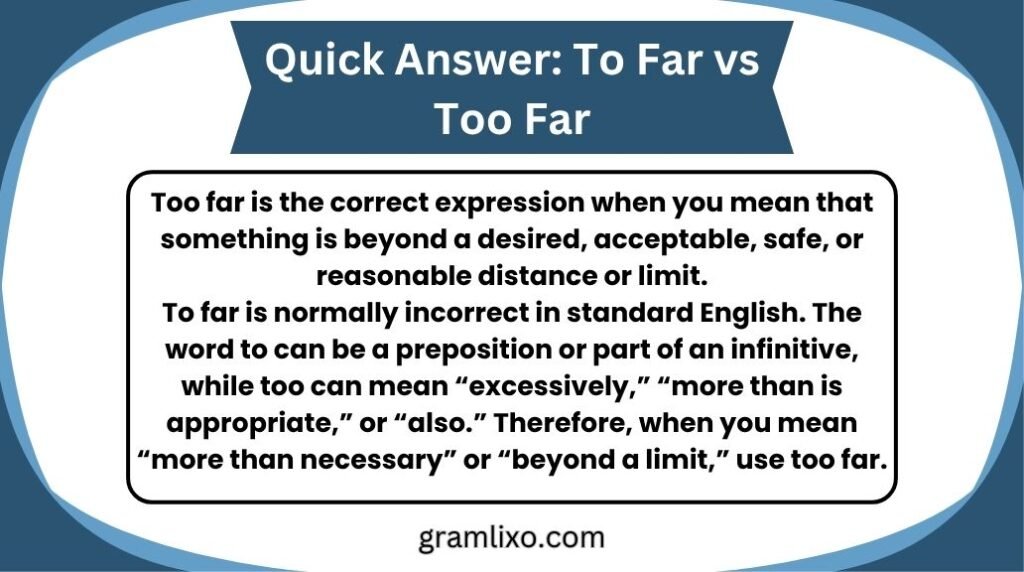
Too far is the correct expression when you mean that something is beyond a desired, acceptable, safe, or reasonable distance or limit.
To far is normally incorrect in standard English. The word to can be a preposition or part of an infinitive, while too can mean “excessively,” “more than is appropriate,” or “also.” Therefore, when you mean “more than necessary” or “beyond a limit,” use too far.
Correct: You walked too far.
Incorrect: You walked to far.
Understanding the Basics: To Far vs Too Far
The easiest way to understand to far vs too far is to look at the individual words.
What Does “To” Mean?
To is a very common English word. It can function as a preposition or as part of an infinitive.
Examples include:
- I went to school.
- She walked to the store.
- He wants to learn.
- We drove to Chicago.
- Give the book to me.
In these examples, to connects a person, place, or action to another part of the sentence.
However, to does not normally modify the adjective or adverb far to express excessive distance.
That is why to far is generally incorrect.
What Does “Too” Mean?
Too is commonly used to mean more than is desirable, necessary, or acceptable.
Examples include:
- The coffee is too hot.
- The box is too heavy.
- The music is too loud.
- The car is too expensive.
- You walked too far.
In too far, the word too modifies far and communicates excess.
In other words:
too far = farther than is appropriate, acceptable, necessary, or intended
Comparison Table
| Form | Type | Meaning | Example | Correct/Incorrect |
|---|---|---|---|---|
| to | Preposition / infinitive marker | Direction, destination, or infinitive | I went to the store. | Correct |
| too | Adverb | Excessively; more than necessary | We walked too far. | Correct |
| to far | Incorrect combination in this meaning | Usually intended to mean “too far” | We walked to far. | Incorrect |
| too far | Adverb + adverb | Beyond a reasonable or intended limit | The car went too far. | Correct |
| far | Adverb/adjective | A great distance | The station is far away. | Correct |
The key distinction is simple: too expresses excess, while to does not.
What Does “Too Far” Mean?
The phrase too far generally means that something has exceeded a particular limit.
That limit can be:
- Physical
- Emotional
- Social
- Moral
- Practical
- Financial
- Figurative
- Logical
Let’s examine these meanings in detail.
1. Too Far as Physical Distance
The most literal use of too far refers to physical distance.
For example:
The restaurant is too far from my house.
This means the restaurant is farther away than the speaker considers convenient or acceptable.
Another example:
We walked too far and had to take a taxi home.
Here, the walking distance exceeded what the people intended to cover.
2. Too Far as an Excessive Amount
Too far does not always describe literal distance.
It can describe an action that goes beyond an acceptable limit.
For example:
You have taken this joke too far.
This does not mean someone physically traveled somewhere. It means the joke has exceeded a social or emotional boundary.
Another example:
His comments went too far.
The speaker believes the comments crossed an acceptable boundary.
3. Too Far in an Emotional Context
The phrase is also common when describing emotional behavior.
For example:
I was angry, but I never meant to take it too far.
The phrase means the person recognizes that their behavior could have exceeded a reasonable emotional limit.
Similarly:
She pushed herself too far.
This can mean that she demanded more from herself than was healthy, practical, or reasonable in the particular situation.
4. Too Far in a Professional Context
In the workplace, too far can describe actions, requests, criticism, or expectations that exceed reasonable limits.
For example:
The manager’s request went too far.
Or:
We should not take the negotiations too far without reviewing the contract.
Here, too far describes a limit in a process rather than physical distance.
5. Too Far in an Argument
You will often hear too far during disagreements.
For example:
I understand your point, but that accusation went too far.
The phrase indicates that the accusation crossed a boundary.
Another example:
We argued for hours, and eventually things went too far.
Again, the meaning is figurative rather than geographical.
Why Is “To Far” Usually Incorrect?
The main problem with to far is that to does not provide the meaning required in this expression.
Suppose you write:
We drove to far.
The intended meaning is probably:
We drove too far.
The second sentence says that the driving distance exceeded the intended limit.
The first sentence does not form a standard grammatical expression.
The confusion is understandable because to and too are pronounced alike in many varieties of English. They are homophones, meaning they have the same pronunciation but different spellings and meanings.
Compare:
- to → direction or infinitive marker
- too → excessively or also
- two → the number 2
These words sound alike but perform different jobs.
A Simple Trick to Remember “Too Far”
Here is one of the easiest ways to remember the correct form:
If you mean “more than necessary,” use “too.”
Ask yourself:
Does “too far” mean “farther than necessary”?
If yes, use too far.
For example:
The store is too far away.
You could mentally replace it with:
The store is more far away than I want it to be.
That wording is awkward, but the meaning makes the rule clear.
Another memory trick is:
Too = extra
Examples:
- too hot = extra hot
- too expensive = more expensive than acceptable
- too loud = excessively loud
- too late = later than acceptable
- too far = farther than acceptable
So:
Too far = farther than the desired limit
Correct Meanings and Uses of “Too Far”
Too Far for Physical Distance
Use too far when a destination or location is beyond a practical distance.
Examples:
The airport is too far from here.
That beach is too far to walk to.
We went too far down the road.
The hotel was too far from the city center.
In each sentence, the phrase relates to physical distance.
Too Far for Actions
The phrase can describe an action that exceeds an acceptable boundary.
Examples:
You took the prank too far.
He pushed the argument too far.
Don’t take the criticism too far.
They carried the experiment too far.
The important idea is not physical distance. It is excess.
Too Far for Opinions or Statements
You can also use too far when someone makes an extreme statement.
For example:
Saying that everyone is dishonest goes too far.
This means the statement is considered excessive or unreasonable.
Too Far for Expectations
The expression works with expectations as well.
Asking employees to work every weekend is too far.
More naturally, you might say:
Asking employees to work every weekend goes too far.
The phrase identifies a boundary that has been exceeded.
“Too Far” in Different Sentence Structures
Understanding sentence patterns can make the expression easier to use.
“Go Too Far”
This is one of the most common structures.
Don’t go too far.
The discussion went too far.
His comments went too far.
Here, go too far can be literal or figurative.
“Take It Too Far”
Another common expression is:
Don’t take it too far.
This usually means do not exaggerate something, continue something excessively, or cross a boundary.
Example:
We can have fun, but don’t take the joke too far.
“Too Far Away”
This construction emphasizes physical distance.
The school is too far away.
My office is too far away to walk.
“Too Far to…”
This pattern is also very common.
The store is too far to walk.
The mountain is too far to see clearly from here.
The restaurant is too far to reach before closing.
The structure is:
too + adjective/adverb + to + verb
Notice something important here: the sentence can contain both too and to, but they perform different jobs.
For example:
The station is too far to walk.
- too far = excessive distance
- to walk = infinitive
This is a great example of why to and too should not be confused.
Test Tip: How to Check “To Far vs Too Far”
When you are unsure, try this three-step test.
Test 1: Can You Replace “Too” With “Excessively”?
If yes, use too.
The road is too far away.
Think:
The road is excessively far away.
The meaning works.
Test 2: Does the Sentence Express a Limit?
If something has gone beyond a reasonable, intended, or acceptable limit, too far is usually correct.
You have gone too far.
The price is too high.
The deadline is too close.
Test 3: Is “To” Showing Direction or an Infinitive?
If to introduces a destination or verb, it is probably the correct word.
I went to the office.
I want to leave.
She walked to school.
But when the word directly describes excessive distance, use:
too far
Case Study: A Workplace Email
Imagine an employee is working on a project and the team has discussed moving the deadline.
An employee might write:
I think we are pushing the project too far beyond the original schedule.
The phrase communicates that the project is moving beyond a reasonable limit.
Now imagine someone accidentally types:
I think we are pushing the project to far beyond the original schedule.
The intended meaning is still understandable, but to far is a spelling and usage error.
A polished professional version should use:
too far
Why This Matters
In casual texting, readers may understand what someone means despite the error. In professional writing, however, repeated mistakes can make writing look less polished.
This is particularly important in:
- Business emails
- Resumes
- Cover letters
- Reports
- Academic papers
- Website content
- Formal messages
Grammar Rules: Why “Too Far” Is Correct
The grammatical explanation is straightforward.
Too is an adverb that can indicate an excessive degree. Far is commonly used as an adverb to indicate distance.
Together, too far expresses excessive distance or movement beyond a limit.
For example:
The store is too far away.
Here:
- too modifies far
- far describes distance
- The complete phrase means the distance is greater than desired or acceptable
By contrast, to is generally used as a preposition or infinitive marker.
For example:
We drove to the store.
Here, to introduces the destination the store.
Or:
I want to go.
Here, to introduces the base form of the verb go.
Merriam-Webster’s dictionary resources distinguish the functions and meanings of these separate words, supporting the standard grammatical distinction between to and too.
The important point is that standard English does not use to far as the normal expression for excessive distance.
“To” vs “Too” vs “Two”
One reason to far vs too far causes confusion is that English contains several frequently confused homophones.
To
To is used for direction, destination, relationships, and infinitives.
Examples:
She went to school.
I need to study.
Give it to him.
Too
Too can mean “also” or “excessively.”
Examples:
I want to come too.
Here, too means “also.”
This bag is too heavy.
Here, too means “excessively.”
We walked too far.
Here, too means “beyond the desired limit.”
Two
Two is the number 2.
Examples:
I have two brothers.
She bought two books.
A simple memory aid is:
- to → direction/action
- too → extra/excess
- two → number
Common Mistakes With “To Far”
Why do people write to far when they mean too far?
There are several common reasons.
1. Fast Typing
When people type quickly, they often choose a familiar short word without checking its grammatical function.
Because to is extremely common, it can easily replace too during fast typing.
2. Autocorrect
Autocorrect and predictive text can sometimes select to when the writer intended too.
The writer may not notice the substitution before sending the message.
3. Homophones
Because to and too sound alike, pronunciation does not help distinguish them.
Someone may know how the phrase sounds but still be unsure which spelling is correct.
4. Lack of Grammar Knowledge
Some writers may not have learned the functional difference between to, too, and two.
The good news is that this is a very easy distinction to learn.
Similar Grammar Confusions
The to vs too problem belongs to a larger group of commonly confused English words.
| Confusing Words | Correct Difference | Example |
|---|---|---|
| to / too | Direction vs excess/also | Go to work / It is too far |
| your / you’re | Possession vs you are | Your phone / You’re late |
| its / it’s | Possession vs it is | The dog hurt its paw / It’s cold |
| there / their / they’re | Place / possession / they are | Over there / their car / they’re ready |
| then / than | Time/order vs comparison | First this, then that / Taller than me |
| accept / except | Receive/agree vs excluding | I accept the offer / Everyone except Tom |
| affect / effect | Usually verb / usually noun | It may affect us / The effect was clear |
| your / you’re | Possession / contraction | Your idea / You’re right |
Learning these pairs can significantly improve everyday writing accuracy.
Usage in Different Contexts
Everyday Conversation
In casual speech, too far is extremely common.
Examples:
Is the mall too far?
We went too far.
Don’t go too far.
That’s too far from my house.
These sentences sound natural in everyday American English.
Professional Writing
Use too far when discussing schedules, costs, distances, decisions, or boundaries.
Examples:
The proposed deadline may push the project too far beyond the original timeline.
The office is too far from the client’s location.
We should not take the discussion too far without additional information.
Always use too far when you mean excessive distance or an exceeded limit.
Creative Writing
Writers can use too far both literally and figuratively.
For example:
She realized she had walked too far into the forest.
Or:
His ambition had taken him too far.
The first sentence describes physical distance. The second expresses a figurative boundary.
Social Media and Texting
You may see mistakes such as:
Bro went to far 😂
The intended phrase is:
Bro went too far 😂
Informal platforms often contain spelling errors because users type quickly. However, the standard spelling remains too far.
Why It Matters
At first glance, to far vs too far may seem like a tiny grammar issue. It is small, but it matters because accurate word choice makes communication easier to understand.
Clarity
Using too far correctly immediately communicates the idea of excess.
Professionalism
Correct grammar helps professional messages appear polished and carefully written.
Digital Communication
Emails, social posts, comments, texts, and online articles are often written quickly. Small homophone errors can become habits if they are not corrected.
Writing Accuracy
Learning the difference between to and too also helps with related expressions such as:
- too much
- too little
- too late
- too early
- too expensive
- too difficult
- too close
- too far
A useful principle is:
If you mean “more than is acceptable or necessary,” think “too.”
Special Exception: Can “To Far” Ever Appear?
There is an important distinction between to far being a standard grammatical expression and the individual words appearing next to each other for another reason.
In ordinary modern English, to far is not the correct replacement for too far.
However, you might occasionally encounter the exact sequence to far in unusual contexts, such as:
- A typo in published text
- A transcription error
- A quotation reproducing someone’s mistake
- A proper name or title
- Highly unusual word boundaries in specialized text
These rare cases do not change the standard rule.
If you are writing a normal English sentence and mean “beyond the appropriate distance or limit,” write:
too far
More Examples: Correct vs Incorrect
Example 1
❌ We walked to far.
✅ We walked too far.
Example 2
❌ The restaurant is to far away.
✅ The restaurant is too far away.
Example 3
❌ You have taken this to far.
✅ You have taken this too far.
Example 4
❌ The car went to far down the road.
✅ The car went too far down the road.
Example 5
❌ Is the airport to far from here?
✅ Is the airport too far from here?
Example 6
❌ Don’t push yourself to far.
✅ Don’t push yourself too far.
Example 7
❌ That joke went to far.
✅ That joke went too far.
Example 8
❌ The price is to far above our budget.
This sentence actually needs a different structure if the intended meaning is excessive cost. A natural version would be:
✅ The price is too far above our budget.
Or:
✅ The price is too high for our budget.
This example shows why understanding the complete sentence matters, not just individual words.
“Too Far” vs “Far Too”
Another useful distinction is between too far and far too.
Too Far
Too far means beyond a reasonable or intended distance or limit.
The school is too far to walk.
Far Too
Far too means excessively or by a very large degree.
The school is far too expensive.
You can also say:
The school is far too far away.
Although grammatically possible, this sounds repetitive. A more natural sentence would be:
The school is much too far away.
Or:
The school is far too distant for us.
The main point is that too far and far too have different structures.
Practice: Choose the Correct Word
Try these sentences before looking at the answers.
Question 1
We drove ___ far and missed the exit.
Answer: too
We drove too far and missed the exit.
Question 2
I went ___ the store after work.
Answer: to
I went to the store after work.
Question 3
This box is ___ heavy to carry.
Answer: too
This box is too heavy to carry.
Question 4
She wants ___ learn Spanish.
Answer: to
She wants to learn Spanish.
Question 5
The hotel is ___ far from the airport.
Answer: too
The hotel is too far from the airport.
The trick is to focus on the meaning rather than the pronunciation.
Quick Recap Checklist
| Question | If Yes → Use |
|---|---|
| Do you mean “more than necessary”? | too |
| Do you mean “excessively far”? | too far |
| Are you describing excessive distance? | too far |
| Does “to” introduce a destination? | to |
| Does “to” introduce a verb? | to |
| Are you talking about the number 2? | two |
| Are you saying something is beyond a reasonable limit? | too far |
Practice Examples
1. The beach is ___ far from our hotel.
Answer: too
2. We went ___ the beach before sunset.
Answer: to
3. Don’t take the joke ___.
Answer: too far
FAQs About To Far vs Too Far
Is “to far” grammatically correct?
No, not when you mean excessive distance or exceeding a limit. In standard English, the correct expression is too far.
Why is “too far” correct?
Too is an adverb that expresses excess, while far describes distance. Therefore, too far means “farther than desired, necessary, reasonable, or acceptable.”
Is “too far” one word?
No. Too far consists of two separate words: too and far.
Can I say “to far away”?
No. When you mean excessive distance, use too far away.
Correct:
The school is too far away.
Incorrect:
The school is to far away.
What is the difference between “to far” and “too far”?
To far is normally an incorrect spelling when the intended meaning is excessive distance. Too far is the standard expression meaning “beyond the desired or acceptable distance or limit.”
How can I remember “too far”?
Remember that too means “more than necessary” or “excessively.” If something is farther than you want it to be, use too far.
Conclusion
The difference between to far vs too far is simple once you understand what to and too do. Too far is the correct expression when you mean that something has exceeded a desired, reasonable, necessary, or acceptable distance or limit. For example, “The store is too far away” and “You have gone too far” are both correct. To is used for direction, destinations, and infinitives, as in “I went to school” or “I want to leave.” Because to and too sound alike, this mistake is common in texting, fast typing, and casual writing. However, the standard spelling is clear: when you mean excessive distance or an exceeded boundary, choose too far. Remember the simplest rule: too means extra or excessive, so excessive distance is too far. Get that one distinction right, and this common grammar mistake becomes easy to avoid.

I’m Christopher Garcia, an English writer and grammar enthusiast at Gramlixo. I enjoy making grammar easy to understand through clear explanations and practical examples.


[…] |To Far vs Too Far: Which One Is Correct? […]
[…] |To Far vs Too Far: Which One Is Correct? […]