Have you ever written a sentence that sounds right when you say it aloud but looks strange when you type it? “Woe is me vs whoa is me” is a perfect example. These two expressions sound almost identical, but they are not interchangeable.
One is a traditional English expression used to express sadness, disappointment, or self-pity. The other is generally a mistaken version created by confusing two words that have completely different meanings.
The confusion is understandable because woe and whoa are pronounced similarly in many varieties of English. However, their meanings and grammatical roles are very different. Woe is me is the established expression, while whoa is me is normally considered incorrect when the intended meaning is “I am miserable” or “my situation is unfortunate.”
In this guide, we will examine woe is me vs whoa is me in detail. You will learn what each word means, why woe is me is correct, where the expression comes from, how to use it naturally, and how to avoid similar word-choice mistakes. 😊
|Braggart vs Bragger: Meaning, Difference & Correct Usage
|I vs Me: What’s the Difference and When Should You Use Each?
|A Hilarious or An Hilarious: Which Is Correct?
Quick Answer: Woe Is Me vs Whoa Is Me
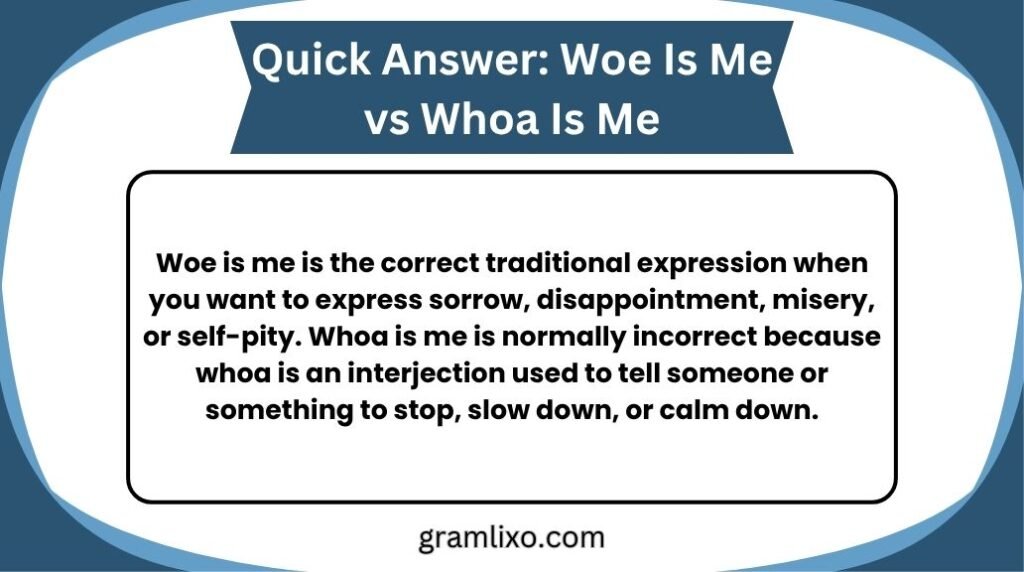
Woe is me is the correct traditional expression when you want to express sorrow, disappointment, misery, or self-pity. Whoa is me is normally incorrect because whoa is an interjection used to tell someone or something to stop, slow down, or calm down.
Correct: Woe is me! I missed the last train.
Incorrect: Whoa is me! I missed the last train.
The easiest way to remember the difference is: woe = sorrow, while whoa = stop or slow down.
Understanding the Basics: Woe Is Me vs Whoa Is Me
The difference becomes easy once you understand the two key words.
What Does “Woe” Mean?
Woe is a noun meaning great sorrow, distress, trouble, or misfortune. It is an old-fashioned or literary word that is still used in certain expressions.
For example:
- The family experienced great woe after the disaster.
- The story is filled with woe and suffering.
- Woe is me! My plans have completely failed.
The word often appears in dramatic or humorous expressions.
What Does “Whoa” Mean?
Whoa is an interjection. It is commonly used to tell someone to stop, slow down, or calm down.
For example:
- Whoa! Slow down.
- Whoa! That horse is moving fast.
- Whoa, that’s a lot of money!
- Whoa! Let’s think about this before making a decision.
Because whoa sounds similar to woe, people sometimes accidentally write whoa is me when they mean woe is me.
Comparison Table
| Form | Type | Meaning | Example | Correct/Incorrect |
|---|---|---|---|---|
| woe | Noun | Sorrow, trouble, or misfortune | Woe followed the family after the accident. | Correct |
| whoa | Interjection | Stop, slow down, or express surprise | Whoa! That’s moving quickly. | Correct |
| woe is me | Traditional expression | I am miserable or unfortunate | Woe is me! I lost my wallet. | Correct |
| whoa is me | Nonstandard/mistaken expression in this meaning | Usually intended to mean “woe is me” | Whoa is me! I failed the test. | Incorrect for this meaning |
The central rule is simple:
Use “woe is me” for sorrow or misfortune. Use “whoa” when you want someone or something to stop, slow down, or pause.
What Does “Woe Is Me” Mean?
Woe is me is an idiomatic expression used to express sadness, distress, disappointment, or self-pity.
In modern English, it can sound dramatic or deliberately exaggerated.
For example:
Woe is me! I forgot my umbrella again.
The speaker is not necessarily experiencing serious suffering. They may simply be joking about an inconvenient situation.
Breaking Down “Woe Is Me”
The expression contains three words:
- Woe = sorrow, trouble, or misfortune
- is = a form of the verb to be
- me = the speaker
The expression literally presents the speaker as being associated with woe or misfortune.
Although the word order may seem unusual to modern English speakers, woe is me is an established expression. It should not be “corrected” to woe am I in ordinary usage.
Examples of “Woe Is Me”
- Woe is me! My favorite restaurant is closed.
- Woe is me! I have three exams this week.
- Woe is me, for I have lost my keys.
- Woe is me! I thought the meeting was tomorrow.
- She jokingly cried, “Woe is me!” after missing dessert.
The expression can be serious, humorous, sarcastic, or theatrical depending on the context.
What Does “Whoa” Mean?
Whoa is an interjection with several related uses.
It can be used when someone wants to:
- Tell a person or animal to stop.
- Tell someone to slow down.
- Express surprise.
- Signal that something is unexpected.
- Ask someone to pause before continuing.
For example:
Whoa! You are walking too fast.
Here, whoa has nothing to do with sadness or misfortune.
Another example:
Whoa! That’s an incredible view.
Here, whoa expresses surprise or amazement.
Why “Whoa Is Me” Causes Confusion
The problem comes from pronunciation.
Woe and whoa are commonly pronounced alike or very similarly. When people hear an expression rather than see it written, they may not know which spelling is intended.
This is especially common with:
- fast speech,
- informal texting,
- voice-to-text software,
- autocorrect,
- unfamiliar idioms.
However, knowing the meaning of the individual words makes the spelling much easier to remember.
Why “Woe Is Me” Is Correct
The expression woe is me uses woe in its traditional sense of sorrow or distress.
The sentence is not using whoa because there is no command to stop or slow down.
Consider these two examples:
Woe is me! I lost my job.
This expresses distress.
Now compare:
Whoa! I lost my job.
This could express surprise, but it does not mean “I am miserable.”
And:
Whoa is me! I lost my job.
This does not work as the traditional expression because whoa does not mean sorrow.
A Useful Meaning Test
Ask yourself:
Am I talking about sadness, trouble, or misfortune?
If the answer is yes, use woe.
Am I telling someone to stop or slow down, or expressing surprise?
If the answer is yes, use whoa.
This simple test solves most woe is me vs whoa is me questions.
The Grammar Behind “Woe Is Me”
At first glance, woe is me may appear grammatically unusual.
Modern English speakers might expect something like:
Woe is I.
That is not the normal expression.
The established idiom is:
Woe is me.
The pronoun me is part of the fixed expression. It should not normally be replaced with I simply because I is the subject pronoun.
The expression has an older, literary structure that has survived in modern English.
This is an important distinction:
Idiomatic English does not always follow the sentence patterns learners might expect from ordinary modern constructions.
For example, English contains many fixed expressions whose structures have historical origins. Their grammatical patterns may feel unusual today, but their conventional forms remain standard.
Is “Woe Is Me” Old-Fashioned?
Yes, woe is me has a somewhat old-fashioned, literary, or dramatic flavor.
That does not make it incorrect.
You may encounter it in:
- literature,
- poetry,
- dramatic dialogue,
- humorous writing,
- theatrical speech,
- historical contexts,
- playful modern conversation.
In everyday professional communication, people often choose simpler alternatives.
Instead of:
Woe is me! The project failed.
A professional email might say:
Unfortunately, the project did not go as planned.
The choice depends on tone and context.
Is “Woe Is Me” Serious or Humorous?
It can be either.
Serious Use
A speaker may use woe is me to express genuine distress.
Woe is me, for everything I built has been lost.
This sounds literary and serious.
Humorous Use
More commonly in casual modern English, the phrase can be deliberately dramatic.
Woe is me! The coffee shop ran out of my favorite pastry.
The situation is not necessarily tragic. The speaker is exaggerating for comic effect.
This playful use is one reason the expression continues to appear in modern conversation and writing.
Correct Meanings and Uses
1. Expressing Misfortune
The most direct use is to describe a difficult or unfortunate situation.
Woe is me! I missed my flight.
Sentence breakdown:
- Woe → trouble or misfortune
- is → connects the subject to the condition
- me → identifies the person experiencing the trouble
The sentence essentially communicates:
“How unfortunate I am!”
2. Expressing Self-Pity
The phrase can also express exaggerated self-pity.
Woe is me! Everyone got ice cream except me.
The speaker may be joking.
3. Creating a Dramatic Tone
Writers can use the expression to make dialogue sound theatrical.
“Woe is me,” she cried dramatically, “for my favorite book is missing!”
This style can be effective in fiction, comedy, or parody.
4. Expressing Disappointment
The expression can describe something disappointing.
Woe is me! The concert has been canceled.
Again, the phrase adds emotional emphasis.
Test Tip: How to Choose Between “Woe” and “Whoa”
Try replacing the word with a definition.
If you can replace it with:
- sorrow,
- misery,
- trouble,
- misfortune,
then woe is the right word.
If you can replace it with:
- stop,
- slow down,
- wait,
- hold on,
- wow,
then whoa is appropriate.
Example
___ is me! I have to work Saturday.
Replace the blank with sorrow/misfortune:
Sorrow is me.
The original expression is therefore:
Woe is me!
Now consider:
___! Don’t drive so fast!
Replace the blank with stop/slow down:
Stop! Don’t drive so fast!
So the correct word is:
Whoa!
Case Study: A Workplace Conversation
Imagine two coworkers discussing a difficult Monday morning.
Alex: I missed my train, spilled coffee on my shirt, and forgot my presentation.
Jordan: Wow. That’s a rough morning.
Alex: Woe is me! I can’t catch a break today.
Here, woe is me works because Alex is humorously expressing frustration and misfortune.
Now imagine a different situation.
Alex: I think we’re moving too quickly with this plan.
Jordan: Whoa! Let’s slow down and review the numbers first.
Here, whoa is correct because Jordan wants everyone to pause.
The two words sound similar, but their meanings are completely different.
Grammar Rules: Why “Whoa Is Me” Is Incorrect in This Context
The primary reason whoa is me is incorrect is semantic rather than simply grammatical.
Woe is a noun associated with sorrow or misfortune.
Whoa is an interjection associated with stopping, slowing down, or surprise.
Standard dictionaries, including Merriam-Webster, distinguish these words by meaning and usage. Merriam-Webster
Therefore:
Woe is me = established expression of distress.
But:
Whoa is me = not the standard expression for distress.
The spelling matters because changing the spelling changes the word and therefore changes the meaning.
A Note About Dictionaries
Dictionaries may document unusual, nonstandard, humorous, or historical usages. Seeing a particular spelling somewhere does not automatically make it the standard choice for a particular meaning.
When writing formal or edited English, use woe is me when you mean the traditional expression of sorrow or misfortune.
Common Mistakes With “Woe Is Me vs Whoa Is Me”
Mistake 1: Writing “Whoa Is Me”
This is the most common error.
❌ Whoa is me! I lost my phone.
✅ Woe is me! I lost my phone.
The intended meaning is sorrow or frustration, so woe is required.
Mistake 2: Thinking “Whoa” Means Sadness
It does not.
Whoa is associated with stopping, slowing down, surprise, or astonishment.
Whoa! That’s a huge dog.
It does not mean:
I am suffering.
Mistake 3: Changing “Woe Is Me” to “Woe Am I”
Because me is an object pronoun, some writers may feel that woe is I or woe am I should be used.
However, the established idiom is:
Woe is me.
Do not alter the expression unnecessarily.
Why These Mistakes Happen
Fast Typing
When people type quickly, they often rely on sound rather than spelling.
Because woe and whoa sound alike, the wrong spelling can easily appear.
Autocorrect
Autocorrect and predictive text may select an unexpected word based on surrounding text.
This is especially possible when the writer is using a phrase they do not frequently type.
Lack of Knowledge
Someone who has heard woe is me but has never seen it written may reasonably assume that it contains whoa.
English contains many homophones and near-homophones, so this kind of confusion is common.
Similar Grammar and Word Confusions
The woe vs whoa problem belongs to a larger group of English word-choice mistakes.
| Confusing Words | Correct Difference |
|---|---|
| its / it’s | Its shows possession; it’s means it is or it has. |
| your / you’re | Your shows possession; you’re means you are. |
| their / there / they’re | Their shows possession; there refers to a place; they’re means they are. |
| to / too / two | To is commonly a preposition or infinitive marker; too means also or excessively; two is the number. |
| then / than | Then relates to time or sequence; than is used for comparisons. |
| accept / except | Accept means receive or agree to; except means excluding. |
| affect / effect | Affect is commonly a verb meaning influence; effect is commonly a noun meaning result. |
| woe / whoa | Woe means sorrow or misfortune; whoa signals stopping, slowing, or surprise. |
Understanding these distinctions improves both accuracy and readability.
Usage in Different Contexts
Everyday Conversation
Woe is me can appear in casual conversation, particularly when someone is being humorous or dramatic.
Woe is me! I have to clean the kitchen tonight.
However, many speakers would simply say:
I’m having such a bad day!
Professional Writing
In professional writing, woe is me can sound overly dramatic unless the context is intentionally humorous.
Instead of:
Woe is me! The deadline was moved.
You might write:
Unfortunately, the deadline was moved.
Professional writing generally benefits from direct and precise language.
Creative Writing
Creative writing is a natural place for woe is me.
A character may use it to sound:
- dramatic,
- humorous,
- theatrical,
- old-fashioned,
- emotional.
For example:
“Woe is me,” he whispered as he stared at the empty cupboard.
The phrase immediately creates a distinctive voice.
Social Media and Texting
On social media, woe is me can be used humorously.
Woe is me 😭 I forgot my headphones.
The exaggerated wording combined with an emoji creates a playful tone.
Meanwhile:
Whoa! 😳 That’s wild.
uses whoa to express surprise.
Woe Is Me vs Whoa Is Me: Pronunciation
Pronunciation is a major reason for the confusion.
In many varieties of English, woe and whoa are homophones or near-homophones. This means they can sound the same or extremely similar even though they have different spellings and meanings.
This is a classic example of why listening alone is not always enough to determine spelling.
Consider:
- woe → sorrow
- whoa → stop/surprise
The sound does not tell you which meaning is intended. The context does.
This is similar to words such as:
- flower and flour
- right and write
- sea and see
English spelling often preserves distinctions that pronunciation does not.
Why It Matters
Correct word choice matters because readers depend on context and spelling to understand exactly what a writer means.
Clarity in Communication
Using woe instead of whoa makes the intended meaning immediately clear.
Professionalism
Although woe is me is usually unsuitable for formal business writing, spelling it correctly still matters when you use it.
Digital Communication
Text messages, social media posts, emails, and online articles are often read quickly. A small spelling mistake can change the meaning of a sentence.
Writing Accuracy
Correct word choice demonstrates control over vocabulary and helps readers trust the rest of your writing.
A useful principle is:
When two words sound alike, let meaning—not sound—guide your spelling.
Special Exception and Edge Cases
There is no standard grammatical exception that makes whoa is me equivalent to woe is me.
However, whoa is me could potentially appear intentionally in creative writing as a pun, joke, title, character name, or playful alteration.
For example, a comedian might deliberately write:
“Whoa Is Me!”
as a humorous play on “Woe Is Me.”
In such a case, the unusual spelling is intentional. It is not being used as the standard expression.
This distinction is important:
- Standard expression: Woe is me.
- Creative wordplay: Whoa is me.
If you are writing ordinary English and want to express sorrow or misfortune, choose woe is me.
Quick Recap Checklist
| Question | If Yes → Use |
|---|---|
| Are you expressing sorrow or misfortune? | Woe |
| Are you expressing self-pity? | Woe |
| Are you using the traditional expression? | Woe is me |
| Are you telling someone to stop? | Whoa |
| Are you telling someone to slow down? | Whoa |
| Are you expressing surprise? | Whoa |
| Are you intentionally making a pun? | Whoa may work creatively |
Practice Examples
1. ___ is me! I forgot my lunch at home.
Correct: Woe is me!
The sentence expresses frustration or misfortune.
2. ___! Slow down!
Correct: Whoa!
The speaker wants someone to slow down.
3. She jokingly said, “___ is me!” after discovering the bakery was closed.
Correct: Woe is me!
The expression communicates humorous disappointment.
FAQs About Woe Is Me vs Whoa Is Me
1. Is “woe is me” correct?
Yes. Woe is me is a standard, established English expression used to express sorrow, distress, misfortune, or exaggerated self-pity.
2. Is “whoa is me” grammatically correct?
Not when you intend the traditional expression meaning “I am unfortunate” or “I am miserable.” In that context, the standard form is woe is me.
3. What does “woe” mean?
Woe is a noun meaning great sorrow, distress, trouble, or misfortune. It is commonly encountered in literary language and expressions such as woe is me.
4. What does “whoa” mean?
Whoa is an interjection used to tell someone or something to stop or slow down. It can also express surprise, astonishment, or the need to pause.
5. Why do people confuse “woe” and “whoa”?
The words are pronounced alike or very similarly in many varieties of English. Because they sound the same, people can confuse their spellings when writing from memory.
6. Can “whoa is me” ever be used?
Yes, but generally only as intentional wordplay, humor, or a creative alteration of woe is me. It is not the standard expression for sadness or misfortune.
Conclusion
The difference between woe is me vs whoa is me becomes simple once you remember what each word means. Woe means sorrow, trouble, or misfortune, so woe is me is the established expression for expressing distress, disappointment, or humorous self-pity. Whoa, on the other hand, is an interjection used to tell someone to stop or slow down or to express surprise.
Although the two words sound very similar, their meanings are completely different. That is why spelling matters. If you are talking about an unfortunate situation, choose woe. If you want someone to stop, slow down, or pause, choose whoa.
Remember this simple rule: Woe means trouble; whoa means stop. Once you connect each spelling with its meaning, you will never have to second-guess woe is me again.

I’m Michael Williams, an English writer and grammar enthusiast at Gramlixo. I’m passionate about making grammar easier to learn and helping readers write with greater confidence.


[…] |Woe Is Me vs Whoa Is Me: Which One Is Correct? […]