Have you ever wondered whether to use adapt vs adopt when writing an email, completing an assignment, or having a professional conversation? These two words look and sound similar, but they have different meanings.
Choosing the wrong one can change the meaning of your sentence and confuse your readers. Understanding the difference between adapt and adopt is easier than you might think once you learn what each word expresses.
The word adapt means to change something or adjust to a new situation. In contrast, adopt means to accept, choose, or take something as your own. For example, you adapt to a new work environment, but you adopt a new company policy. Both words are commonly used in American English, everyday conversations, business communication, and academic writing.
In this guide, I will explain the difference between adapt and adopt with simple definitions, practical examples, grammar rules, common mistakes, and helpful exercises. By the end, you will know exactly when to use each word.
|Who vs Whom: What’s the Difference and How to Use Them Correctly?
|Adapter vs Adaptor: What’s the Difference?
|Presence vs Presense: Which Spelling Is Correct?
Quick Answer: Adapt vs Adopt
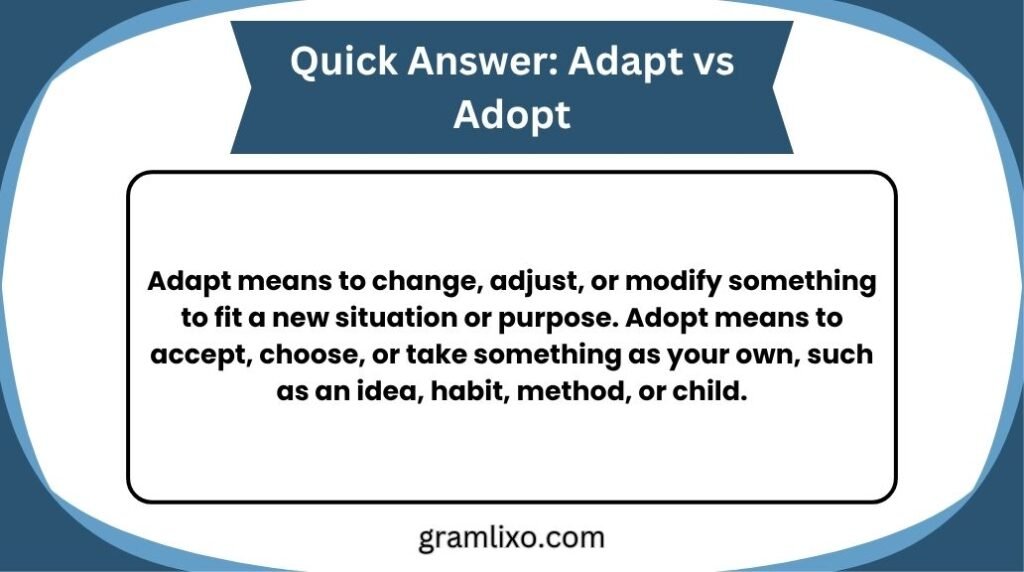
Adapt means to change, adjust, or modify something to fit a new situation or purpose. Adopt means to accept, choose, or take something as your own, such as an idea, habit, method, or child.
- Adapt: You adapt to changes in your workplace.
- Adopt: You adopt a new strategy to improve your workplace.
Easy way to remember: Adapt means adjust; adopt means accept.
Understanding the Basics of Adapt vs Adopt
The main difference between adapt and adopt is the action each word describes. Although they contain similar letters, they are not interchangeable.
When you adapt something, you make changes so it works better in a particular situation. When you adopt something, you decide to accept or use it.
For example:
- The company adapted its website for mobile users.
- The company adopted a new marketing strategy.
In the first sentence, the company changed its website to make it suitable for mobile devices. In the second sentence, the company decided to start using a different marketing strategy.
Adapt vs Adopt Comparison Table
| Form | Type | Meaning | Example | Correct/Incorrect |
|---|---|---|---|---|
| Adapt | Verb | To change or adjust | We adapted to the new schedule. | Correct |
| Adopt | Verb | To accept or take up | We adopted a new schedule. | Correct |
| Adapt | Verb | To modify something | She adapted the lesson for children. | Correct |
| Adopt | Verb | To accept an idea | He adopted her suggestion. | Correct |
| Adapted | Past tense | Changed or adjusted | They adapted quickly. | Correct |
| Adopted | Past tense | Accepted or took as one’s own | They adopted a new policy. | Correct |
| Adapting | Present participle | Making adjustments | We are adapting to change. | Correct |
| Adopting | Present participle | Accepting or choosing | We are adopting new methods. | Correct |
The Simplest Way to Understand the Difference
Think about two everyday situations.
Situation 1: Moving to a new country
When someone moves to another country, they may need to learn a different language, understand new customs, and adjust to a different lifestyle.
They must adapt to their new environment.
Situation 2: Choosing a new lifestyle
Suppose someone decides to follow a healthier lifestyle by exercising regularly and eating nutritious food.
They adopt healthier habits.
Remember these two ideas:
- Adapt = Make changes to fit something.
- Adopt = Accept or begin using something.
Correct Meanings and Uses of Adapt
The verb adapt has several meanings depending on the context. It generally describes making changes, adjusting to circumstances, or modifying something for a particular purpose.
Let’s explore its most common uses.
1. Adapt Means to Adjust to a New Situation
The most common meaning of adapt is to become comfortable with a new environment, condition, or situation.
People adapt when their circumstances change.
Examples:
- Children adapt quickly to new schools.
- I had to adapt to my new working hours.
- Employees must adapt to changes in the workplace.
- She adapted well to living in another country.
- Animals adapt to different environmental conditions.
Sentence breakdown:
Consider this sentence:
“The new employee adapted quickly to the company culture.”
- Subject: The new employee
- Verb: Adapted
- Adverb: Quickly
- Prepositional phrase: To the company culture
The sentence explains that the employee adjusted successfully to the company’s working environment.
2. Adapt Means to Modify or Change Something
Adapt can also mean changing something to make it more suitable for a particular purpose.
This usage is common in education, business, technology, and everyday communication.
Examples:
- The teacher adapted the lesson for younger students.
- We adapted the original plan to meet our needs.
- The company adapted its services for international customers.
- She adapted the recipe to make it healthier.
- The designer adapted the website for mobile devices.
Sentence breakdown:
“The author adapted the story for television.”
- Subject: The author
- Verb: Adapted
- Object: The story
- Purpose: For television
The author changed the original story so it could work as a television production.
3. Adapt Means to Change Your Behavior
Sometimes, adapting involves changing your behavior, attitude, or approach to deal with a particular situation.
Examples:
- You must adapt your communication style to your audience.
- He adapted his teaching methods to help struggling students.
- Successful leaders adapt their management styles.
- We need to adapt our expectations to reality.
- She adapted her behavior to the professional environment.
In these examples, adapt describes making personal or behavioral adjustments.
4. Adapt Means to Create a New Version of Something
In literature, entertainment, and media, adapt often means transforming an existing work into another format.
For example, a novel can be adapted into a movie, a play, or a television series.
Examples:
- The director adapted the novel into a movie.
- The popular book was adapted for television.
- The studio adapted the comic book into an animated series.
- The playwright adapted the historical story for the stage.
- The film was adapted from a bestselling novel.
Important grammar note: The expression “adapted from” identifies the original source of a new version.
For example:
“The movie was adapted from a famous novel.”
This means the movie was based on that novel.
5. Adapt Means to Respond to Changing Conditions
Adapt is also frequently used when discussing businesses, technology, nature, and society.
It describes the ability to respond effectively when circumstances change.
Examples:
- Businesses must adapt to changing customer expectations.
- Plants adapt to different environmental conditions.
- Technology companies adapt to new market demands.
- Workers need to adapt to modern technology.
- Communities adapt to changing economic conditions.
This meaning is particularly useful in professional and academic writing.
Correct Meanings and Uses of Adopt
The verb adopt has a different meaning. It generally refers to accepting, choosing, or taking something as your own.
It is used when someone makes a decision to accept something or begin using it.
1. Adopt Means to Accept an Idea or Belief
One common use of adopt is accepting an idea, opinion, belief, or principle.
When someone adopts an idea, they decide that it is worth accepting or following.
Examples:
- She adopted a positive attitude toward life.
- The manager adopted my suggestion.
- Many people adopt different beliefs as they grow older.
- He adopted a practical approach to the problem.
- The organization adopted new principles.
Sentence breakdown:
“The manager adopted a new business strategy.”
- Subject: The manager
- Verb: Adopted
- Object: A new business strategy
The manager decided to accept and use the strategy.
2. Adopt Means to Take a Child Into Your Family
Another important meaning of adopt is legally taking responsibility for a child and becoming their parent.
Adoption creates a legal parent-child relationship.
Examples:
- They decided to adopt a child.
- My neighbors adopted two children.
- The couple hopes to adopt a baby next year.
- She was adopted when she was three years old.
- Many families choose to adopt children.
This meaning is commonly used in family discussions, legal documents, and social services.
Important distinction:
- Adopt a child = Legally become the child’s parent.
- Adapt to a child = Adjust your behavior or lifestyle to meet the child’s needs.
These expressions describe two completely different actions.
3. Adopt Means to Start Using a Method or Practice
Adopt is frequently used when individuals, companies, or organizations decide to begin using a particular method, system, or practice.
Examples:
- The company adopted a flexible working policy.
- Schools are adopting modern teaching methods.
- We adopted a new approach to customer service.
- The organization adopted stricter safety standards.
- Many businesses have adopted digital payment systems.
Sentence breakdown:
“Our school adopted a new learning system.”
- Subject: Our school
- Verb: Adopted
- Object: A new learning system
The school decided to begin using the new system.
4. Adopt Means to Officially Approve Something
In formal and legal contexts, adopt can mean officially accepting or approving a proposal, resolution, policy, or recommendation.
Examples:
- The committee adopted the proposed resolution.
- The board adopted the new company policy.
- The government adopted additional safety regulations.
- The organization adopted a formal code of conduct.
- The council adopted the proposed budget.
This meaning is especially common in government, business, and organizational communication.
5. Adopt Means to Take on a Particular Attitude or Style
Adopt can also describe choosing a particular appearance, attitude, position, or way of behaving.
Examples:
- He adopted a friendly attitude toward everyone.
- She adopted a professional appearance for the interview.
- The speaker adopted a confident tone.
- They adopted a cautious approach to the investment.
- The team adopted a more positive mindset.
In these sentences, adopt describes deliberately choosing a particular way of acting or presenting yourself.
Adapt vs Adopt: Important Differences in Everyday Examples
Understanding definitions is helpful, but comparing complete sentences makes the difference even clearer.
| Adapt Sentence | Adopt Sentence |
|---|---|
| We adapted to the new environment. | We adopted a new lifestyle. |
| She adapted the lesson for children. | She adopted a new teaching method. |
| The company adapted its website. | The company adopted new technology. |
| He adapted his behavior. | He adopted a positive attitude. |
| The director adapted the novel. | The organization adopted a new policy. |
| Animals adapt to their surroundings. | Families adopt children. |
Notice that adapt usually involves adjustment or modification, while adopt involves acceptance or choosing something.
Case Study: Adapt vs Adopt in a Workplace Situation
Let’s understand the difference through a realistic workplace example.
Imagine that a company introduces a new digital project management system. Employees must learn how to use it, and management wants everyone to follow a new workflow.
The manager sends the following email:
Workplace Email Example
Subject: Introducing Our New Project Management System
Hello Team,
Starting next Monday, we will adopt a new project management system to improve communication and organize our daily tasks.
During the first few weeks, everyone will need to adapt to the new platform and become familiar with its features.
We understand that changing established routines can be challenging. Therefore, our training team will provide support to help employees adapt comfortably.
Thank you for your cooperation.
Best regards, Management Team
Why Are Both Words Correct?
Let’s examine how each word works in the email.
“We will adopt a new project management system.”
The company is choosing to accept and begin using a new system. Therefore, adopt is correct.
“Everyone will need to adapt to the new platform.”
Employees must adjust to the new technology. Therefore, adapt is correct.
“Help employees adapt comfortably.”
The company wants employees to become familiar with the new working environment. Again, adapt is correct.
What Happens If You Switch the Words?
Consider these incorrect alternatives:
- Incorrect: We will adapt a new project management system.
- Correct: We will adopt a new project management system.
- Incorrect: Employees must adopt to the new platform.
- Correct: Employees must adapt to the new platform.
The first incorrect sentence suggests modifying a system without explaining what changes are being made. The second uses adopt with the wrong grammatical construction.
This example shows why choosing the correct word matters in professional communication.
Grammar Rules: Why Adapt and Adopt Are Different
Adapt and adopt are both verbs, but their meanings and grammatical patterns are different.
Understanding their sentence structures will help you avoid common mistakes.
Rule 1: Use Adapt With To When Describing Adjustment
The expression adapt to is commonly used when someone or something adjusts to a new situation, condition, or environment.
Examples:
- Children adapt to new surroundings.
- Employees adapt to workplace changes.
- I am adapting to my new schedule.
- She quickly adapted to city life.
Basic structure:
Subject + adapt + to + situation
Example:
“Students must adapt to new learning methods.”
Here, the students are adjusting to different methods of learning.
Rule 2: Use Adapt Something When Modifying It
Adapt can also take a direct object when you change or modify something.
Examples:
- We adapted the original design.
- The teacher adapted the assignment.
- She adapted the recipe.
- The company adapted its services.
Basic structure:
Subject + adapt + object
Example:
“The designer adapted the logo.”
The designer made changes to the original logo.
Rule 3: Use Adopt Something When Accepting It
Adopt generally takes a direct object when someone accepts, chooses, or begins using something.
Examples:
- They adopted a new policy.
- She adopted a healthier lifestyle.
- The company adopted new technology.
- He adopted a different approach.
Basic structure:
Subject + adopt + object
Example:
“The school adopted a new curriculum.”
The school officially accepted and began using the curriculum.
Rule 4: Adopt Does Not Normally Use To for Acceptance
A common grammatical mistake is writing “adopt to” when the intended meaning is adjusting to something.
Remember:
- Incorrect: I adopted to the new environment.
- Correct: I adapted to the new environment.
However, adopt can appear before a to-infinitive in a different grammatical structure.
For example:
“The organization adopted a plan to improve customer service.”
Here, “to improve” expresses the purpose of the plan. It is not the preposition in “adapt to.”
Rule 5: Both Words Have Different Noun Forms
The related nouns also have different meanings.
| Word | Noun Form | Meaning | Example |
|---|---|---|---|
| Adapt | Adaptation | The process of adjusting or modifying | The adaptation took several months. |
| Adopt | Adoption | The act of accepting or legally taking something as one’s own | The adoption was completed successfully. |
| Adapt | Adaptability | The ability to adjust to change | Adaptability is important at work. |
| Adopt | Adopter | A person or organization that adopts something | Early adopters often try new technology. |
What Do Grammar Authorities Say?
Standard dictionaries distinguish these words by meaning.
- Merriam-Webster defines adapt in terms of making something suitable through modification or adjusting to new conditions.
- Cambridge Dictionary explains adopt through meanings such as taking something up, accepting an idea, or legally taking a child into a family.
- Oxford English Dictionary documents the established meanings and historical usage of both verbs.
The important grammar lesson is that similar spelling does not make two words interchangeable. Their meanings determine which word belongs in a sentence.
Common Mistakes When Using Adapt vs Adopt
Many English learners and even native speakers occasionally confuse adapt and adopt.
This usually happens because the words look similar, have similar pronunciations, and often appear in similar contexts.
Let’s examine the most common mistakes.
Mistake 1: Using Adopt Instead of Adapt
Incorrect: She adopted to her new school quickly.
Correct: She adapted to her new school quickly.
Why?
The sentence describes adjusting to a new environment. Adapt is the correct choice.
Mistake 2: Using Adapt Instead of Adopt
Incorrect: The company adapted a new policy.
Correct: The company adopted a new policy.
Why?
The company accepted and began following a policy. It did not necessarily modify an existing one.
Mistake 3: Confusing Adopt With Modify
Incorrect: We adopted the old design to fit the new requirements.
This sentence is not necessarily grammatically wrong, but it may be unclear if the intended meaning is that the design was changed.
Better: We adapted the old design to fit the new requirements.
Why?
Adapt clearly communicates that changes were made to the existing design.
Mistake 4: Forgetting the Correct Preposition
Incorrect: He adopted to the changes in his workplace.
Correct: He adapted to the changes in his workplace.
Why?
The correct expression for adjusting to something is adapt to.
Mistake 5: Confusing the Past Tense Forms
Both verbs are regular, but their past forms have different spellings.
- Adapt → Adapted
- Adopt → Adopted
Examples:
- We adapted our strategy.
- We adopted a new strategy.
The spelling changes only slightly, but the meanings remain different.
Why Do These Mistakes Happen?
Several everyday factors contribute to confusion.
1. Fast typing
People often type quickly without checking whether the word matches the intended meaning.
2. Autocorrect
Some keyboards may suggest an incorrect word because adapt and adopt have similar spelling patterns.
3. Lack of knowledge
Writers who have not learned the difference may assume that both words mean changing something.
4. Similar pronunciation
Their pronunciation is similar enough to cause occasional confusion, especially for English learners.
5. Limited proofreading
Writers may focus on spelling and punctuation without checking whether a word communicates the correct meaning.
Other Commonly Confused English Words
Adapt vs adopt is not the only confusing word pair in English.
| Word Pair | Difference | Example |
|---|---|---|
| It’s vs Its | It’s means it is; its shows possession. | It’s raining. The dog wagged its tail. |
| Your vs You’re | Your shows possession; you’re means you are. | Your book is here. You’re welcome. |
| Affect vs Effect | Affect is usually a verb; effect is usually a noun. | Sleep affects mood. The effect was noticeable. |
| Accept vs Except | Accept means receive; except means excluding. | I accept the offer. Everyone came except John. |
| Advice vs Advise | Advice is a noun; advise is a verb. | She gave me advice. I advise caution. |
| Lose vs Loose | Lose means misplace or fail to win; loose means not tight. | Don’t lose your keys. This shirt is loose. |
| Principal vs Principle | Principal can mean a school leader or something primary; principle means a rule or belief. | The principal explained the principle. |
| Adapt vs Adopt | Adapt means adjust; adopt means accept or take up. | Adapt to change. Adopt a new method. |
Learning these differences can improve your overall English grammar and writing accuracy.
Adapt vs Adopt in Different Contexts
Both words are useful in everyday English, but their meanings depend on the situation.
Let’s explore how they work in different communication styles.
1. Everyday Conversation
In daily conversations, adapt usually describes adjusting to a new experience, while adopt often describes choosing a habit or behavior.
Adapt examples:
- I’m still adapting to my new neighborhood.
- It takes time to adapt to cold weather.
- She adapted quickly to her new routine.
- We need to adapt to the situation.
Adopt examples:
- I adopted a healthier eating habit.
- They adopted a dog from a shelter.
- He adopted a positive attitude.
- We adopted a new family tradition.
2. Professional Writing
Business communication frequently uses both words.
Adapt is useful when discussing changes in strategy, customer expectations, or working conditions.
Adopt is useful when discussing policies, systems, procedures, and business practices.
Adapt examples:
- Our company must adapt to changing market conditions.
- The marketing team adapted its strategy.
- Employees should adapt to new technologies.
Adopt examples:
- Management adopted a new employee policy.
- The organization adopted updated security standards.
- Our department adopted a more efficient workflow.
3. Academic Writing
In academic writing, adapt is commonly used when discussing adjustments, modifications, or responses to environmental and social changes.
Adopt often appears when discussing theories, approaches, methods, and research positions.
Adapt examples:
- Researchers adapted the questionnaire for younger participants.
- Species adapt to environmental pressures.
- The study adapted an existing research framework.
Adopt examples:
- The researchers adopted a qualitative approach.
- The university adopted new academic guidelines.
- The author adopted a different theoretical perspective.
4. Creative Writing
Writers can use both words to communicate different ideas.
Adapt helps describe characters responding to challenges or stories transformed into new formats.
Adopt helps describe characters accepting new beliefs, identities, or behaviors.
Adapt examples:
- The hero learned to adapt to an unfamiliar world.
- The filmmaker adapted the story into a screenplay.
- She adapted her plans after the unexpected discovery.
Adopt examples:
- The character adopted a mysterious identity.
- He adopted the customs of the village.
- The family adopted an abandoned puppy.
5. Social Media and Texting
On social media, both words appear in captions, posts, comments, and messages.
Adapt examples:
- Learning to adapt is part of growing.
- Adapt your mindset and embrace change.
- We all adapt differently to new experiences.
Adopt examples:
- Adopt kindness every day.
- Adopt better habits and improve your life.
- Choose to adopt a positive mindset.
Even in informal communication, choosing the correct word makes your message easier to understand.
Why the Difference Between Adapt and Adopt Matters
Understanding adapt vs adopt may seem like a small grammar lesson, but using the correct word can make a meaningful difference in communication.
Here are some important reasons to learn this distinction.
1. Clarity in Communication
The wrong word can change the meaning of a sentence.
For example:
- Adapt a new policy.
- Adopt a new policy.
The second expression clearly communicates accepting and implementing a policy.
Using the right word helps readers understand your actual intention without guessing.
2. Professionalism
Professional writing requires accurate vocabulary.
Whether you are preparing a business email, workplace report, proposal, or presentation, correct word choice helps create a positive impression.
For example:
“The company adopted a new strategy to adapt to changing customer needs.”
This sentence uses both words correctly and communicates two related but different actions.
3. Better Writing Accuracy
Learning the difference improves your vocabulary and helps you write more confidently.
It also makes proofreading easier because you can recognize when a word does not fit its context.
4. Clear Digital Communication
Emails, online articles, social media posts, and business messages often require quick and direct communication.
Using adapt and adopt correctly prevents misunderstandings and makes digital writing more effective.
A Short Quote to Remember
“Adapt to change. Adopt what makes you better.”
This simple reminder captures the difference between the two verbs.
Special Cases and Interesting Usage Notes
Although adapt and adopt have distinct meanings, some situations require extra attention.
1. Adapt Can Be Used With a Direct Object
Many learners think adapt must always be followed by to. That is incorrect.
Adapt can be transitive, meaning it can take a direct object.
Examples:
- She adapted the story.
- We adapted our business model.
- The teacher adapted the lesson.
It can also be intransitive when describing adjustment.
Examples:
- Children adapt quickly.
- Employees adapt to change.
- Animals adapt to their environment.
2. Adopt Can Describe an Idea Without Legal Approval
Adopt does not always mean formally approving something through a legal process.
It can also describe an individual’s personal decision.
Examples:
- I adopted a healthier lifestyle.
- She adopted a positive mindset.
- He adopted a new way of thinking.
The meaning depends on the context.
3. Adaptation and Adoption Are Different
These two nouns are also frequently confused.
Adaptation refers to a change or adjustment that makes something suitable for a particular purpose.
Example: The adaptation of the novel was successful.
Adoption refers to accepting or taking something as your own.
Example: The adoption of the new policy improved workplace organization.
4. Adapt and Adopt Can Appear in the Same Sentence
Both verbs can be used together because they describe different actions.
Examples:
- We adopted a new strategy to adapt to market changes.
- The school adopted new technology to help students adapt to modern learning.
- She adopted a healthier lifestyle and adapted her daily routine.
There is no contradiction because one action involves acceptance, while the other involves adjustment.
5. Adaptation Is Also Used in Biology
In biology, adaptation refers to a characteristic or process that helps an organism survive or reproduce in its environment.
Example:
“Camels have adaptations that help them survive in desert environments.”
Adopt, on the other hand, is not normally used to describe biological adaptations in this sense.
Quick Recap Checklist: Adapt vs Adopt
Use the following checklist whenever you are unsure which word belongs in your sentence.
| Question | If Yes → Use |
|---|---|
| Are you adjusting to a new situation? | Adapt |
| Are you changing something to make it suitable? | Adapt |
| Are you modifying an existing design? | Adapt |
| Are you accepting a new idea? | Adopt |
| Are you beginning to use a new method? | Adopt |
| Are you legally taking a child into your family? | Adopt |
| Are you officially approving a policy? | Adopt |
| Are you choosing a new attitude or approach? | Adopt |
Three Simple Practice Examples
Test your understanding with these sentences.
Example 1:
The new employee had to _____ to the company’s working environment.
- A. Adapt
- B. Adopt
Correct answer: A. Adapt
Explanation: The employee needs to adjust to a new environment. Therefore, adapt is correct.
Example 2:
The school decided to _____ a new teaching method.
- A. Adapt
- B. Adopt
Correct answer: B. Adopt
Explanation: The school is choosing to begin using a new method. Therefore, adopt is correct.
Example 3:
The director plans to _____ the famous novel into a movie.
- A. Adapt
- B. Adopt
Correct answer: A. Adapt
Explanation: The director will transform the novel into a different format. Therefore, adapt is correct.
Frequently Asked Questions (FAQs)
Here are answers to common questions about adapt vs adopt.
1. What Is the Main Difference Between Adapt and Adopt?
The main difference is that adapt means to adjust or modify something, while adopt means to accept, choose, or take something as your own.
For example, you adapt to a new environment but adopt a new lifestyle.
2. Is It Adapt to or Adopt to?
The correct expression for adjusting to a situation is adapt to.
Example: “She needs time to adapt to her new job.”
Adopt usually takes a direct object when expressing acceptance.
Example: “She decided to adopt a new working method.”
3. Can Adapt and Adopt Be Used Interchangeably?
No. Adapt and adopt have different meanings and cannot normally replace each other.
Adapt describes adjustment or modification, while adopt describes acceptance or choosing something.
For example, “adapt to a new environment” is correct, while “adopt to a new environment” is incorrect when adjustment is intended.
4. What Is an Example of Adapt and Adopt in One Sentence?
Here is a correct example:
“The company adopted a new business strategy to adapt to changing market conditions.”
In this sentence, adopted means the company accepted a new strategy, while adapt means responding to changes in the market.
5. What Are the Past Tense Forms of Adapt and Adopt?
Both verbs use the regular -ed ending.
- Adapt → Adapted
- Adopt → Adopted
Examples:
- We adapted to the new schedule.
- We adopted a new schedule.
Although the spelling is similar, their meanings remain different.
6. What Are the Nouns of Adapt and Adopt?
The main noun forms are adaptation and adoption.
- Adaptation means a change or adjustment that makes something suitable.
- Adoption means accepting or taking something as your own, or legally becoming the parent of a child.
Example: “The adaptation was successful, and the adoption of the new policy followed shortly afterward.”
Conclusion: Adapt vs Adopt
Understanding the difference between adapt vs adopt is essential for clear and accurate English writing. Although these words look and sound similar, they communicate different actions.
Adapt means to adjust, change, or modify something to fit a new situation or purpose. Adopt means to accept, choose, or begin using something as your own. You adapt to a new environment, adapt a story into a movie, adopt a healthier lifestyle, and adopt a new company policy.
The easiest way to remember the distinction is to associate adapt with adjustment and adopt with acceptance. Whenever you write one of these words, consider what you are trying to communicate. Are you making an adjustment, or are you accepting something new?
With regular practice and attention to context, you can use both words confidently in everyday conversations, professional emails, academic assignments, and online content.
Remember: Adapt when you need to adjust, and adopt when you decide to accept.

I’m Sarah Martinez, a writer and English language enthusiast at Gramlixo. I love explaining grammar concepts in a clear and practical way that anyone can understand.
[…] |Adapt vs Adopt: Meaning, Difference, Grammar Rules, and Examples […]