
Grateful vs Greateful is a common English spelling confusion that many students, writers, and professionals face.
If you want to express thankfulness or appreciation, you may wonder which spelling is correct. The answer is simple: grateful is the correct spelling, while greateful is incorrect.
In this guide, I will explain the difference between grateful vs greateful, share clear examples, and help you remember the correct spelling.
Whether you are writing a school assignment, a professional email, or a social media post, understanding this simple rule will help you write confidently and avoid common spelling mistakes.
|Heros vs Heroes: Which Spelling Is Correct?
|Appreciate It vs Appreciated It: Meaning, Difference, and Correct Usage
|Ourselves vs Ourself: What’s the Difference and Which Is Correct?
Quick Answer: Grateful vs Greateful
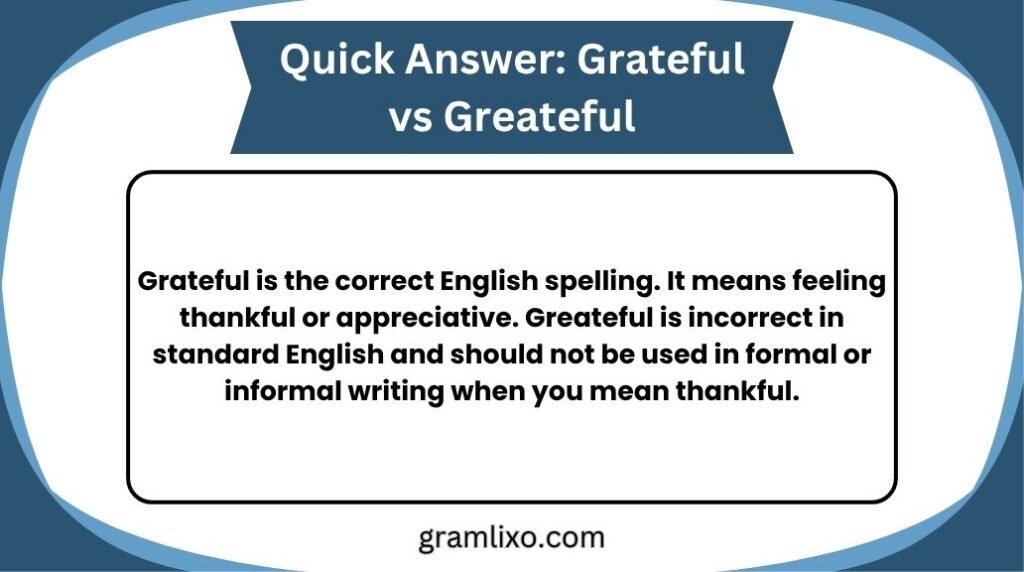
Grateful is the correct English spelling. It means feeling thankful or appreciative. Greateful is incorrect in standard English and should not be used in formal or informal writing when you mean thankful.
Examples:
- Correct: I am grateful for your help.
- Incorrect: I am greateful for your help.
- Correct: We are grateful for this opportunity.
Easy rule: If you mean thankful, always write grateful, without an extra “e.”
Understanding the Basics of Grateful vs Greateful
The confusion between grateful and greateful usually comes from the word great. Since great is a familiar English word, writers sometimes mistakenly add its spelling to grateful. However, the two words have different meanings and spelling patterns.
The word grateful describes appreciation. You might feel grateful when someone helps you, when you receive a thoughtful gift, or when you recognize something positive in your life.
The word greateful, on the other hand, is not the standard spelling of this adjective. Although readers may understand what you mean, the extra “e” makes the word incorrect.
Comparison Table: Grateful vs Greateful
| Form | Type | Meaning | Example | Correct/Incorrect |
|---|---|---|---|---|
| Grateful | Adjective | Feeling thankful or appreciative | I am grateful for your support. | Correct |
| Greateful | Misspelling | Intended to mean thankful | I am greateful for your support. | Incorrect |
| Gratitude | Noun | The feeling of being thankful | She expressed her gratitude. | Correct |
| Gratefully | Adverb | In a thankful manner | He gratefully accepted the offer. | Correct |
| Gratefulness | Noun | The quality of feeling grateful | Her gratefulness was sincere. | Correct |
Why Do People Confuse These Spellings?
There are several reasons people write greateful instead of grateful.
- Association with “great”: Writers may assume that grateful comes directly from the word great.
- Pronunciation confusion: The similar opening sounds can make the spelling less obvious.
- Typing habits: People sometimes type quickly without checking each word.
- Autocorrect limitations: A spelling tool may not flag every error in every context.
- Limited vocabulary practice: Someone who has seen the word more often than they have written it may remember its sound but not its exact spelling.
The best solution is to learn the correct spelling as a complete word rather than trying to build it from great.
Correct Meanings and Uses of Grateful
Understanding the meaning of grateful makes it easier to use the word correctly. Although it is most commonly associated with saying thank you, it can express appreciation in several situations.
1. Grateful Means Feeling Thankful
The most common meaning of grateful is feeling thankful because someone has helped you, given you something, or done something kind.
Examples:
- I am grateful for your kindness.
- She was grateful for the help she received.
- We are grateful for your generous support.
- He felt grateful when his friends visited him.
Sentence breakdown:
Consider this sentence:
I am grateful for your kindness.
- I: The person expressing the feeling.
- Am: The linking verb connecting the subject to the adjective.
- Grateful: The adjective describing the person’s feeling.
- For your kindness: The phrase explaining the reason for the appreciation.
Here, grateful describes an emotional response to someone’s kindness.
Notice that we say grateful for your kindness, not greateful for your kindness.
2. Grateful Can Express Appreciation for an Opportunity
You can also use grateful when someone gives you a chance to learn, grow, work, or achieve something important.
Examples:
- I am grateful for the opportunity to work with your team.
- She is grateful for the chance to continue her education.
- We are grateful to be part of this project.
- He was grateful for the opportunity to share his ideas.
In these sentences, the appreciation is not necessarily about receiving a physical gift. It is about recognizing the value of an experience or opportunity.
Sentence breakdown:
I am grateful for the opportunity to learn.
The word grateful expresses appreciation, while for the opportunity to learn identifies what the speaker appreciates.
This usage is especially common in job interviews, scholarship applications, business communications, and professional introductions.
3. Grateful Can Describe Appreciation for People
Sometimes, you want to tell someone that their presence, support, or relationship means a lot to you.
Examples:
- I am grateful to have you in my life.
- We are grateful to have such wonderful friends.
- She is grateful to her parents for their guidance.
- I will always be grateful to the people who believed in me.
Two common patterns are worth remembering:
- Grateful to someone: Identifies the person you appreciate.
- Grateful for something: Identifies the reason for your appreciation.
For example:
I am grateful to my teacher for her guidance.
Here, to my teacher identifies the person receiving the appreciation, while for her guidance explains why the speaker feels grateful.
Both parts work together to communicate the message clearly.
4. Grateful Can Express Appreciation for Life Experiences
The word grateful can also describe appreciation for experiences, achievements, relationships, and everyday moments.
Examples:
- I am grateful for the lessons I learned from my mistakes.
- She feels grateful for the time she spends with her family.
- We are grateful for another opportunity to succeed.
- He is grateful for the memories he has created.
This meaning is common in personal reflections, journals, inspirational writing, and conversations about life.
For instance, someone might say, I am grateful for the challenges that helped me grow.
The sentence does not mean that every challenge was pleasant. Instead, it expresses appreciation for the lessons that came from those experiences.
5. Grateful Can Describe a Polite Response
In everyday English, grateful can also help you communicate appreciation politely.
Examples:
- I would be grateful if you could send me the report.
- We would be grateful for an update by Friday.
- I would be grateful for your advice.
- The team would be grateful if you could confirm your availability.
In these examples, the word appears in a polite request.
Compare these sentences:
- Direct: Please send me the report.
- Polite: I would be grateful if you could send me the report.
Both sentences communicate a request, but the second emphasizes appreciation and may sound more courteous in a professional setting.
However, the phrase should not be used to disguise an unreasonable demand. Polite language works best when the request itself is respectful.
Test Tip: How to Check the Spelling
Whenever you are unsure about grateful vs greateful, ask yourself:
Am I trying to express thankfulness or appreciation?
If the answer is yes, write grateful.
You can also remember this short sentence:
I am grateful, not greateful.
Repeat it a few times, and the correct spelling will become easier to recall.
Grateful vs Greateful: A Real-Life Case Study
Imagine that Maya has recently started a new job. Her manager has helped her learn the company’s software, introduced her to the team, and answered her questions during the first week.
Maya wants to send a thank-you email to express her appreciation.
Example 1: Incorrect Email
Hi Sarah,
I am greateful for all the help you have given me during my first week. Your guidance has made it much easier for me to understand my responsibilities.
Thank you for being so supportive.
Best regards,
Maya
The email communicates Maya’s appreciation, but greateful is misspelled. The error does not change the intended meaning, yet it can make the message look less carefully proofread.
Example 2: Correct Email
Hi Sarah,
I am grateful for all the help you have given me during my first week. Your guidance has made it much easier for me to understand my responsibilities.
Thank you for being so supportive.
Best regards,
Maya
This version uses the correct spelling and preserves the warm, professional tone.
What Can We Learn from This Example?
The difference between the two emails is only one letter, but accurate spelling contributes to a polished message.
When writing professional emails, take a moment to check:
- Spelling and punctuation.
- Names and job titles.
- The clarity of your message.
- Whether your tone suits the situation.
- Whether the words communicate what you intend.
You do not need complicated vocabulary to sound professional. Simple, correctly spelled English is often the best choice.
Grammar Rules: Why Is Grateful Correct?
The spelling difference becomes easier to understand when you look at the word’s history and grammatical role.
1. Grateful Is the Standard English Adjective
Grateful is an adjective. An adjective describes a person, place, thing, or state.
Examples include:
- I am grateful.
- She seems grateful.
- They were grateful for the invitation.
- We feel grateful for your assistance.
In each sentence, grateful describes a feeling or state of appreciation.
By contrast, greateful is not the accepted standard spelling of this adjective. It should be corrected to grateful in ordinary English writing.
2. Grateful Is Related to Gratitude
The word grateful is historically related to words expressing thankfulness and favor, including gratitude. It is not formed by simply adding a suffix to the modern English adjective great.
This is an important distinction because English spelling is influenced by a word’s history, not just by the appearance of similar words.
Consider this word family:
| Word | Part of Speech | Meaning |
|---|---|---|
| Grateful | Adjective | Feeling thankful |
| Gratitude | Noun | The feeling of being thankful |
| Gratefully | Adverb | In a thankful manner |
| Gratefulness | Noun | The quality of being grateful |
These words share the same general idea of appreciation.
For example:
- Adjective: I am grateful for your help.
- Noun: I feel gratitude for your help.
- Adverb: I gratefully accepted your help.
Learning this word family helps you remember the correct spelling.
3. What Does a Standard Dictionary Say?
Standard English dictionaries, including Merriam-Webster, recognize grateful as the correct spelling for the adjective meaning thankful or appreciative. The related noun is gratitude.
You can check the dictionary entry directly through Merriam-Webster’s definition of grateful.
The important distinction is straightforward: grateful is the established word, whereas greateful is a misspelling when used with the intended meaning of thankfulness.
4. Why Doesn’t Grateful Contain “Great”?
The words great and grateful may look similar, but their meanings are different.
- Great: Excellent, important, large, or impressive.
- Grateful: Thankful or appreciative.
Examples:
- She did a great job.
- She is grateful for the opportunity.
In the first sentence, great describes the quality of the job. In the second, grateful describes a feeling.
The similarity between the words can mislead writers into inserting an extra letter. However, spelling should follow the established form of each word, not a guess based on a similar-looking word.
Common Mistakes With Grateful vs Greateful
Spelling mistakes often happen even when a writer understands the intended meaning. Recognizing the common causes can help you avoid repeating them.
1. Confusing Grateful With Great
The most obvious mistake is adding an extra “e” because great is spelled with “ea.”
Incorrect: I am greateful for your advice.
Correct: I am grateful for your advice.
Why it happens: The writer mentally connects grateful with great and assumes that the spelling should include the same letter sequence.
How to avoid it: Learn grateful as a complete word. Do not use great as a spelling guide.
2. Typing Too Quickly
Fast typing is another common cause of spelling mistakes.
You might know that grateful is correct but accidentally type greateful while writing an email or social media post.
How to avoid it:
- Read your message before sending it.
- Slow down when writing important documents.
- Use a spell-checking tool as a second line of defense.
- Memorize frequently confused words.
Spell-checking is useful, but careful proofreading remains important.
3. Relying Too Much on Autocorrect
Autocorrect can fix many common errors, but its behavior depends on the device, application, language settings, and dictionary.
Some tools may correct a misspelling automatically. Others may leave it unchanged or fail to flag it in a particular context.
How to avoid it: Learn the correct spelling yourself and review important messages instead of assuming that your device has caught every error.
4. Not Knowing the Word’s Correct Form
English contains many words whose spelling cannot be predicted reliably from pronunciation alone.
If you have mostly heard grateful in conversation, you may know its meaning without remembering its exact spelling.
How to avoid it: Read examples, practice writing the word, and use a reputable dictionary whenever you are uncertain.
5. Confusing Similar-Looking English Words
The confusion between grateful and greateful is part of a broader pattern in English spelling.
Here are several other common confusions:
| Confused Words | Correct Usage | Example |
|---|---|---|
| It’s vs. its | It’s means “it is” or “it has”; its shows possession. | It’s a beautiful day. |
| Your vs. you’re | Your shows possession; you’re means “you are.” | You’re holding your bag. |
| Their vs. there | Their shows possession; there refers to a place or introduces a statement. | Their car is parked there. |
| Accept vs. except | Accept means receive; except means excluding. | I accept every option except the last. |
| Definitely vs. definately | Definitely is correct; definately is a misspelling. | I will definitely attend. |
| Separate vs. seperate | Separate is correct; seperate is a misspelling. | Keep the documents separate. |
| A lot vs. alot | A lot is the standard two-word form. | I learned a lot today. |
| Grateful vs. greateful | Grateful is correct; greateful is a misspelling. | I am grateful for your support. |
The best approach is to learn both the correct spelling and the meaning of each word. This helps you make accurate choices instead of relying only on how a word looks or sounds.
Usage of Grateful in Different Contexts
The word grateful works in many situations. The basic meaning remains the same, but the tone and sentence structure can change depending on your audience.
1. Everyday Conversation
In everyday conversations, grateful expresses appreciation for help, kindness, support, or a positive experience.
Examples:
- I am grateful for everything you have done for me.
- I’m really grateful you came to help.
- We are grateful to have such caring neighbors.
- I am grateful for another beautiful day.
Contractions such as I’m and we’re are natural in casual conversation.
Tip: Use simple sentences when expressing genuine appreciation. You do not need formal language to communicate gratitude.
2. Professional Writing
In professional communication, grateful can help you express appreciation respectfully.
Examples:
- I would be grateful for your feedback.
- We are grateful for your continued support.
- I am grateful for the opportunity to interview for this position.
- Our team is grateful for your contribution to the project.
These sentences are suitable for business emails, applications, workplace messages, and professional correspondence.
However, consider the tone of the situation. In some contexts, thank you may sound more direct and natural than I would be grateful if you could.
3. Academic Writing
Students and researchers can use grateful when acknowledging assistance or expressing appreciation.
Examples:
- I am grateful to my professor for the valuable feedback.
- The researchers are grateful to the participants who contributed their time.
- We are grateful for the suggestions that improved this paper.
In formal academic work, make sure that expressions of gratitude fit the document. Acknowledgments are generally the appropriate place for personal appreciation in research papers and theses.
4. Creative Writing
Writers can use grateful to communicate a character’s emotions, develop relationships, or create a reflective tone.
Examples:
- She was grateful for the quiet moments they shared.
- He felt grateful to the stranger who had helped him.
- Despite the difficult year, she remained grateful for her family.
In creative writing, the word can express sincere appreciation, relief, humility, or a change in perspective.
For example, a character who initially takes other people for granted might gradually become grateful for their support. This creates an opportunity for emotional development.
5. Social Media and Texting
On social media, grateful often appears in captions, personal updates, and messages of appreciation.
Examples:
- Grateful for the little things. ❤️
- Feeling grateful for all the love and support.
- So grateful to have these amazing people in my life!
- Forever grateful for this opportunity.
You can use emojis to reinforce the tone, but the spelling should remain correct.
Incorrect: Greateful for all the love!
Correct: Grateful for all the love!
Even in informal communication, using the correct spelling makes your message easier to read and understand.
Why Correct Spelling Matters
You might wonder whether one extra letter really matters when everyone understands what you mean. In casual messages, a reader may easily recognize the intended word. Nevertheless, correct spelling has several benefits.
1. It Improves Clarity
Correct spelling helps readers process your message without unnecessary distractions.
When someone reads grateful, the intended meaning is immediately recognizable. When they encounter greateful, they may pause to determine whether it is a typo or an unfamiliar term.
Clear writing makes communication smoother.
2. It Supports Professionalism
Spelling is one part of presenting yourself professionally.
A correctly written email shows attention to detail. A misspelled word does not automatically mean that someone lacks professional ability, but repeated errors can make a document appear less polished.
This matters in:
- Job applications and cover letters.
- Business emails.
- School assignments.
- Website content and blog articles.
- Reports and presentations.
3. It Helps With Digital Communication
Digital communication is often quick, and messages may be sent without careful review.
Using the correct spelling consistently improves the quality of emails, social media posts, website content, and online discussions. It also reduces the need for later corrections.
For bloggers and website owners, accurate spelling supports readability and a positive user experience. It is not a guarantee of better search rankings, but it contributes to clear, useful content.
4. It Builds Stronger Writing Habits
Learning one spelling rule can help you develop a more reliable proofreading process.
Instead of relying entirely on autocorrect, you begin to recognize common errors independently. Over time, this improves confidence and reduces avoidable mistakes.
A useful reminder is:
“Clear writing begins with careful word choices.”
This is a general writing principle, not a quotation attributed to a particular author.
Special Exceptions: Is Greateful Ever Correct?
In standard English, greateful is not an accepted alternative spelling of grateful. There is no ordinary grammatical exception that makes the extra “e” correct when you mean thankful.
However, you may occasionally encounter Greateful as a deliberately chosen username, fictional name, brand name, or creative spelling.
For example, a business could choose an unusual spelling for its name. In that case, the spelling may be intentional as a proper name, even though it remains nonstandard as the ordinary English adjective.
Keep these distinctions in mind:
- Standard adjective: grateful
- Standard noun: gratitude
- Standard adverb: gratefully
- Nonstandard spelling for the intended adjective: greateful
If you are writing a school assignment, article, professional email, or everyday message, use grateful.
Quick Recap Checklist: Grateful vs Greateful
Use this checklist whenever you are unsure about the spelling.
| Question | If Yes → Use |
|---|---|
| Do I mean thankful or appreciative? | Grateful |
| Am I thanking someone for their help? | Grateful |
| Am I expressing appreciation for an opportunity? | Grateful |
| Am I writing a sentence with the intended meaning of gratitude? | Grateful |
| Did I add an extra “e” because I was thinking of “great”? | Remove the extra “e” and write grateful. |
Practice Examples
Choose the correct spelling for each sentence before checking the answers.
1. I am ______ for your support during this difficult time.
- A. Grateful
- B. Greateful
2. We are ______ for the opportunity to work with your organization.
- A. Greateful
- B. Grateful
3. She felt ______ when her friends helped her move into her new home.
- A. Grateful
- B. Greateful
Check your answers
1. I am ___ for your support.AB
2. We are ___ for the opportunity.AB
3. She felt ___ when her friends helped.AB
Check answersReset
Remember that the correct answer is always grateful when the intended meaning is thankful or appreciative.
Frequently Asked Questions (FAQs)
1. Is it grateful or greateful?
Grateful is correct. Greateful is a misspelling in standard English. Use grateful when expressing thankfulness or appreciation for a person, action, gift, or opportunity.
Example: I am grateful for your kindness.
2. Why is grateful spelled without an extra “e”?
Grateful is the established spelling of the English adjective related to gratitude. It is not formed by simply combining great with another ending. Although the two words look similar, they have different meanings and spellings.
3. What does grateful mean?
Grateful means feeling or showing appreciation for something good that someone has done, something you have received, or an experience you value.
Example: She is grateful for the support of her family.
4. Is grateful a noun or an adjective?
Grateful is an adjective. It describes a person’s feeling of thankfulness.
Example: He is grateful for the opportunity.
The related noun is gratitude, as in: He expressed his gratitude for the opportunity.
5. How do you use grateful in a sentence?
Use grateful to describe appreciation, usually with for or to.
- I am grateful for your help.
- She is grateful to her teacher.
- We are grateful for this opportunity.
Use grateful to someone for something when you want to identify both the person you appreciate and the reason for your appreciation.
6. What is the difference between grateful and thankful?
Both words express appreciation and are often interchangeable. Grateful can emphasize a deeper recognition of the value of someone’s help, a gift, or an experience. Thankful is also widely used for expressing appreciation or relief.
Examples:
- I am grateful for your continued support.
- I am thankful that everyone arrived safely.
Neither word is universally better. Choose the one that best fits your meaning and tone.
Conclusion: Grateful vs Greateful
The difference between grateful vs greateful is simple once you learn the correct spelling. Grateful is the only standard spelling when you want to express thankfulness or appreciation. Greateful is a common misspelling and should be avoided in ordinary English writing.
You can use grateful in everyday conversations, professional emails, academic assignments, creative writing, and social media posts. Remember the related words gratitude and gratefully to strengthen your understanding of the word family.
The easiest way to avoid this mistake is to stop connecting grateful with great. Instead, memorize the correct form and proofread your writing before sharing it. A dictionary or spell-checking tool can help when you are uncertain.
Most importantly, correct spelling makes it easier to express your thoughts clearly and confidently. The next time you want to thank someone for their kindness, remember this simple rule: Be grateful, never greateful.

Hi, I’m Lisa Jones, a grammar enthusiast and writer at Gramlixo. I enjoy making English grammar simple, clear, and easy to apply in everyday writing.
[…] |Grateful vs Greateful: Which Spelling Is Correct? […]