Heros vs. heroes is a common spelling confusion in English, especially when writing about brave people, inspiring characters, or individuals who make a difference.
The correct plural form of hero is heroes, while heros is generally considered a misspelling in standard English.
Although many English nouns form their plurals by adding -s, the word hero follows a different pattern and takes -es. For example, you should write, “The firefighters are our heroes,” rather than “The firefighters are our heros.”
Understanding the difference between heros vs. heroes will help you improve your spelling, write more confidently, and avoid common grammar mistakes in school assignments, professional documents, blog posts, and social media captions.
|Long Term vs. Long-Term: What’s the Difference?
|Than vs Then: What’s the Difference and How to Use Them Correctly?
|Sunrise vs Sunset: Meaning, Differences, Grammar, and Correct Usage
Quick Answer: Heros vs. Heroes
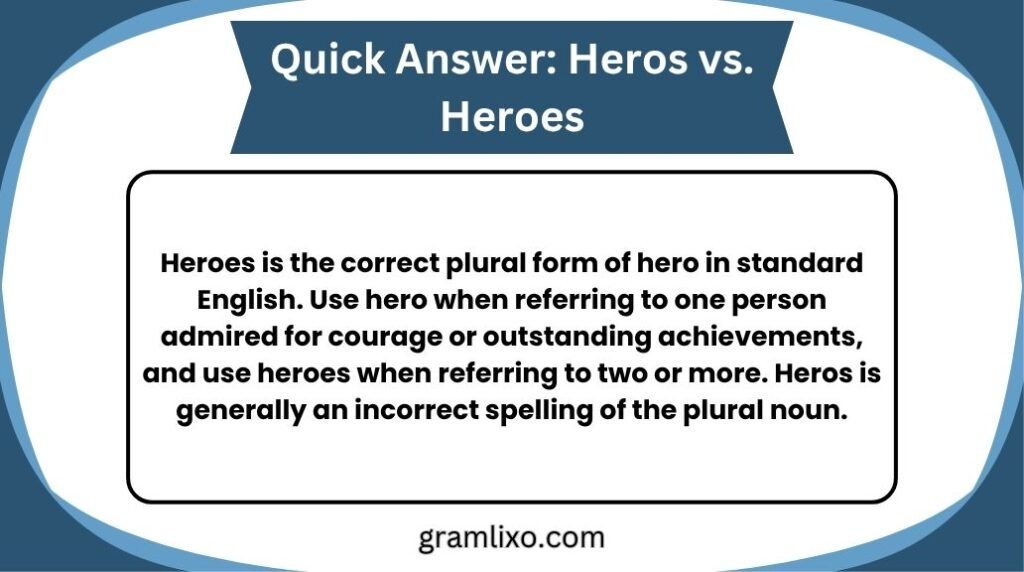
Heroes is the correct plural form of hero in standard English. Use hero when referring to one person admired for courage or outstanding achievements, and use heroes when referring to two or more. Heros is generally an incorrect spelling of the plural noun.
Examples:
- Singular: The firefighter is a hero.
- Plural: The firefighters are heroes.
- Incorrect: The firefighters are heros.
Easy rule to remember: When making hero plural, add -es, not just -s.
Understanding the Basics of Heros vs. Heroes
The difference between heros and heroes comes down to standard English spelling. Although heros may look reasonable at first glance, it is not the accepted plural form of the common noun hero.
A hero is someone admired for courage, selflessness, achievement, or an important contribution. The word can describe a real person, a fictional character, or someone who helps others in a meaningful way.
For example:
- A doctor who saves a patient’s life can be called a hero.
- A fictional character who protects a city may be a hero.
- People who risk their lives to rescue others may be described as heroes.
When there is more than one hero, the correct spelling is heroes.
Heros vs. Heroes Comparison Table
| Form | Type | Meaning | Example | Correct/Incorrect |
|---|---|---|---|---|
| Hero | Singular noun | One admired person or character | She is my hero. | Correct |
| Heroes | Plural noun | Two or more admired people or characters | The rescue workers became heroes. | Correct |
| Heros | Nonstandard spelling in ordinary usage | Intended to mean multiple heroes | The firefighters were heros. | Incorrect |
| Hero’s | Singular possessive | Something belonging to one hero | The hero’s actions inspired us. | Correct |
| Heroes’ | Plural possessive | Something belonging to multiple heroes | The heroes’ stories were inspiring. | Correct |
Notice that hero’s and heroes’ are both correct, but they serve different grammatical purposes. The apostrophe indicates possession, while the spelling heroes forms the regular plural.
Why Is Heroes the Correct Spelling?
English has several pluralization patterns. Most nouns simply take -s, as in book → books and car → cars. Other nouns take -es, especially when their endings make that form necessary or conventional.
Words ending in -o do not all follow one identical rule. Some add -s, while others add -es. For example:
- Photo → photos
- Piano → pianos
- Potato → potatoes
- Tomato → tomatoes
- Hero → heroes
Because these patterns vary, it is best to learn the established plural of each word rather than assume that every noun ending in o follows the same rule.
The important point is simple: the standard plural of hero is heroes.
Correct Meanings and Uses of Hero and Heroes
To understand heros vs. heroes fully, it helps to learn how the word works in different sentences. The meaning usually stays the same when the word changes from singular to plural. What changes is the number of people or characters being described.
1. Hero: The Singular Form
Use hero when talking about one person or character who is admired for courage, kindness, sacrifice, or achievement.
Examples:
- My grandfather is my hero.
- The hero saved the village from danger.
- She became a hero after rescuing the child.
- Every child needs a hero to look up to.
Sentence breakdown:
Consider the sentence, “My grandfather is my hero.”
- My grandfather identifies one person.
- Is is the singular linking verb.
- My hero describes the person being admired.
Since the sentence refers to one person, hero is the correct choice.
2. Heroes: The Plural Form
Use heroes when referring to two or more people or characters who are admired for their actions, achievements, or qualities.
Examples:
- The firefighters are our heroes.
- The movie features three heroes.
- Teachers can be heroes in their communities.
- The heroes worked together to protect the town.
- These athletes became national heroes.
Sentence breakdown:
Consider the sentence, “The firefighters are our heroes.”
- The firefighters refers to multiple people.
- Are agrees with the plural subject.
- Our heroes describes the firefighters as admired people.
The noun must be plural because the sentence refers to more than one firefighter. Therefore, heroes is correct.
3. Hero’s: The Singular Possessive Form
The word hero’s includes an apostrophe before the s. It indicates that something belongs to, relates to, or is associated with one hero.
Examples:
- The hero’s courage inspired the entire team.
- We learned about the hero’s childhood.
- The hero’s decision changed the story.
- The hero’s costume was bright red.
In the sentence “The hero’s courage inspired the entire team,” the courage is associated with one hero.
Do not confuse hero’s with heroes. One shows possession by a single hero; the other refers to multiple heroes.
4. Heroes’: The Plural Possessive Form
Use heroes’ when something belongs to or is associated with more than one hero.
Examples:
- The heroes’ efforts saved the community.
- We celebrated the heroes’ achievements.
- The heroes’ names appeared on the memorial.
- The heroes’ families attended the ceremony.
In “The heroes’ efforts saved the community,” the efforts belong to multiple heroes.
Compare these three forms:
- Hero’s story: The story of one hero.
- Heroes’ stories: The stories of multiple heroes.
- Heroes: More than one hero, without showing possession.
Understanding these distinctions will help you avoid punctuation errors as well as spelling mistakes.
5. Hero as a Verb or Descriptive Expression
In ordinary modern English, hero is primarily a noun. You may also encounter it in compounds and expressions, such as hero worship, hero role, and hero character.
Examples:
- The actor played the hero in the film.
- The novel’s hero faces several difficult choices.
- The community organized a hero appreciation event.
When referring to multiple main characters or admired people, the plural is still heroes.
Test Tip: How to Check Your Spelling
If you are unsure whether to write heros or heroes, follow these steps:
- Identify whether you mean one hero or more than one.
- If you mean one, use hero.
- If you mean several, use heroes.
- If you are showing ownership, decide whether you need hero’s or heroes’.
- Read the sentence again to make sure the noun and verb agree.
Try this example:
“The brave soldiers became national _____.”
The sentence refers to several soldiers, so the correct answer is heroes.
Remember that heros is not the standard plural spelling of hero.
Case Study: Using Heroes Correctly at Work
Imagine that a school administrator is preparing an email to thank emergency responders who helped students during a building evacuation.
The administrator drafts this sentence:
Incorrect draft
Our school would like to thank the local firefighters. They are true heros who put the safety of our students first.
The message is understandable, but the plural noun is misspelled. Because the email is intended for parents, staff, and community members, the administrator should correct the error before sending it.
Corrected version
Our school would like to thank the local firefighters. They are true heroes who put the safety of our students first.
What Changed and Why?
- Heros → Heroes: The plural noun now follows the standard spelling.
- They are: This is appropriate because they refers to multiple firefighters.
- True heroes: This phrase communicates admiration for the firefighters’ courage and service.
The correction is small, but it makes the email more polished and professional.
The same principle applies to blog articles, school essays, business reports, presentations, and social media posts. Correct spelling helps readers focus on your message instead of being distracted by errors.
Grammar Rules Explanation: Why Heroes Is Correct
The spelling difference between heros and heroes is an example of English plural formation. To understand it, you need to know how regular nouns form their plural versions and why nouns ending in o can be different.
Rule 1: Most Singular Nouns Add -s
Many English nouns form the plural by adding -s.
Examples:
- Teacher → teachers
- Student → students
- Book → books
- Chair → chairs
- Hero-related example: superhero → superheroes
The last example is especially useful because superhero follows the same plural pattern as hero. When you refer to several superheroes, write superheroes, not superheros.
Rule 2: Some Nouns Ending in -o Add -es
Certain nouns ending in o take -es in the plural. Common examples include potato → potatoes, tomato → tomatoes, and hero → heroes.
Examples in sentences:
- The chef peeled three potatoes.
- The garden produced several tomatoes.
- The story follows two heroes.
However, this is not a universal rule for every word ending in o. For instance, photo becomes photos, and piano becomes pianos.
That is why learning familiar plural forms is more reliable than applying a blanket rule to all nouns.
Rule 3: Standard Dictionaries Confirm Established Spellings
Standard American English dictionaries, including Merriam-Webster, record established word forms and spellings. The accepted plural of the noun hero is heroes.
A dictionary is useful when you encounter an unfamiliar plural or a word with competing spellings. Look up the singular noun and check its plural form rather than relying only on what looks correct.
You can consult the Merriam-Webster dictionary for the entry for hero.
Rule 4: The Plural Must Match the Meaning
A plural noun refers to more than one person, place, object, or idea. In a sentence, it should also work naturally with the surrounding grammar.
Examples:
- Correct: One hero saved the day.
- Correct: Two heroes saved the day.
- Incorrect: Two hero saved the day.
- Incorrect: Two heros saved the day.
The first incorrect example has a number agreement problem. The second has a spelling problem. Both need correction.
Rule 5: Apostrophes Do Not Form Ordinary Plurals
An apostrophe is not normally added to make a noun plural. It is often used to show possession or to form a contraction.
Compare:
- Heroes: Multiple heroes.
- Hero’s: Something belonging to one hero.
- Heroes’: Something belonging to multiple heroes.
For example, “The heroes’ bravery inspired the children” uses the plural possessive because the bravery is associated with multiple heroes.
This distinction is particularly important in formal writing.
Common Mistakes When Writing Heros vs. Heroes
Even experienced writers make spelling mistakes when a word does not follow their expected pattern. The confusion between heros and heroes often occurs because people know that many English nouns form their plurals by adding -s.
Here are the most common reasons for this error.
1. Applying the Wrong Plural Rule
A writer may assume that every noun ending in o simply needs an s.
For example:
- Incorrect: The movie’s heros were brave.
- Correct: The movie’s heroes were brave.
The mistake happens because the writer applies the pattern found in words such as photos to a word that uses a different plural form.
How to avoid it: Learn common plural pairs individually, including hero → heroes, tomato → tomatoes, and photo → photos.
2. Fast Typing
When writing quickly, you may type the first spelling that comes to mind. This is especially common in text messages, comments, and social media captions.
Example:
- Incorrect: Our local heros deserve recognition.
- Correct: Our local heroes deserve recognition.
How to avoid it: Read your writing once before publishing it. Pay special attention to words that change spelling in the plural.
3. Autocorrect and Spell-Checking Limitations
Spell-checking tools can catch many mistakes, but they are not perfect. Different applications may respond differently to uncommon words, names, or specialized terms. A tool might miss a mistake or fail to recognize the intended meaning.
How to avoid it: Do not depend entirely on autocorrect. If you are uncertain, consult a reliable dictionary or grammar reference.
4. Lack of Knowledge
Some people have never been taught the plural rule for hero. Others may have seen the incorrect form online and assumed it was acceptable.
How to avoid it: Remember this simple pair:
- One hero.
- Two or more heroes.
Practice using both forms in complete sentences until the spelling becomes familiar.
5. Confusing Plurals With Possessives
A writer may add an apostrophe unnecessarily or put it in the wrong place.
Examples:
- Incorrect for a simple plural: The hero’s arrived.
- Correct: The heroes arrived.
- Correct possessive: The hero’s cape was red.
- Correct plural possessive: The heroes’ capes were red.
The correct choice depends on whether you are describing multiple people or showing ownership.
Similar Grammar Confusions
The following table contains other commonly confused English words. Although these pairs do not all follow the same rule as hero → heroes, they demonstrate why careful word selection matters.
| Confusing forms | Correct use | Example |
|---|---|---|
| Its / It’s | Possession / it is or it has | The dog wagged its tail. It’s happy. |
| Your / You’re | Belonging to you / you are | You’re holding your book. |
| Their / There | Belonging to them / a place or introductory expression | Their car is parked there. |
| Then / Than | Time or sequence / comparison | We ate, then left. She is taller than me. |
| Woman / Women | One adult female / multiple adult females | One woman arrived; three women followed. |
| Child / Children | One child / multiple children | The child smiled; the children laughed. |
| Hero / Heroes | One hero / multiple heroes | The hero arrived; the heroes followed. |
| Potato / Potatoes | One potato / multiple potatoes | One potato, four potatoes. |
The lesson is straightforward: English spelling patterns are useful, but they do not cover every word. When a form seems uncertain, verify it rather than guessing.
Usage in Different Contexts
The correct spelling heroes works across almost every form of standard English writing. However, the context may affect the tone of the sentence and the way you use the word.
1. Everyday Conversation
In ordinary conversation, people use hero and heroes to express admiration, gratitude, or respect.
Examples:
- “My mom is my hero.”
- “The rescue workers are real heroes.”
- “Those kids were heroes for helping their classmates.”
In casual speech, the difference between singular and plural is often clear from context. In writing, however, you must also use the correct spelling.
2. Professional Writing
In business emails, workplace announcements, reports, and public statements, spelling accuracy helps communicate professionalism.
Examples:
- “We recognize the heroes who supported our community.”
- “The company honored its employees as everyday heroes.”
- “Their stories remind us that heroes can be found in every profession.”
Avoid writing heros in a professional document. It is not the standard plural spelling, and it may make the writing appear less carefully edited.
3. Creative Writing
Writers use hero and heroes in novels, short stories, scripts, comics, and poems.
Examples:
- “The hero crossed the desert alone.”
- “The heroes joined forces to defeat the enemy.”
- “Every hero faces a moment of doubt.”
- “The village remembered its heroes for generations.”
Creative writing sometimes uses invented words, unusual spellings, or deliberate stylistic choices. Even so, heroes remains the standard plural when referring to more than one hero.
4. Social Media and Texting
Social media captions often use short, emotional phrases to celebrate family members, friends, teachers, healthcare workers, and emergency responders.
Examples:
- “Our everyday heroes deserve the best!”
- “Celebrating the heroes who make a difference.”
- “Real heroes don’t always wear capes. ❤️”
- “Thank you to all the heroes in our community!”
A casual platform does not change the standard spelling rule. If you want your caption to look polished and credible, use heroes rather than heros.
5. Academic Writing
Students may need the word in essays about literature, history, leadership, or social responsibility.
Examples:
- “The novel’s heroes represent courage and sacrifice.”
- “Historical heroes often become symbols of national identity.”
- “The author presents several heroes with different motivations.”
Academic writing should use standard spelling consistently. When writing about a single character, use hero. When writing about several characters, use heroes.
Why Correct Spelling Matters
Spelling may seem like a small detail, but it contributes to clear communication. Choosing heroes instead of heros helps readers understand your message without distraction.
Clarity in Communication
Correct spelling allows readers to focus on the meaning of your sentence. A misspelled word may not prevent understanding, but it can interrupt the reading experience.
For example, “Our heroes protected the town” is immediately recognizable and grammatically standard.
Professionalism and Credibility
Carefully edited writing creates a more polished impression. This is particularly important when writing applications, business emails, articles, educational content, or public announcements.
Correct spelling alone does not guarantee strong writing, but it is an important part of presenting your ideas clearly.
Accuracy in Digital Communication
Online content can be shared quickly and widely. A spelling error in a post, headline, or article may be copied or repeated by other users.
Checking words such as heroes before publishing can improve the overall quality of your digital communication.
A Short Quote to Remember
“Small details make a big difference.”
This reminder applies to spelling, punctuation, grammar, and many other parts of effective writing. Taking a moment to check one word can help make an entire message more polished.
Special Exceptions and Edge Cases
Although heroes is the standard plural of the common noun hero, a few situations deserve special attention.
1. Brand Names and Proper Names
A company, product, game, or creative work may use a nonstandard spelling as part of its official name. Proper names can preserve unusual forms that do not follow ordinary grammar rules.
If Heros appears as the verified name of a particular brand or fictional entity, reproduce that official spelling when referring to the name itself. This does not make heros the correct general plural of hero.
2. Fictional Worlds and Invented Terms
Authors and game developers sometimes invent names for characters, groups, or fictional species. An invented term may follow its own naming convention.
For example, a fictional organization could officially be called “The Heros.” In that case, the spelling is part of the organization’s name, not an example of standard pluralization.
3. British and American English
There is no standard US-versus-UK spelling difference for this word. Both American and British English use heroes as the ordinary plural of hero.
Examples:
- American English: The heroes returned home.
- British English: The heroes returned home.
You do not need to change this spelling when switching between these two varieties of English.
4. Compound Words
The same spelling pattern appears in familiar compound nouns.
Examples:
- Superhero → superheroes
- Action hero → action heroes
- Folk hero → folk heroes
When a compound uses hero as its final element, the plural generally takes the form heroes.
Remember that a special name or an invented expression may have its own official spelling, but the ordinary grammatical rule remains unchanged.
Quick Recap Checklist: Heros vs. Heroes
Use this checklist whenever you are unsure which form belongs in your sentence.
| Question | If Yes → Use |
|---|---|
| Are you talking about one admired person? | Hero |
| Are you talking about two or more admired people? | Heroes |
| Are you showing that something belongs to one hero? | Hero’s |
| Are you showing that something belongs to several heroes? | Heroes’ |
| Are you writing the ordinary plural of hero? | Heroes |
| Are you referring to a verified proper name with unusual spelling? | Follow the official name |
Practice Examples
Choose the correct word to complete each sentence before checking the answers.
1. The firefighters were celebrated as national _____.
- A. Heros
- B. Heroes
Correct answer: B. Heroes. The sentence refers to multiple firefighters, so the plural form is needed.
2. My older brother has always been my _____.
- A. Hero
- B. Heroes
Correct answer: A. Hero. The sentence describes one person.
3. The _____ courage inspired everyone in the village.
- A. Hero’s
- B. Heroes’
Correct answer: A. Hero’s if the courage belongs to one hero. If it belongs to several heroes, the correct choice is heroes’.
These exercises demonstrate that choosing the correct form depends on both number and possession.
Frequently Asked Questions (FAQs)
1. Is it heros or heroes?
Heroes is the correct standard English plural of hero. Use it when referring to two or more admired people or fictional characters. Heros is generally a misspelling when used as the ordinary plural.
2. Why is the plural of hero heroes instead of heros?
The word hero follows an established English plural pattern in which -es is added to form heroes. Although some nouns ending in o add only -s, others take -es. The plural form depends on the individual word.
3. Is heroes correct in American English?
Yes. Heroes is the standard plural spelling in American English. It is also the standard spelling in British English, so there is no difference between these varieties for this word.
4. What is the difference between hero’s, heroes, and heroes’?
Hero’s is the singular possessive form, heroes is the ordinary plural, and heroes’ is the plural possessive form.
Examples:
- The hero’s shield was damaged.
- The heroes arrived together.
- The heroes’ shields were damaged.
The apostrophe placement changes the grammatical meaning.
5. Can heros ever be correct?
In ordinary writing, heros is not the accepted plural of hero. However, the same letter sequence could appear in a verified proper name, brand name, or intentionally invented term. Such a special case does not change the standard plural spelling.
6. How can I remember the correct spelling of heroes?
Remember the simple pair hero → heroes. You can also memorize familiar examples such as potato → potatoes and tomato → tomatoes. When uncertain, check a reliable dictionary and proofread your sentence before publishing it.
Conclusion
Understanding heros vs. heroes is simple once you learn the correct plural spelling. Hero refers to one admired person or character, while heroes refers to two or more. In standard English, heroes is the correct plural, and heros is generally a spelling mistake.
Remember that hero’s and heroes’ have different functions because they indicate possession. Use hero’s when something belongs to one hero and heroes’ when something belongs to multiple heroes.
The word follows an established English plural pattern, although not every noun ending in o follows the same rule. That is why learning common word forms and consulting a reliable dictionary can improve your writing.
Whether you are writing a school essay, a professional email, a blog post, or a social media caption, choosing the correct spelling helps your message look clear and polished.
The rule to remember is simple: one hero, two heroes. Write it correctly, and let your message shine.
I’m Christopher Garcia, an English writer and grammar enthusiast at Gramlixo. I enjoy making grammar easy to understand through clear explanations and practical examples.
[…] |Heros vs Heroes: Which Spelling Is Correct? […]