Have you ever wondered whether you should call someone a patron or a benefactor? 🤔 The two words are closely related, especially when you are talking about people who financially support artists, charities, organizations, or causes. However, patron vs benefactor is not simply a case of two interchangeable words. Each term carries its own meaning and is appropriate in different situations.
A patron can be someone who supports an artist, organization, or activity, but the word can also mean a customer who regularly visits a business. A benefactor, on the other hand, is specifically a person who gives money or other assistance to help a person or organization.
Cambridge Dictionary defines patron as someone who supports an activity or organization, especially financially, while benefactor refers to someone who gives money to help an organization, society, or person.
So, which word should you use? The answer depends on the relationship and the kind of support involved. Let’s make the difference simple.
|When Can I vs When I Can: Which Is Correct? A Complete Grammar Guide
|Full Proof vs Foolproof: Which Is Correct?
Quick Answer: Patron vs Benefactor
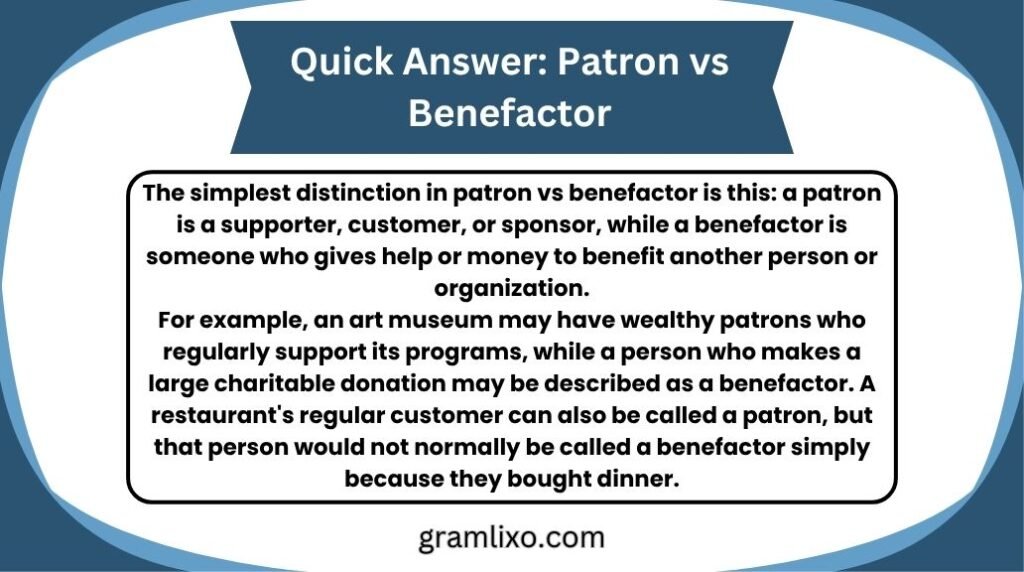
The simplest distinction in patron vs benefactor is this: a patron is a supporter, customer, or sponsor, while a benefactor is someone who gives help or money to benefit another person or organization.
For example, an art museum may have wealthy patrons who regularly support its programs, while a person who makes a large charitable donation may be described as a benefactor. A restaurant’s regular customer can also be called a patron, but that person would not normally be called a benefactor simply because they bought dinner.
Quick rule:
👉 Patron = supporter or customer
👉 Benefactor = person who provides help, especially financial help
Understanding the Basics of Patron vs Benefactor
Both patron and benefactor are nouns. They can describe people who provide support, but their meanings are not identical.
The biggest difference is scope.
The word patron has several established meanings. It can refer to someone who supports an artist, institution, activity, or organization. It can also refer to a customer of a restaurant, store, hotel, or similar business, particularly a regular customer.
The word benefactor is narrower. It describes someone who gives money or assistance to help another person, organization, or cause. In business usage, the word often suggests that the person is providing assistance without expecting something in return.
Patron vs Benefactor Comparison Table
| Form | Type | Meaning | Example | Correct/Incorrect |
|---|---|---|---|---|
| Patron | Noun | A supporter, sponsor, or customer | She is a patron of the local theater. | ✅ Correct |
| Benefactor | Noun | Someone who provides financial or other help | The university thanked its benefactor. | ✅ Correct |
| Patron | Noun | A customer, often a regular customer | The restaurant welcomed its patrons. | ✅ Correct |
| Benefactor | Noun | A person who gives help to benefit someone else | He became a benefactor of the scholarship fund. | ✅ Correct |
| Patron for every donor | Noun | Supporter, but not necessarily a donor | She is a patron of the arts. | ⚠️ Depends on context |
| Benefactor for an ordinary customer | Noun | Financial helper, not simply a customer | The restaurant called every diner a benefactor. | ❌ Usually incorrect |
The important thing to remember is that patron and benefactor can overlap, but they are not complete synonyms.
What Does Patron Mean?
A patron is a person who supports an activity, organization, artist, or institution. That support may involve money, influence, attendance, or continued involvement.
For example:
She is a patron of the local arts center.
Here, patron identifies her as someone who supports the arts center.
The word is especially common in phrases such as:
- patron of the arts
- museum patron
- theater patron
- library patron
- patron of a charity
- patron of a cultural organization
Cambridge Dictionary also gives patron another important meaning: a person who uses a particular store, restaurant, hotel, or similar business, especially regularly.
For example:
The restaurant thanked its patrons for their continued support.
In this sentence, patrons means customers.
Sentence Breakdown
Consider:
The wealthy patron supported several young painters.
- The wealthy patron = the person providing support
- supported = the action
- several young painters = the people receiving the support
The sentence does not necessarily tell us exactly how the support was provided. It could have involved money, introductions, resources, publicity, or another form of assistance.
What Does Benefactor Mean?
A benefactor is someone who helps another person, organization, or cause, particularly by providing money.
For example:
The university received a generous donation from an anonymous benefactor.
Here, benefactor emphasizes the person’s role as someone who provided financial assistance.
Another example:
The hospital honored its longtime benefactor.
The word suggests that the person made meaningful contributions that benefited the hospital.
Cambridge Dictionary defines benefactor as someone who gives money to help an organization, society, or person. Its Business English definition also emphasizes giving money, usually without expecting something in return.
Sentence Breakdown
Consider:
An anonymous benefactor paid for the student’s education.
- An anonymous benefactor = the person providing the assistance
- paid for = the form of assistance
- the student’s education = what benefited from the assistance
The focus is on the benefit provided, rather than on a broader relationship of support.
Patron vs Benefactor: The Core Difference
The easiest way to understand patron vs benefactor is to focus on the breadth of each word.
Patron Is Broader
Patron can describe:
- A financial supporter
- An arts supporter
- A sponsor
- A regular customer
- A supporter of an institution
- A person associated with patronage
For example:
The museum’s patrons attended the opening ceremony.
Depending on context, the patrons could be supporters, donors, members, or people who regularly engage with the institution.
Benefactor Is More Specific
Benefactor focuses on someone who does something beneficial for another person or organization.
For example:
A generous benefactor funded the new scholarship program.
The word immediately draws attention to the assistance provided.
A Simple Memory Trick
Think of it this way:
Patron = “I support it.”
Benefactor = “I help it.”
A patron may support an organization through money, attendance, influence, or continued involvement.
A benefactor is specifically characterized by giving assistance that benefits someone else.
When Should You Use Patron?
Use patron when you want to describe someone who supports an organization, activity, artist, or institution.
It is particularly natural when discussing the arts.
Example 1: Art
She became a patron of the local art museum.
This means she supports the museum.
Example 2: Theater
The theater depends on loyal patrons to remain open.
Here, patrons means customers or supporters.
Example 3: Business
The hotel welcomed its patrons during the holiday season.
Here, patrons means customers.
Example 4: Charity
Several wealthy patrons contributed to the charity’s annual campaign.
Here, patrons refers to supporters who contributed resources.
Test Tip
Ask yourself:
“Am I describing a supporter, sponsor, or customer?”
If the answer is yes, patron may be the better choice.
When Should You Use Benefactor?
Use benefactor when the main idea is that someone has provided meaningful help or financial assistance.
Example 1: Education
The student received a scholarship from an anonymous benefactor.
The person provided financial assistance.
Example 2: Hospital
The hospital named the new wing after its largest benefactor.
The person made a significant contribution.
Example 3: Charity
The charity relies on several generous benefactors.
The emphasis is on people who financially support the organization.
Example 4: Individual Help
An unexpected benefactor helped the family pay its medical bills.
Here, the person directly benefited someone in need.
Test Tip
Ask:
“Did this person provide help or money that benefited someone else?”
If yes, benefactor may be the more precise word.
Can Someone Be Both a Patron and a Benefactor?
Yes. 👍
This is one of the most important points in understanding patron vs benefactor.
One person can legitimately be both.
Imagine that Maria regularly supports a community theater. She attends performances, promotes the theater, and makes substantial donations.
You could say:
Maria is a patron of the theater.
You could also say:
Maria is a benefactor of the theater.
Both sentences can be correct, but they highlight different aspects of Maria’s relationship.
Patron emphasizes her ongoing support.
Benefactor emphasizes the benefit she provides, especially through financial contributions.
This is why the words sometimes appear in similar contexts without being perfect synonyms.
Patron vs Benefactor in a Real-Life Case Study
Imagine a nonprofit organization called Community Arts Network.
The organization has three important supporters:
- Daniel regularly buys tickets and attends performances.
- Maria contributes $10,000 every year.
- James provides a large donation to build a new rehearsal space.
How would you describe them?
Daniel
Daniel is a patron of Community Arts Network.
This works because he regularly participates and supports the organization.
Maria
Maria is a patron and benefactor of Community Arts Network.
Both terms work because she provides ongoing financial support.
James
James is a major benefactor of Community Arts Network.
This emphasizes the significant financial benefit he provided.
Workplace Example
Imagine an employee writes:
“We are grateful to our company’s benefactor for supporting the annual employee program.”
This could be correct if one individual personally funded the program.
But if the company is talking about a customer:
“We are grateful to our patrons for supporting our business.”
Here, patrons is the natural choice because the people are customers.
Calling ordinary customers benefactors would change the meaning and make the statement sound unusual.
Grammar Rules for Patron vs Benefactor
From a grammatical perspective, both patron and benefactor are countable nouns.
That means they can appear in singular and plural forms.
Singular
- one patron
- one benefactor
Plural
- several patrons
- several benefactors
Examples:
The patron donated a painting.
The patrons attended the exhibition.
The benefactor funded the scholarship.
The benefactors supported the university.
Neither word is grammatically “more correct” than the other. The issue is meaning and context.
Standard dictionary definitions support this distinction. Cambridge identifies patron as a noun for both a supporter and a customer, while benefactor is a noun for someone who gives money to help a person or organization.
So, if someone asks, “Which is grammatically correct, patron or benefactor?” the best answer is:
Both are grammatically correct; the appropriate choice depends on what you mean.
Patron vs Benefactor: Common Mistakes
People often confuse these words because both can appear in discussions about donations and support.
Mistake 1: Treating Them as Perfect Synonyms
Incorrect assumption:
Every patron is a benefactor.
Not necessarily.
A restaurant patron is simply a customer. That person may never provide charitable assistance.
Mistake 2: Calling Every Customer a Benefactor
Consider:
The restaurant thanked its benefactors for dining there.
This sounds strange because benefactor suggests someone who provides a benefit or financial assistance beyond ordinary customer activity.
Better:
The restaurant thanked its patrons for dining there.
Mistake 3: Assuming Every Benefactor Is a Patron
A person can anonymously donate $50,000 to a scholarship fund without having any ongoing relationship with the institution.
Calling that person a benefactor is natural.
Calling them a patron may be possible in some contexts, but it is not necessarily the most precise choice.
Mistake 4: Using the Words Without Considering Context
Compare:
The museum welcomed its patrons.
This could refer to visitors, customers, members, or supporters.
Now compare:
The museum honored its benefactors.
This strongly suggests people who provided financial or other meaningful assistance.
Similar Grammar Confusions
The patron vs benefactor confusion belongs to a larger group of English word-choice problems. Many words appear similar but perform different jobs.
| Confusing Words | Main Difference | Example |
|---|---|---|
| Patron / Benefactor | Supporter/customer vs. person who provides significant help | She is a patron of the theater. |
| It’s / Its | “It is” vs. possessive | It’s cold. / The dog wagged its tail. |
| Your / You’re | Possessive vs. “you are” | Your book is here. / You’re early. |
| Affect / Effect | Usually verb vs. usually noun | Noise can affect sleep. |
| Then / Than | Time/order vs. comparison | First eat, then rest. / Taller than me. |
| Principal / Principle | Person/main element vs. rule or belief | The principal spoke. / Follow the principle. |
| Compliment / Complement | Praise vs. something that completes another thing | She complimented me. / The colors complement each other. |
Why do these mistakes happen?
Fast Typing
When people type quickly, they often choose the first familiar word that comes to mind.
Autocorrect
Autocorrect can replace an intended word with a different valid word. Because patron and benefactor are both legitimate English words, software may not recognize a context problem.
Lack of Knowledge
Some words have overlapping meanings. Without understanding the subtle difference, writers may use them interchangeably.
The solution is simple: slow down and consider the exact meaning you want to express.
Patron vs Benefactor in Different Contexts
The best word can change depending on where you are writing.
Everyday Conversation
In casual conversation, patron is common when talking about customers.
The café has many loyal patrons.
You might use benefactor when discussing someone who has helped another person financially.
She was a generous benefactor to the community.
Professional Writing
Both words work well in formal writing.
Patron:
The museum recognizes its patrons for their continued support.
Benefactor:
The university honored its longtime benefactors at the annual ceremony.
In professional writing, choose the word that accurately describes the relationship.
Creative Writing
Authors may use patron to describe historical relationships between wealthy supporters and artists.
The young composer found a powerful patron who supported his work.
Benefactor can create a stronger sense of generosity or personal assistance:
An unknown benefactor paid for the artist’s studio.
Social Media and Texting
In social media posts, either word may work depending on context.
For a museum:
Thank you to all our amazing patrons! ❤️
For a donor:
We’re incredibly grateful to our generous benefactors! 🙏
Because social media relies heavily on short messages, context becomes especially important.
Patron vs Benefactor in the Arts
The arts provide one of the clearest examples of the distinction.
Historically and today, a patron of the arts is someone who supports artists, artistic institutions, or cultural activities.
For example:
The painter gained a wealthy patron who helped finance her studio.
The word patron highlights a continuing relationship between the supporter and the artistic activity.
A benefactor can also support the arts:
The anonymous benefactor donated $1 million to the museum.
Here, benefactor focuses more strongly on the financial contribution and the benefit it creates.
The terms may therefore overlap, but their emphasis differs.
Why Patron vs Benefactor Matters
Choosing the right word is more than a grammar exercise. It affects clarity.
1. Clarity in Communication
Compare:
The restaurant thanked its benefactors.
with:
The restaurant thanked its patrons.
The second sentence clearly communicates that the people were customers.
2. Professionalism
In business, nonprofit, academic, and institutional writing, precise word choice makes your writing sound more polished.
Calling a donor a benefactor can accurately acknowledge their generosity.
Calling a regular customer a patron accurately describes their relationship with a business.
3. Digital Communication
Online communication moves quickly. A single word can change how readers understand a sentence.
This is especially important in:
- Emails
- Websites
- Press releases
- Social media
- Fundraising campaigns
- Annual reports
- Newsletters
4. Respect and Accuracy
When recognizing someone’s contribution, choosing the right title matters.
A major donor may appreciate being recognized as a benefactor, while customers of a theater may appropriately be described as patrons.
A useful principle is:
Good word choice makes your meaning easier to understand.
Special Exceptions and Edge Cases
There is no major grammatical exception that makes patron and benefactor interchangeable in every situation. However, both words can be used in specialized institutional contexts.
Patron Can Mean Customer
This is the most important special case.
A patron can be a person who uses a business or service, particularly regularly. Cambridge explicitly lists this customer meaning for stores, restaurants, hotels, and similar establishments.
For example:
Library patrons must return borrowed books on time.
Here, patrons means library users.
Patron Can Also Describe Support
In another sentence:
The museum’s patrons helped fund its educational programs.
Here, patrons means supporters.
Benefactor Is Not Limited to Charities
A benefactor does not have to support a registered charity.
Someone can be a benefactor of:
- A student
- An artist
- A hospital
- A university
- A community
- A religious institution
- A nonprofit
- A family
- A specific project
The central idea is that the person provides a benefit or assistance.
Patron vs Benefactor: Quick Recap Checklist
Use this checklist whenever you’re unsure.
| Question | If Yes → Use |
|---|---|
| Is the person a customer of a restaurant, store, hotel, or similar business? | Patron |
| Does the person support an artist or artistic organization? | Patron |
| Does the person regularly support an institution? | Patron |
| Does the person provide money or meaningful assistance to help someone? | Benefactor |
| Are you emphasizing a generous donation? | Benefactor |
| Could the person reasonably be both a supporter and a donor? | Patron and benefactor |
| Are you talking about ordinary customers? | Patrons |
| Are you emphasizing charitable assistance? | Benefactors |
Practice Example 1
Sentence:
“Every Saturday, hundreds of people visit the theater.”
Best choice:
The theater welcomed its patrons.
Why? They are customers or attendees.
Practice Example 2
Sentence:
“An anonymous donor paid for the theater’s new equipment.”
Best choice:
An anonymous benefactor paid for the theater’s new equipment.
Why? The focus is on financial assistance.
Practice Example 3
Sentence:
“A wealthy supporter regularly attends performances and makes large donations.”
Best choice:
She is both a patron and a benefactor of the theater.
Why? Both words describe different aspects of her relationship.
How to Remember the Difference
If you’re still unsure about patron vs benefactor, use this simple mental shortcut:
Think “Patron = Participation”
A patron may:
- Attend
- Visit
- Buy
- Support
- Sponsor
- Follow
- Donate
The word has a broad range.
Think “Benefactor = Benefit”
A benefactor gives something that benefits another person or organization.
That could be:
- Money
- Resources
- Financial assistance
- Significant support
So remember:
Patron → broader support or customer relationship
Benefactor → person who provides a benefit, especially financial help
This shortcut will help you choose the right word in most everyday situations.
Frequently Asked Questions About Patron vs Benefactor
1. What is the difference between a patron and a benefactor?
A patron is a supporter, sponsor, or customer, while a benefactor is someone who provides help or money to benefit another person or organization. The two terms can overlap when a patron provides substantial financial assistance.
2. Is a patron always a donor?
No. A patron is not necessarily a donor. A patron can simply be a customer of a restaurant, hotel, store, library, or other organization. A patron can also be a supporter of an artistic or cultural activity.
3. Is a benefactor always wealthy?
No. A benefactor does not have to be wealthy. The word describes someone who provides help or benefit. The amount of money or assistance is not what determines whether the word is grammatically appropriate.
4. Can one person be both a patron and a benefactor?
Yes. Someone can be a patron because they regularly support an organization and a benefactor because they provide significant financial assistance to it.
For example:
She is a patron and benefactor of the local museum.
Both terms can be correct.
5. Is “patron of the arts” correct?
Yes. Patron of the arts is a standard expression for someone who supports artists, artistic activities, or arts organizations.
6. Is “benefactor of the arts” correct?
Yes. Benefactor of the arts can also be correct when the person provides financial or other meaningful assistance to artists or arts organizations. However, patron of the arts is the more established expression when emphasizing ongoing support for the arts.
Final Thoughts on Patron vs Benefactor
The difference between patron vs benefactor becomes much easier once you focus on the type of relationship being described. A patron is a broad term for someone who supports an activity, organization, or artist, and it can also mean a customer who regularly uses a business or service. A benefactor is more specific and emphasizes someone who provides help, particularly financial assistance, to benefit another person or organization.
Remember that the words can overlap. A generous donor to a museum may be both a patron and a benefactor. However, an ordinary restaurant customer is a patron, not usually a benefactor.
When you’re choosing between the two, ask one simple question: Am I emphasizing someone’s support or their act of providing a benefit?
If you’re describing broad support or customer activity, choose patron. If you’re emphasizing generous assistance, especially financial help, choose benefactor.
Choose the word that matches the relationship, and your writing will communicate exactly what you mean.

Hi, I’m Lisa Jones, a grammar enthusiast and writer at Gramlixo. I enjoy making English grammar simple, clear, and easy to apply in everyday writing.


[…] |Patron vs Benefactor: What’s the Difference? […]
[…] |Patron vs Benefactor: What’s the Difference? […]