Have you ever wondered whether to write principal vs principle when talking about a school leader, an important person, or a basic rule? You are not alone. These two words sound exactly alike, but their meanings, spellings, and uses are different. Confusing them is a common grammar mistake, especially in emails, school assignments, business documents, and everyday conversations.
The good news is that learning the difference between principal and principle is easier than it seems. One word usually refers to a person, something important, or a financial amount. The other refers to a rule, belief, or fundamental idea. Once you understand their meanings and remember a simple trick, you can use both words confidently.
In this guide, I will explain principal vs principle with clear definitions, practical examples, grammar rules, comparison tables, and common mistakes. Whether you are a student, teacher, professional writer, or English learner, you will find simple ways to remember which spelling belongs in each sentence.
|Their vs There vs They’re: What’s the Difference?
|Reorder vs Re-Order: Which Spelling Is Correct?
|Propose vs Purpose: What’s the Difference? Meaning, Usage, and Examples
Quick Answer: Principal vs Principle
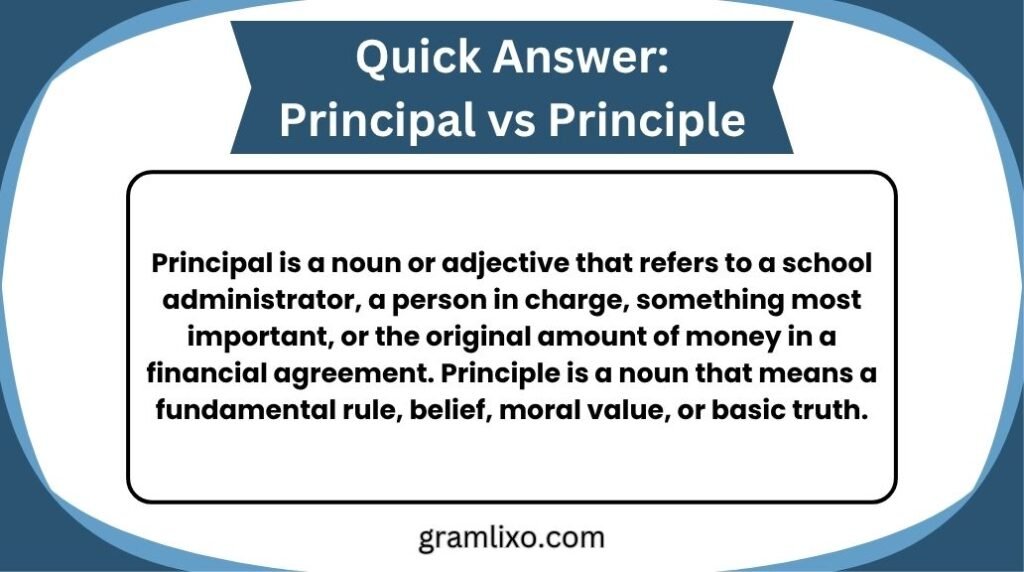
Principal is a noun or adjective that refers to a school administrator, a person in charge, something most important, or the original amount of money in a financial agreement. Principle is a noun that means a fundamental rule, belief, moral value, or basic truth.
Easy memory trick: The principal is your pal at school, while a principle is a rule or belief you follow.
Understanding the Basics of Principal vs Principle
The main difference between principal and principle is their meaning and grammatical function. Although they have the same pronunciation, they are not interchangeable.
Both words are examples of homophones. Homophones are words that sound alike but have different meanings and spellings. Because principal and principle sound identical in standard American English, you must understand the context to choose the correct one.
Let’s look at their basic meanings.
What Does Principal Mean?
Principal can function as both a noun and an adjective.
As a noun, it commonly refers to:
- The head of a school or educational institution.
- A person who has a leading or controlling position.
- The original amount of money borrowed or invested.
- A person who is directly involved in a legal or business transaction.
As an adjective, principal means:
- Main.
- Most important.
- Primary.
- Chief.
Examples:
- The school principal welcomed the new students.
- Our principal concern is student safety.
- She paid the principal on her home loan.
- The principal reason for the delay was bad weather.
In each sentence, principal refers to a leading person, an original financial amount, or something of primary importance.
What Does Principle Mean?
Principle is a noun. It refers to a fundamental belief, rule, standard, or truth that guides someone’s behavior or explains how something works.
It commonly refers to:
- A moral belief.
- A personal value.
- A basic scientific rule.
- A general law or concept.
- A fundamental standard of behavior.
Examples:
- Honesty is an important principle in our family.
- She refused to compromise her principles.
- The principle of gravity explains why objects fall toward Earth.
- Fairness is a basic principle of good leadership.
In these sentences, principle describes an idea, belief, or fundamental rule.
Principal vs Principle: Comparison Table
| Form | Type | Meaning | Example | Correct/Incorrect |
|---|---|---|---|---|
| Principal | Noun | Head of a school | The principal called my parents. | Correct |
| Principal | Adjective | Main or most important | Safety is our principal concern. | Correct |
| Principal | Noun | Original amount of a loan | I paid part of the principal. | Correct |
| Principle | Noun | Fundamental belief | Honesty is my guiding principle. | Correct |
| Principle | Noun | Basic rule or truth | This principle applies to everyone. | Correct |
| Principle | Noun | School administrator | The principle called the students. | Incorrect |
| Principal | Noun | Moral belief | Honesty is an important principal. | Incorrect |
Note: The incorrect examples use a real English word in the wrong context. Their sentences require the other spelling.
Correct Meanings and Uses of Principal
Understanding the different meanings of principal will help you recognize it in various situations. It is particularly common in education, finance, business, and professional communication.
1. Principal as a School Administrator
One of the most familiar uses of principal is to describe the person responsible for managing a school.
A school principal supervises teachers, supports students, handles administrative responsibilities, and helps maintain educational standards.
Examples:
- The principal announced the school’s new attendance policy.
- Our principal organized a meeting for parents.
- The students thanked their principal for her support.
- Mr. Johnson became the principal of the elementary school.
Sentence breakdown:
Consider this sentence:
“The principal spoke to the students after lunch.”
- The subject is “the principal.”
- The action is “spoke.”
- The people receiving the message are “the students.”
- Principal refers to the person leading the school.
Therefore, principal is the correct spelling.
2. Principal as an Adjective Meaning Main or Primary
Principal can also describe something that is more important than other things.
In this context, it works as an adjective and often appears before a noun.
Examples:
- The principal reason for the meeting was to discuss safety.
- Her principal responsibility is managing the department.
- The principal objective of the project is customer satisfaction.
- Time management is the principal challenge for many students.
Sentence breakdown:
“The principal goal of this business is customer satisfaction.”
Here:
- Principal describes the word “goal.”
- Goal means the desired result.
- Principal means the main or most important goal.
You could replace principal with main without changing the essential meaning.
3. Principal in Banking and Finance
In financial writing, principal refers to the original amount of money borrowed, invested, or owed, excluding interest.
This meaning is particularly important when discussing mortgages, personal loans, student loans, and investments.
Examples:
- The borrower made an extra payment toward the principal.
- Your monthly payment includes principal and interest.
- The principal amount of the loan was $20,000.
- Paying down the principal can reduce the amount of interest charged over time.
Sentence breakdown:
“She paid $500 toward the principal of her mortgage.”
In this example:
- Mortgage refers to the home loan.
- Principal refers to the original borrowed amount that remains unpaid.
- The $500 payment reduces the outstanding principal if applied to it.
Remember that principal is a financial term, not a moral belief or rule.
4. Principal as a Person in Charge
Principal can also refer to someone who holds a leading position or has primary responsibility in a business, legal, or professional situation.
Examples:
- The principal investor approved the project.
- Each principal partner attended the meeting.
- The company appointed a new principal consultant.
- The principal actors signed the agreement.
In these examples, principal identifies someone with a leading, primary, or directly involved role.
5. Principal in Legal and Business Contexts
In legal and business language, a principal may refer to a person who authorizes another person, known as an agent, to act on their behalf.
For example, a property owner may authorize a real estate agent to negotiate a transaction.
Example:
“The principal authorized the agent to sign the agreement.”
Here, principal refers to the person granting authority, while the agent performs an action on that person’s behalf.
This usage is common in agency law, business agreements, and commercial transactions.
Correct Meanings and Uses of Principle
Unlike principal, principle is always a noun in standard modern English. It refers to an idea, belief, rule, or fundamental truth.
Let’s explore its most common uses.
1. Principle as a Moral Belief
A principle can describe a personal value that guides someone’s decisions and behavior.
Common moral principles include:
- Honesty.
- Respect.
- Fairness.
- Responsibility.
- Integrity.
- Kindness.
Examples:
- Honesty is one of my strongest principles.
- She refused to lie because it went against her principles.
- Respect is an important principle in every healthy relationship.
- He believes in the principle of treating everyone fairly.
Sentence breakdown:
“Honesty is an important principle in our family.”
- Honesty is the subject.
- Is connects the subject to its description.
- Principle identifies a guiding belief.
- Important describes the value of that belief.
Principle is correct because the sentence discusses a moral standard.
2. Principle as a Fundamental Rule
A principle can also describe a general rule that guides a system, organization, activity, or process.
Examples:
- The principle of equality supports equal treatment.
- This principle guides our company’s decisions.
- The teacher explained the basic principles of good writing.
- Every successful organization needs clear operating principles.
In these examples, principle describes a rule or standard that influences how something works.
3. Principle in Science
Science uses the word principle to describe fundamental laws, concepts, or established explanations.
These principles help scientists understand natural events and explain how different systems operate.
Examples:
- The principle of conservation of energy is important in physics.
- Students learned the basic principles of chemistry.
- The principle of buoyancy explains why some objects float.
- Scientists use established principles to develop new theories.
A scientific principle provides a foundation for understanding a particular subject.
4. Principle in Education
In education, principles are fundamental ideas that guide teaching, learning, and academic development.
Examples:
- The teacher explained the principles of effective communication.
- Critical thinking is a key principle of modern education.
- Students should understand the principles of academic honesty.
- The school follows principles of fairness and inclusion.
Notice that principal would not work in these sentences because the discussion is about ideas and standards, not a person or something primary.
5. Principle in Everyday Decision-Making
People often use principles to explain why they make certain decisions.
A principle can help someone decide what is right, fair, or consistent with their beliefs.
Examples:
- I never break my principles for money.
- She follows the principle of honesty in every situation.
- He made his decision based on personal principles.
- We should apply the same principle to everyone.
Principles help people maintain consistency between their beliefs and actions.
Principal vs Principle: A Real-Life Case Study
Imagine that a student named Daniel is writing an email to his teacher about a school event.
He writes:
“Dear Principle, I want to thank you for teaching us the principle of honesty.”
Although the sentence is understandable, it contains a spelling mistake.
The correct version is:
“Dear Principal, I want to thank you for teaching us the principle of honesty.”
Why?
- Principal: Daniel is addressing the head of the school.
- Principle: Daniel is referring to the moral value of honesty.
Both words appear in the same sentence, but they have completely different meanings.
Another Workplace Example
Imagine an employee writing a report about company policies.
Incorrect:
“Our company believes in strong business principals, and our principle manager approved the plan.”
Correct:
“Our company believes in strong business principles, and our principal manager approved the plan.”
In this example:
- Principles refers to the company’s fundamental values.
- Principal manager identifies a manager with a leading role.
The context determines which word is appropriate.
Grammar Rules: Principal vs Principle
The difference between principal and principle becomes easier when you understand their grammatical roles.
Although they sound identical, their spelling and meanings follow different rules.
Rule 1: Use Principal for a Person or Something Primary
Use principal when referring to a person in charge, a school administrator, an original financial amount, or something that is most important.
Examples:
- The principal invited the parents to school.
- Our principal objective is to improve customer service.
- The bank calculated the remaining principal.
- The principal investigator presented the research findings.
Grammar tip: If you can replace the word with “main,” “primary,” or “head of the school,” principal is probably correct.
Rule 2: Use Principle for a Rule, Belief, or Fundamental Idea
Use principle when discussing a moral value, scientific concept, basic truth, or guiding standard.
Examples:
- Trust is an important principle in friendship.
- The principle of gravity explains the movement of objects.
- The company follows the principle of transparency.
- She stood by her principles during the disagreement.
Grammar tip: If you can replace the word with “belief,” “rule,” or “fundamental idea,” use principle.
Rule 3: Principal Can Be an Adjective
Principal can describe a noun by explaining that something is the most important or primary.
For example:
- The principal reason for leaving was the weather.
- Her principal responsibility is managing the team.
- The principal purpose of this lesson is to improve writing.
Principle does not work as an adjective in these sentences.
Rule 4: Principle Is a Noun
Principle functions as a noun. It can be singular or plural.
- Singular: A principle should guide your decisions.
- Plural: Strong principles help build trust.
You can also use possessive forms:
- My principle is honesty.
- Her principles are important to her.
- The company’s principles guide its employees.
Rule 5: Both Words Have the Same Pronunciation
Principal and principle are homophones. They sound alike, so listening to a sentence is not enough to identify the correct spelling.
You must consider the meaning.
For example:
- The principal is attending the meeting.
- The principle is important to the discussion.
The pronunciation remains the same, but the context changes the meaning.
What Do Standard Dictionaries Say?
Established dictionaries recognize principal and principle as separate words with different meanings.
According to Merriam-Webster, principal can refer to someone who has controlling authority, the head of a school, a primary or chief matter, or the original amount of a debt. Principle refers to a fundamental truth, law, doctrine, or guiding rule.
You can explore their dictionary definitions here:
- Merriam-Webster: Principal
- Merriam-Webster: Principle
The distinction is based on meaning, not pronunciation. Neither spelling is universally more correct than the other. Each is correct in its appropriate context.
Common Principal vs Principle Mistakes
Even experienced English speakers sometimes confuse these words. The reason is simple: they sound exactly alike, and their spellings differ by only one letter.
Let’s examine the most common mistakes and how to avoid them.
Mistake 1: Using Principle for a School Administrator
Incorrect:
“The principle called an emergency meeting.”
Correct:
“The principal called an emergency meeting.”
Why?
The sentence refers to the head of a school. Therefore, principal is required.
Mistake 2: Using Principal for a Moral Belief
Incorrect:
“Honesty is an important principal of friendship.”
Correct:
“Honesty is an important principle of friendship.”
Why?
Honesty is a moral value, not a person or primary financial amount. Principle is the appropriate noun.
Mistake 3: Confusing Principal and Principle in Professional Writing
Incorrect:
“Our business principals include fairness and transparency.”
Correct:
“Our business principles include fairness and transparency.”
Why?
The sentence discusses the company’s guiding values. The plural noun principles is correct.
Mistake 4: Confusing Principal and Principle in Financial Documents
Incorrect:
“I want to reduce the principle on my mortgage.”
Correct:
“I want to reduce the principal on my mortgage.”
Why?
In financial terminology, principal means the original amount borrowed or invested.
Mistake 5: Using Principle as an Adjective
Incorrect:
“This is our principle concern.”
Correct:
“This is our principal concern.”
Why?
The sentence means that something is the main concern. Principal functions as an adjective meaning primary or most important.
Why Do These Mistakes Happen?
Several everyday writing habits contribute to confusion.
Fast typing: People often type quickly without checking whether the selected spelling matches the intended meaning.
Autocorrect: Some keyboards may replace one word with the other because both are correctly spelled English words.
Lack of knowledge: English learners may know that the words sound alike without understanding their separate definitions.
Limited proofreading: Writers sometimes focus on sentence structure and punctuation but overlook homophones.
Memory confusion: The only spelling difference is the final few letters, which makes both words easy to mix up.
Other Commonly Confused English Words
Principal vs principle is not the only confusing word pair in English. Here are several similar examples.
| Word Pair | Difference | Correct Example |
|---|---|---|
| It’s vs Its | It’s means it is or it has; its shows possession. | It’s raining, and the dog is eating its food. |
| Your vs You’re | Your shows possession; you’re means you are. | You’re holding your notebook. |
| There vs Their | There indicates a place; their shows possession. | Their bags are over there. |
| To vs Too | To is a preposition or infinitive marker; too means also or excessively. | I want to go, too. |
| Then vs Than | Then relates to time or sequence; than makes comparisons. | She is taller than me, so we left then. |
| Affect vs Effect | Affect is usually a verb; effect is usually a noun. | The change may affect the final effect. |
| Principal vs Principle | Principal means main or a person in charge; principle means a rule or belief. | The principal explained the school’s principles. |
Learning these differences can improve your spelling, sentence construction, and overall writing accuracy.
Principal vs Principle in Different Contexts
The words appear in several types of communication. Understanding their context makes it easier to choose the right spelling.
1. Everyday Conversation
In everyday conversations, principal commonly refers to a school administrator or something important.
Principle usually refers to a personal belief or general rule.
Examples:
- My principal is organizing a school event.
- I believe honesty is an important principle.
- The principal reason I stayed home was the rain.
- My parents taught me to follow good principles.
Although both words sound the same, the meaning becomes clear from the conversation.
2. Professional Writing
Professional communication requires accurate word choice. A spelling mistake can make a report, email, or business document less clear.
Examples:
- The principal investigator submitted the research report.
- Our organization follows ethical principles.
- The principal amount of the business loan is $50,000.
- The principal objective is to improve customer satisfaction.
When writing professionally, check whether you are referring to a person, an important matter, a financial amount, or a fundamental rule.
3. Creative Writing
Authors use both words when developing characters, describing institutions, or exploring moral questions.
Examples:
- The school principal stood at the entrance and welcomed every student.
- The hero refused to abandon his principles.
- Her principal motivation was to protect her family.
- The story explores the principle of forgiveness.
In creative writing, choosing the right word helps readers understand the intended meaning without confusion.
4. Social Media and Texting
People often use shortened sentences and informal language on social media. However, that does not mean correct spelling is unimportant.
Examples:
- Our principal is the best!
- Never compromise your principles.
- The principal reason I love this school is its teachers.
- Respect and honesty are principles worth following.
Even in short messages, choosing the correct word makes your meaning clear.
5. Academic Writing
Academic writing frequently uses principle when discussing theories, methods, and established concepts.
Principal is also common when describing primary research objectives, school administrators, or leading investigators.
Examples:
- The principle of supply and demand influences economic markets.
- The principal objective of this study is to examine language development.
- Researchers explained the principles of experimental design.
- The principal researcher reviewed the findings.
Academic writers should pay attention to the grammatical role of each word.
Why the Difference Between Principal and Principle Matters
You might think that confusing two words with identical pronunciation is a small issue. However, the wrong spelling can change the meaning of a sentence.
Here are some reasons why this distinction matters.
1. Clarity in Communication
Correct word choice helps readers understand your message.
Consider these sentences:
- The principal discussed the new school policy.
- The principle behind the policy is fairness.
The first sentence identifies a person. The second explains an idea.
Using the wrong word can make a reader pause and reconsider what you mean.
2. Professionalism
Spelling accuracy matters in job applications, business emails, academic assignments, and official reports.
For example, writing “principal amount” in a loan document communicates a specific financial concept. Writing “principle amount” introduces an incorrect term.
Careful proofreading helps demonstrate attention to detail.
3. Accuracy in Digital Communication
Digital communication moves quickly. People write emails, publish blog posts, update websites, and send messages throughout the day.
A simple spelling mistake can appear in a public post or professional document.
Using the correct word helps maintain consistency across different communication platforms.
4. Better English Learning
Learning the difference between principal and principle also strengthens your understanding of homophones.
Once you recognize how context determines spelling, you can apply the same technique to other confusing word pairs.
A useful reminder:
Clear writing begins with choosing the right word for the right meaning.
Special Exceptions and Interesting Facts
There is no general spelling exception that allows principal and principle to replace each other. However, a few special uses are worth understanding.
1. The Principal and Principle Memory Trick
A popular memory trick is:
The principal is your pal.
The word principal contains the word “pal.” This can help you remember that a school principal is a person.
For principle, remember that it contains the ending “ple,” just as in “rule” or “example”—although this is only a memory association, not a spelling rule.
2. Principal Is Not Only Used in Schools
Many people first learn principal as the person who manages a school. However, the word has several other meanings.
For example:
- Principal amount in banking.
- Principal investigator in research.
- Principal actor in entertainment.
- Principal reason in general writing.
- Principal party in a business transaction.
This is why it is important to understand the full definition rather than memorizing only one meaning.
3. Principle Has a Plural Form
The plural of principle is principles.
Examples:
- Good principles guide responsible decisions.
- Scientific principles help explain natural phenomena.
- Their principles are based on fairness and respect.
The plural of principal is principals.
Examples:
- The principals attended the education conference.
- Several principals discussed school improvement.
- The bank calculated the principals of different loans.
Both plural forms are correct, but their meanings remain different.
4. Principal and Principle Are Not British vs American Spellings
Some English words have different spellings in American and British English. For example, color and colour are regional spelling variations.
However, principal and principle are not regional alternatives. Both spellings exist in American and British English, and their meanings remain distinct.
Quick Recap Checklist: Principal vs Principle
If you still find it difficult to choose between principal and principle, use this simple checklist before writing your sentence.
| Question | If Yes → Use |
|---|---|
| Are you talking about the head of a school? | Principal |
| Do you mean the main or most important thing? | Principal |
| Are you discussing the original amount of a loan? | Principal |
| Are you referring to someone in a leading position? | Principal |
| Are you describing a moral belief? | Principle |
| Are you discussing a fundamental rule? | Principle |
| Are you explaining a scientific concept? | Principle |
| Are you talking about personal values? | Principle |
Three Easy Practice Examples
Test your understanding with these sentences. Choose the correct word for each blank.
Example 1:
The school ______ welcomed the new students.
- A. Principal
- B. Principle
Correct answer: A. Principal
Explanation: The sentence refers to the head of a school, so principal is correct.
Example 2:
Honesty is an important ______ in every relationship.
- A. Principal
- B. Principle
Correct answer: B. Principle
Explanation: Honesty is a moral value or guiding belief. Therefore, principle is correct.
Example 3:
The borrower made an additional payment toward the loan ______.
- A. Principal
- B. Principle
Correct answer: A. Principal
Explanation: In finance, principal means the original amount borrowed or the outstanding amount of that debt.
One-Minute Memory Test
Remember these two simple statements:
- Principal = Person, Primary, or Payment.
- Principle = Belief, Rule, or Value.
This memory trick will help you select the correct word in most everyday, academic, and professional situations.
Frequently Asked Questions (FAQs)
Here are answers to six common questions about principal vs principle.
1. What is the main difference between principal and principle?
Principal refers to a school administrator, a leading person, the main or most important thing, or the original amount of a loan. Principle refers to a fundamental rule, belief, moral value, or basic truth. Both words sound alike but have different meanings.
2. Is it school principal or school principle?
The correct phrase is school principal. A principal is the person responsible for managing a school. Principle refers to a belief, rule, or fundamental idea, so it does not describe the school administrator.
Example: The school principal announced the new timetable.
3. Is it principal or principle amount in banking?
The correct financial term is principal amount. It refers to the original amount of money borrowed or invested, excluding interest. As payments are applied to the principal, the outstanding loan balance can decrease.
Example: I want to pay off the principal amount of my mortgage.
4. Can principal and principle be used interchangeably?
No. Principal and principle cannot be used interchangeably because they have different meanings and grammatical functions. Principal can be a noun or adjective, while principle is a noun referring to a fundamental rule, belief, or truth.
5. What is an easy way to remember principal vs principle?
Use the memory trick “The principal is your pal.” The word principal refers to the person who manages a school. Remember principle as a rule or belief that guides your behavior.
You can also associate principal with primary and principle with principles of life.
6. What is the plural of principal and principle?
The plural of principal is principals, while the plural of principle is principles.
Examples:
- Several school principals attended the conference.
- Good principles help people make responsible decisions.
Both plural forms are correct, but they are used in different contexts.
Conclusion: Principal vs Principle
Understanding principal vs principle is simple once you recognize what each word represents. Principal refers to a school administrator, someone in a leading position, something most important, or the original amount of a loan. Principle refers to a fundamental belief, moral value, scientific concept, or guiding rule.
Although these words sound identical, they cannot replace each other. Remember the simple trick: the principal is your pal, while a principle is a belief or rule you follow.
Before choosing either spelling, consider the meaning of your sentence. Are you discussing a person, something primary, or a financial amount? Choose principal. Are you discussing a belief, value, or fundamental rule? Choose principle.
With regular practice and careful proofreading, you can avoid this common homophone mistake and write with greater confidence.
Remember: The right spelling makes your meaning clear!

I’m Christopher Garcia, an English writer and grammar enthusiast at Gramlixo. I enjoy making grammar easy to understand through clear explanations and practical examples.
[…] |Principal vs Principle: What’s the Difference and How to Use Them Correctly? […]