
Have you ever wondered whether to write “draw on my experience” or “draw from my experience”? Both expressions are common in American English, and both can describe using knowledge, experience, or resources to accomplish something. However, they emphasize slightly different ideas. Understanding the difference between draw on vs. draw from can help you write more clearly in emails, essays, reports, and everyday conversations.
The confusion happens because both phrases can refer to getting something useful from a source. For example, a manager might draw on years of experience to solve a problem, while a researcher might draw from previous studies to support a conclusion. These sentences are both correct, but the expressions can emphasize different relationships between the source and the action.
In this guide, I’ll explain the meanings, grammar rules, common mistakes, and practical uses of draw on and draw from. You’ll learn how to choose the right phrase based on context, recognize situations in which either expression works, and avoid errors that can make your writing sound unnatural.
Whether you’re a student, professional, blogger, or English learner, this straightforward guide will help you use both expressions with greater confidence. ✍️
|Maybe vs May Be: What’s the Difference?
|Who vs Whom: What’s the Difference and How to Use Them Correctly?
|Presence vs Presense: Which Spelling Is Correct?
Quick Answer: Draw On vs Draw From
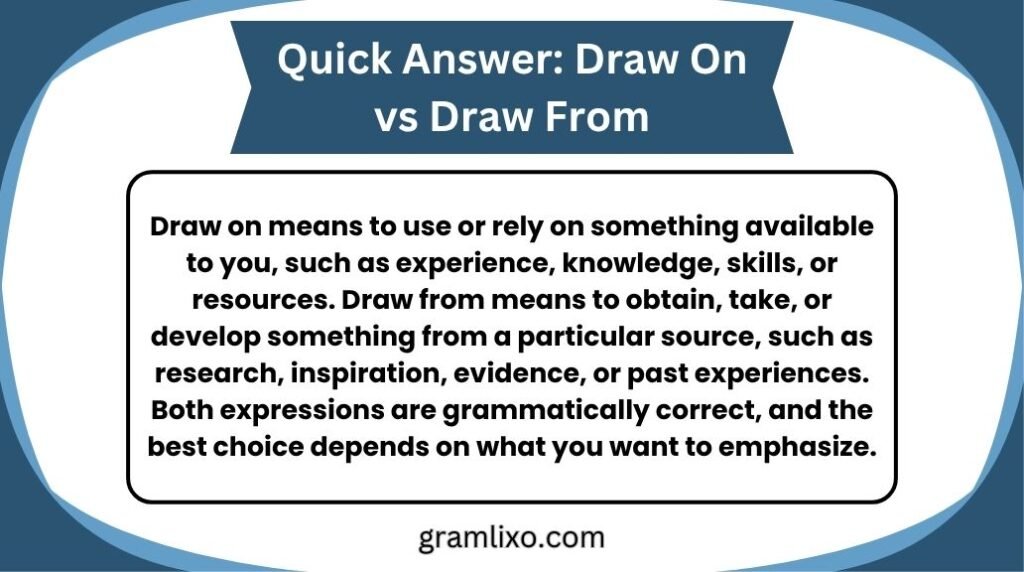
Draw on means to use or rely on something available to you, such as experience, knowledge, skills, or resources. Draw from means to obtain, take, or develop something from a particular source, such as research, inspiration, evidence, or past experiences. Both expressions are grammatically correct, and the best choice depends on what you want to emphasize.
Examples:
- Draw on: The teacher drew on her experience to help the new students.
- Draw from: The teacher drew examples from her previous classes.
The first sentence emphasizes using accumulated experience. The second emphasizes the source from which the examples came.
Understanding the Basics of Draw On vs. Draw From
The main difference between these expressions is the emphasis they place on a source.
- Draw on focuses on using something that is available or accumulated.
- Draw from focuses on where something is obtained, taken, or developed.
The distinction is not absolute. In many sentences, both expressions are natural and correct. For example, a writer can draw on personal experience or draw from personal experience. The choice depends on the intended emphasis and the surrounding sentence. Standard learner’s dictionaries recognize both patterns, including draw on/upon and draw something from a source.
Oxford Learner’s Dictionaries
+1
Comparison Table
| Form | Type | Meaning | Example | Correct/Incorrect |
|---|---|---|---|---|
| Draw on | Phrasal verb | Use available knowledge, experience, or resources | She drew on her training. | Correct |
| Draw from | Verb + preposition | Obtain something from a source | She drew inspiration from nature. | Correct |
| Draw upon | Variant of draw on | Rely on or make use of something | We drew upon our experience. | Correct |
| Draw on from | Usually an incorrect combination in this meaning | Unnecessarily combines two patterns | She drew on from her training. | Usually incorrect |
| Draw from on | Incorrect combination in this meaning | Places the prepositions in the wrong order | She drew from on her training. | Incorrect |
Remember: The expressions are not opposites. They overlap in meaning, so you should choose the one that communicates your idea most naturally.
Consider these examples:
- The coach drew on his experience to motivate the players.
- The coach drew from his experience to develop a new strategy.
Both sentences are grammatically correct. The first emphasizes using experience as a resource. The second emphasizes experience as the source of the strategy.
Correct Meanings and Uses of Draw On
1. Draw On Means to Use Experience or Knowledge
One of the most common uses of draw on is to describe using knowledge, skills, or experience to complete a task or solve a problem.
Examples:
- The doctor drew on years of medical experience to make a decision.
- I draw on my knowledge of grammar when editing articles.
- The new manager drew on lessons from her previous job.
Sentence breakdown:
Consider the sentence, “The doctor drew on years of medical experience to make a decision.”
- The doctor: The person performing the action.
- Drew on: Indicates using an existing resource.
- Years of medical experience: The resource being used.
- To make a decision: Explains the purpose.
The expression works because the doctor already has experience and uses it to help make a decision.
2. Draw On Means to Rely on Available Resources
You can also use draw on when talking about money, time, energy, support, or other resources.
Examples:
- The family had to draw on its savings during the emergency.
- The team drew on its limited resources to finish the project.
- She drew on her inner strength during a difficult period.
In each sentence, something available is being used to meet a need.
Why this usage works: The phrase presents the resource as something a person or group can access when necessary.
For example, a company may draw on its emergency fund when unexpected expenses arise. The money is already available, and the company uses it to handle the situation.
3. Draw On Means to Use Ideas or Information
Writers, teachers, researchers, and students frequently use draw on to describe applying existing information or ideas.
Examples:
- The author draws on historical records to explain the event.
- The teacher drew on several theories to design the lesson.
- The report draws on years of research.
This usage is particularly helpful in academic and professional writing because it shows that an argument, explanation, or decision is based on existing knowledge.
4. Draw On Means to Apply Skills or Abilities
The phrase can also describe using a particular ability to accomplish something.
Examples:
- The designer drew on her creativity to develop a unique logo.
- The speaker drew on his communication skills during the presentation.
- The athletes drew on their teamwork to win the match.
Here, the resource is not a physical object. It is a personal quality or ability.
5. Draw On or Draw Upon
Draw upon is a standard alternative to draw on. Both expressions can mean to use or rely on something.
Examples:
- We drew on our past experiences.
- We drew upon our past experiences.
Both sentences are correct. Draw upon may sound slightly more formal in some contexts, but draw on is also appropriate in professional and academic writing.
Collins English Dictionary
+1
Correct Meanings and Uses of Draw From
1. Draw From Means to Obtain Something From a Source
Use draw from when you want to identify where an idea, resource, example, or other thing comes from.
Examples:
- The artist draws inspiration from nature.
- The student drew several examples from the textbook.
- The organization drew funding from multiple sources.
Sentence breakdown:
Consider the sentence, “The artist draws inspiration from nature.”
- The artist: The person performing the action.
- Draws: Indicates obtaining or developing something.
- Inspiration: What the artist obtains.
- From nature: Identifies the source.
The phrase from nature answers the question, “Where does the inspiration come from?”
2. Draw From Means to Get Inspiration
Creative professionals often use draw from when explaining the sources of their ideas.
Examples:
- The novelist draws from childhood memories when creating characters.
- The photographer drew from city life to plan her exhibition.
- The songwriter draws from personal experiences when writing lyrics.
This expression makes the relationship between an idea and its source clear.
For example, a novelist may use memories of a childhood neighborhood to create a fictional setting. Those memories are the source from which the author develops ideas.
3. Draw From Means to Use Evidence or Research as a Source
In academic, scientific, and professional writing, draw from can identify the evidence or material used to support a conclusion.
Examples:
- The researcher drew from several published studies.
- The report draws from interviews with local residents.
- The presentation draws from data collected over five years.
These sentences emphasize the sources behind the work.
However, draw on can also be correct in these contexts. For example, “The report draws on interviews with local residents” is natural English. The difference is one of emphasis, not a strict rule that separates correct from incorrect grammar.
4. Draw From Means to Learn From Past Experiences
You can use draw from to describe taking lessons or insights from previous events.
Examples:
- She drew from her mistakes to improve her performance.
- The team drew from its previous failures to create a better plan.
- I draw from my experiences when giving advice to new writers.
This usage emphasizes how past events become a source of future learning.
5. Draw From Means to Take From a Particular Group or Collection
The phrase can identify the people, places, or collections from which something is selected or developed.
Examples:
- The committee selected candidates from a pool of qualified applicants.
- The filmmaker drew characters from people he had met.
- The course draws examples from different cultures.
In these cases, from helps identify the source, group, or collection involved.
Draw On vs. Draw From: Side-by-Side Examples
The easiest way to understand the difference is to compare similar sentences.
| Draw on | Draw from | Main emphasis |
|---|---|---|
| She drew on her experience. | She drew from her experience. | Both are correct; the first emphasizes using experience, while the second emphasizes its role as a source. |
| The writer drew on historical records. | The writer drew details from historical records. | Using source material vs. obtaining specific details |
| He drew on his creativity. | He drew inspiration from art. | Applying an ability vs. identifying a source of inspiration |
| The company drew on its reserves. | The company drew money from its reserves. | Using available resources vs. specifying what was taken and where it came from |
| The professor drew on previous research. | The professor drew evidence from previous research. | Relying on research vs. identifying evidence obtained from it |
Notice that the second expression often sounds especially natural when the sentence names a specific thing obtained from a source: draw evidence from, draw inspiration from, or draw examples from.
But this is a helpful tendency, not an unbreakable grammar rule.
Test Tip 💡
Ask yourself two questions:
- Am I emphasizing the use of an available resource? Try draw on.
- Am I emphasizing where a particular idea, example, or piece of information comes from? Try draw from.
If both descriptions fit, both expressions may be acceptable. Read the entire sentence to see which one communicates your meaning more clearly.
Case Study: Draw On vs. Draw From in the Workplace
Imagine that Maya is a marketing manager preparing a campaign for a new product. She has worked in marketing for ten years and has reviewed several successful campaigns from other companies.
Her team asks how she plans to develop the new campaign.
Maya explains:
“I will draw on my experience managing previous campaigns and draw inspiration from successful examples in our industry.”
This response uses both expressions naturally.
Why the First Expression Works
“I will draw on my experience managing previous campaigns.”
Maya is emphasizing the professional knowledge she has accumulated over ten years. She will use that knowledge to make decisions, solve problems, and guide her team.
Why the Second Expression Works
“I will draw inspiration from successful examples in our industry.”
Maya is identifying the source of her inspiration. She has examined other campaigns and plans to use ideas from them to guide her creative process.
How Maya Could Use Both Expressions in an Email
EmailApproach for Our New Marketing Campaign
Approach for Our New Marketing Campaign
Hi Team,
For our upcoming campaign, I plan to draw on my experience with previous product launches and draw inspiration from successful campaigns in our industry.
I will also draw on our team’s research and draw examples from recent customer feedback to help us develop a strategy that meets our audience’s needs.
I’ll share the initial plan once I’ve reviewed the available information.
Best,
Maya
This example demonstrates an important point: the expressions can appear together because they serve different purposes in the same message. One emphasizes using existing knowledge, while the other can identify the source of ideas or evidence.
Grammar Rules: Why Draw On and Draw From Are Correct
Both expressions are accepted in standard English. Neither is inherently incorrect, and choosing between them is mainly a matter of meaning, emphasis, and natural phrasing.
Rule 1: Use Draw On When Emphasizing Use or Reliance
The structure is:
draw on + noun phrase
Examples:
- draw on experience
- draw on knowledge
- draw on savings
- draw on available resources
- draw on professional skills
The phrase after on identifies the resource being used.
For example:
“During the crisis, the organization drew on its emergency fund.”
The organization used money that was available to it.
Rule 2: Use Draw From When Emphasizing a Source
The basic structure is:
draw + object + from + source
Examples:
- draw inspiration from nature
- draw evidence from research
- draw examples from a textbook
- draw strength from family
- draw information from official records
For example:
“The researcher drew evidence from several published studies.”
Here, evidence is what the researcher obtained, and several published studies are the sources.
The object does not always have to be expressed explicitly. For example, “The researcher drew from several published studies” is also possible when the intended meaning is clear.
Rule 3: Keep the Verb Form Consistent With the Tense
The prepositions do not change the verb’s tense. The verb draw changes according to the sentence.
| Tense or form | Example |
|---|---|
| Present simple | I draw on my experience. |
| Third-person singular | She draws from her research. |
| Simple past | He drew on his training. |
| Present continuous | They are drawing from several sources. |
| Present perfect | We have drawn on past lessons. |
| Infinitive | She hopes to draw from the available data. |
Remember the main forms of the verb:
- Present: draw
- Past: drew
- Past participle: drawn
- Present participle: drawing
Incorrect: “She drawed on her experience.”
Correct: “She drew on her experience.”
Rule 4: Do Not Combine the Prepositions Unnecessarily
When you mean “use a resource” or “obtain something from a source,” avoid combining on and from into an awkward sequence.
Incorrect: “The author drew on from several books.”
Correct: “The author drew on several books.”
Also correct: “The author drew information from several books.”
The correction depends on what the writer wants to emphasize. The first correct version focuses on using the books as resources. The second identifies the information obtained from them.
What Do Standard Dictionaries Say?
The Oxford Advanced Learner’s Dictionary defines draw on/upon something in terms of using an available supply or resource. It defines draw from as taking or obtaining something from a particular source. Cambridge also recognizes draw on for using information or knowledge to accomplish something.
Oxford Learner’s Dictionaries
+2
These definitions support the practical distinction in this article. They do not establish a rule that one expression is always correct while the other is always wrong.
For authoritative reference, consult Oxford Learner’s Dictionaries: Draw On, Oxford Learner’s Dictionaries: Draw From, and Cambridge Dictionary: Draw On.
Common Mistakes With Draw On vs. Draw From
Even experienced writers sometimes confuse these expressions. The most common problem is assuming that they have exactly the same emphasis in every context—or believing that one is always wrong.
Mistake 1: Treating One Expression as Universally Correct
Incorrect reasoning: “I must always use draw from when talking about experience.”
Better understanding: Both expressions can describe using experience.
- Correct: The consultant drew on her experience to solve the problem.
- Correct: The consultant drew from her experience to solve the problem.
The first emphasizes reliance on experience. The second presents experience as the source of the consultant’s approach or insight.
Mistake 2: Using Both Prepositions in the Same Construction
Incorrect: “The speaker drew on from his research.”
Better:
- “The speaker drew on his research.”
- “The speaker drew evidence from his research.”
The problem is not that on and from can never appear in one sentence. The problem is combining them in a single construction without a grammatical reason.
Mistake 3: Confusing the Source With the Resource
Consider these examples:
- “She drew on her knowledge.”
- “She drew several conclusions from the evidence.”
The first sentence presents knowledge as a resource. The second identifies evidence as the source of the conclusions.
A useful question is: What exactly is the sentence describing—the use of a resource or the origin of something?
Mistake 4: Using the Wrong Verb Form
Because draw is an irregular verb, its past tense can also cause errors.
Incorrect: “They have drew from the report.”
Correct: “They have drawn from the report.”
After have, has, or had, use the past participle drawn, not drew.
Similar Grammar Confusions
| Common confusion | Correct usage | Example |
|---|---|---|
| It’s vs. its | It’s means “it is” or “it has”; its shows possession. | It’s losing its color. |
| Your vs. you’re | Your shows possession; you’re means “you are.” | You’re holding your book. |
| Their vs. there | Their shows possession; there refers to a place or introduces a statement. | Their bags are over there. |
| Affect vs. effect | Affect is usually a verb; effect is usually a noun. | The change may affect the result. |
| Draw on vs. draw from | Choose according to whether you emphasize use or source. | She drew on her skills and drew ideas from her research. |
Why Do These Mistakes Happen?
- Fast typing: Writers may select the first phrase that comes to mind without checking the intended meaning.
- Autocorrect: Predictive text may replace a phrase with another grammatically possible expression that does not fit the sentence.
- Lack of knowledge: Learners may memorize one example without understanding how the prepositions affect emphasis.
- Overthinking: Writers sometimes assume there must be one rigid rule even when English permits both constructions.
- Translation habits: Translating directly from another language can produce combinations that sound unnatural in English.
The best solution is to learn each expression through complete sentences rather than memorizing isolated prepositions.
Usage in Different Contexts
1. Everyday Conversation
In everyday American English, both expressions sound natural.
Examples:
- “I’ll draw on what I learned last year.”
- “I draw inspiration from my favorite artists.”
- “We can draw on our savings if we need to.”
- “He drew strength from his friends.”
Use the expression that most clearly communicates your meaning. You do not need to make every conversation sound formal or academic.
2. Professional Writing
In workplace communication, draw on is particularly useful when discussing expertise, skills, experience, and resources.
Examples:
- “We will draw on the team’s expertise to improve the process.”
- “The department drew on its existing budget to cover the expense.”
Draw from is also effective when identifying sources of evidence, ideas, or information.
Examples:
- “The proposal draws data from recent customer surveys.”
- “The report draws conclusions from the available evidence.”
Professional writing benefits from clear relationships between actions and sources. Both phrases can help establish those relationships.
3. Academic Writing
Academic writers often need to explain how arguments relate to evidence, theories, and previous research.
Examples:
- “This paper draws on established theories of language acquisition.”
- “The analysis draws examples from a collection of published essays.”
- “The researcher drew on earlier findings to formulate a hypothesis.”
The choice depends on the sentence’s focus. If the sentence emphasizes the body of research informing an argument, draws on is a natural choice. If it identifies specific information obtained from a source, draws … from may be more precise.
4. Creative Writing
Authors can use both expressions to discuss inspiration, character development, and storytelling.
Examples:
- “The novelist draws on family history to create believable characters.”
- “The poet draws inspiration from the changing seasons.”
- “The screenwriter drew details from real-life interviews.”
In creative writing, either expression can work well. Choose the version that best reflects the relationship between the creator and the source material.
5. Social Media and Texting
Casual messages rarely require a detailed explanation of the difference, but natural wording still matters.
Examples:
- “I’m drawing on everything I learned during training.”
- “This design draws inspiration from nature.”
- “We can draw from our past experiences and do better next time.”
For shorter posts, clarity is more important than trying to sound sophisticated. Choose a phrase that fits the intended message.
Why the Difference Matters
Understanding draw on vs. draw from improves your writing in several important ways.
1. Clarity in Communication
The right phrase helps readers understand how information, experience, or resources relate to an action.
Compare:
- “The writer drew on the interviews.”
- “The writer drew quotes from the interviews.”
Both sentences are correct, but the second identifies a specific item obtained from the interviews.
2. Professionalism
Using expressions accurately makes workplace emails, reports, and presentations easier to understand. It also helps you communicate your ideas with confidence.
3. Accuracy in Digital Communication
Online articles, emails, social media posts, and educational materials reach readers quickly. Clear language reduces confusion and makes your message easier to interpret.
4. Stronger Writing Skills
Learning the difference between similar expressions helps you recognize how small word choices affect meaning. This skill is useful when editing your own work or reviewing someone else’s writing.
“Choose the words that express your meaning, not merely the words that sound familiar.”
Special Exceptions and Less Common Uses
Although this article focuses on using knowledge, experience, and resources, draw on and draw from have other meanings and uses.
Draw On Can Refer to Time Passing
In a different construction, draw on can mean that a period of time is passing or approaching.
Examples:
- As evening drew on, the temperature dropped.
- Winter is drawing on, so we should prepare for colder weather.
This meaning is different from using a resource. The subject is usually a period of time or a season.
Oxford Learner’s Dictionaries
+1
Draw On Can Refer to Putting on Clothing
In some contexts, draw on means to put on a garment.
Example:
– She drew on her gloves before leaving the house.
This is a separate meaning and does not follow the resource-use distinction discussed earlier.
Draw Upon Is an Accepted Alternative
Draw upon is not an error or a separate phrasal verb with a completely different meaning. It can replace draw on when the intended meaning is to use or rely on something.
Examples:
- The teacher drew on her experience.
- The teacher drew upon her experience.
Both are correct.
There Is No Special Brand-Name Exception
In ordinary writing, no special brand-name rule determines whether you should use draw on or draw from. If a company or product uses either expression in its official name or slogan, preserve that exact wording when referring to it. Otherwise, follow standard usage and the meaning you intend to convey.
Quick Recap Checklist
Use this checklist when editing your sentences.
| Question | If Yes → Use |
|---|---|
| Am I emphasizing the use of accumulated experience? | Draw on |
| Am I describing reliance on skills or knowledge? | Draw on |
| Am I emphasizing where an idea or example originated? | Draw from |
| Am I identifying the source of inspiration? | Draw from |
| Am I describing research or information used to support an argument? | Either may work; choose based on emphasis |
| Am I talking about a season or time approaching? | Draw on, in the appropriate time-related construction |
Practice Examples
Choose the best expression for each blank.
- The manager decided to ______ her experience when handling the difficult situation.
- The artist draws inspiration ______ the natural world.
- The report draws ______ several years of customer research.
Answers:
- Draw on — The manager is using accumulated experience.
- From — The sentence identifies the source of inspiration.
- On — The report relies on the research as a resource. “Draws from several years of customer research” would also be correct, particularly if the emphasis is on the research as the source.
Frequently Asked Questions (FAQs)
1. What is the difference between draw on and draw from?
Draw on usually emphasizes using or relying on an available resource, such as knowledge, experience, or savings. Draw from often emphasizes obtaining something from a source, such as inspiration, evidence, or examples. Both expressions can be correct when referring to experience or research.
2. Is it draw on experience or draw from experience?
Both are correct.
- “She drew on her experience to solve the problem.”
- “She drew from her experience to develop the solution.”
The first emphasizes using experience. The second emphasizes experience as the source of the solution.
3. Is draw upon grammatically correct?
Yes. Draw upon is a standard alternative to draw on. For example, “The team drew upon its collective knowledge” is grammatically correct. It has the same basic meaning as “The team drew on its collective knowledge.”
4. Can I use draw on and draw from in the same sentence?
Yes. For example: “The writer drew on her experience and drew examples from her research.” The expressions work together because they describe related but different aspects of the writing process.
5. Is draw from more formal than draw on?
Neither expression is inherently more formal in every context. Both appear in professional, academic, and everyday English. The choice should depend on the intended meaning and the natural flow of the sentence.
6. Is “draw on from” grammatically correct?
Usually not when you mean using a resource or obtaining something from a source. Write “draw on experience” or “draw inspiration from experience” instead. Choose one grammatical construction rather than combining on and from unnecessarily.
Conclusion
Understanding draw on vs. draw from is easier when you focus on meaning rather than memorizing a strict rule. Draw on generally emphasizes using or relying on something available, such as experience, knowledge, skills, or resources. Draw from often emphasizes obtaining something from a particular source, such as inspiration, information, or evidence.
However, these expressions overlap. You can correctly say that someone draws on experience or draws from experience. The best choice depends on the sentence, the intended emphasis, and the type of source being discussed.
For everyday conversations, professional emails, academic papers, and creative writing, both expressions are useful. Remember to use the correct verb forms—draw, drew, drawn, and drawing—and avoid combining prepositions unnecessarily.
The golden rule is simple: draw on what you use, draw from where something comes, and choose the expression that makes your meaning clearest.

I’m Michael Williams, an English writer and grammar enthusiast at Gramlixo. I’m passionate about making grammar easier to learn and helping readers write with greater confidence.
[…] |Draw On vs Draw From: Meaning, Differences, and Correct Usage […]