
Long term vs. long-term is a common grammar confusion in American English. Have you ever wondered whether to write “long term” or “long-term” in an email, blog post, school assignment, or business report? Both forms are correct, but they serve different grammatical purposes.
Generally, “long term” is used as a noun phrase to refer to an extended period, while “long-term” is a compound adjective that describes a noun. For example, you might say, “We are planning for the long term,” but write, “We need a long-term strategy.”
Understanding this simple difference can improve your writing accuracy, readability, and professionalism.
In this guide, I’ll explain the rules with clear examples, practical tips, common mistakes, and frequently asked questions to help you use both forms confidently.
|Cacoon vs. Cocoon: Which Spelling Is Correct?
|To vs Too: What’s the Difference? Easy Rules, Examples, and Tips
|Extensible vs Extendible: What’s the Difference?
Quick Answer: Long Term vs. Long-Term
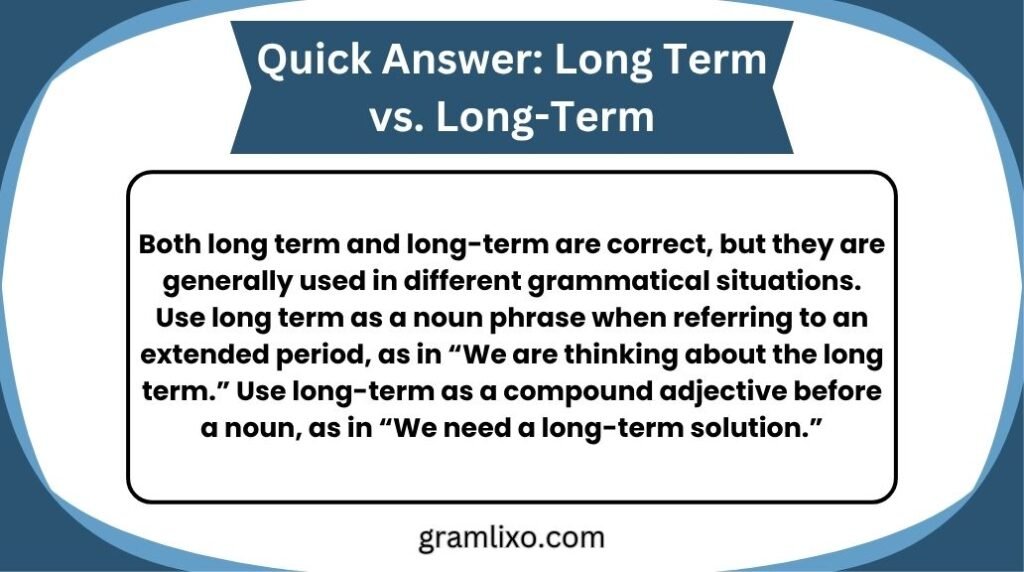
Both long term and long-term are correct, but they are generally used in different grammatical situations. Use long term as a noun phrase when referring to an extended period, as in “We are thinking about the long term.” Use long-term as a compound adjective before a noun, as in “We need a long-term solution.”
Easy rule: If the expression describes a noun, the hyphen is usually appropriate. If it refers to an extended period as a noun phrase, leave out the hyphen.
Examples:
- Correct: We are investing for the long term.
- Correct: She developed a long-term investment plan.
- Correct: In the long term, regular exercise can improve overall fitness.
Notice that the third sentence uses “long term” without a hyphen because the expression follows the preposition “in” and functions as a noun phrase.
Understanding the Basics of Long Term vs. Long-Term
The key to understanding this difference is recognizing the grammatical role of the expression. Both forms communicate the idea of something lasting or extending over a considerable period. The difference is mainly in sentence structure, not meaning.
What Does “Long Term” Mean?
“Long term” generally refers to an extended period or the future considered over a substantial length of time. It often appears in expressions such as “in the long term,” “over the long term,” and “for the long term.”
Examples:
- We need to consider the long term before making a decision.
- The policy could benefit the community in the long term.
- They are saving money for the long term.
In each sentence, “long term” refers to a period of time rather than describing a noun immediately after it.
What Does “Long-Term” Mean?
“Long-term” is a compound adjective that describes a person, thing, plan, effect, relationship, or condition expected to last or remain relevant for an extended period.
Examples:
- The company created a long-term business plan.
- He is looking for a long-term relationship.
- The treatment may have long-term effects.
In these examples, the hyphen connects “long” and “term” so they work together as a single descriptive unit.
Comparison Table: Long Term vs. Long-Term
| Form | Type | Meaning | Example | Correct/Incorrect |
|---|---|---|---|---|
| Long term | Noun phrase | An extended period | We are planning for the long term. | Correct |
| Long-term | Compound adjective | Lasting over an extended period | We need a long-term plan. | Correct |
| Long-term | Compound adjective | Describes future effects | The drug may have long-term effects. | Correct |
| Long term | Noun phrase | An extended period | In the long term, costs may fall. | Correct |
| Long-term plan | Compound adjective + noun | A plan for an extended period | They created a long-term plan. | Correct |
| Long-term, used without a following noun | Depends on context | Often unnecessary hyphenation in ordinary prose | We must think about the long-term. | Usually avoid; write “the long term.” |
The final example needs a little nuance. Some styles use a hyphenated form when the phrase is elliptical or when a particular style guide permits it. However, in standard everyday US English, “the long term” is the clearer and more conventional choice when the expression stands as a noun phrase.
Correct Meanings and Uses of Long Term vs. Long-Term
The easiest way to master this grammar rule is to see how the expression works in different sentences. Let’s examine the main uses, with sentence breakdowns and practical examples.
1. When to Use “Long Term” Without a Hyphen
Use “long term” when you are referring to an extended period rather than using the phrase as a compound adjective before a noun.
This form commonly appears after prepositions such as in, over, and for.
Examples:
- In the long term, the new system should save money.
- She is thinking about the long term.
- We are planning for the long term.
- Over the long term, small changes can produce significant results.
- The decision may prove beneficial in the long term.
Sentence breakdown:
Consider this example:
“In the long term, the company expects to grow.”
- “In” is a preposition.
- “The long term” is a noun phrase referring to an extended period.
- “The company expects to grow” explains what may happen during that period.
Because “long term” refers to a period of time, it does not need a hyphen here.
2. When to Use “Long-Term” With a Hyphen
Use “long-term” when it functions as a compound adjective describing a noun. The hyphen shows that “long” and “term” work together to describe one thing.
Examples:
- We need a long-term solution.
- She has long-term career goals.
- The business developed a long-term strategy.
- They are discussing the long-term effects of the policy.
- He wants to build a long-term relationship with his clients.
Sentence breakdown:
Consider this sentence:
“The team developed a long-term strategy.”
- “Strategy” is the noun.
- “Long-term” describes the strategy.
- The hyphen connects the two words into one descriptive unit.
The phrase tells readers what kind of strategy the team developed: one intended to guide decisions over an extended period.
The Oxford Advanced American Dictionary also lists long-term as an adjective, with examples such as “a long-term strategy” and “a long-term investment.”
Oxford Learner’s Dictionaries
3. Is “Long Term” Correct After a Verb?
Yes. The unhyphenated form can appear after a verb when it functions as a noun phrase or as part of an established expression.
Examples:
- We must think about the long term.
- She is investing for the long term.
- They are focused on the long term.
- The company plans for the long term.
In these sentences, the phrase refers to an extended period or a future-oriented perspective.
However, do not assume that every expression appearing after a verb must be written without a hyphen. Consider these examples:
- The medication may have long-term effects.
- The company hopes to build a long-term partnership.
The hyphen remains because “long-term” describes the nouns “effects” and “partnership.”
4. Can “Long-Term” Appear at the End of a Sentence?
Yes. Although “long-term” is commonly placed before a noun, it can also appear later in a sentence, particularly when it functions as an adverbial expression.
Examples:
- We cannot afford to maintain this arrangement long-term.
- She hopes to remain in the role long-term.
- The business wants to retain its customers long-term.
In these examples, “long-term” describes the duration of the action or situation rather than directly preceding a noun.
Usage can vary by dictionary and style guide. For consistent, polished US English, the hyphenated form is a reasonable choice in these adverbial uses. If you are following a specific publication’s style guide, follow its preferred spelling.
5. What About “In the Long Term” vs. “In the Long-Term”?
The standard expression is “in the long term,” without a hyphen.
Examples:
- In the long term, this investment may pay off.
- Exercise can provide benefits in the long term.
- In the long term, good habits can make everyday tasks easier.
Compare the following sentences:
- Correct: The company expects lower costs in the long term.
- Correct: The company expects long-term cost savings.
The first sentence refers to a period. The second uses “long-term” to describe the cost savings.
Test Tip: Ask yourself whether you are naming a period of time or describing something. If you mean “over an extended period,” use “in the long term.” If you mean “a plan that lasts for an extended period,” use “a long-term plan.”
Case Study: Long Term vs. Long-Term in a Workplace Email
Imagine that a marketing manager is preparing an email about a new business strategy. The company wants to improve its current sales while building a stronger future.
The manager writes:
WORKPLACE EMAIL EXAMPLE
Subject: Planning for Long-Term Growth
Hi Team,
We need a long-term strategy that supports sustainable growth. Our current goal is to increase sales, but we should also consider how today’s decisions will affect the business in the long term.
I recommend investing in customer relationships, improving our website, and developing a long-term content plan. These changes may require additional work now, but they could create lasting benefits over time.
Let’s review our options and choose an approach that supports our long-term goals.
Best regards, Marketing Manager
Why Is This Email Correct?
The email uses both forms appropriately.
| Expression | Why It Works |
|---|---|
| Long-term growth | “Long-term” describes growth. |
| Long-term strategy | “Long-term” describes strategy. |
| In the long term | “Long term” refers to a future period. |
| Long-term content plan | “Long-term” describes the content plan. |
| Long-term goals | “Long-term” describes the goals. |
Now imagine the manager wrote, “We need a long term strategy.”
Although readers would probably understand the intended meaning, the missing hyphen makes the compound adjective less clear. In polished professional writing, “long-term strategy” is the better choice.
This example shows why the distinction matters in business emails, reports, presentations, and proposals. Correct hyphenation helps readers understand the intended relationship between words without stopping to interpret the sentence.
Grammar Rules Explained: Why Is the Hyphen Important?
A hyphen is a punctuation mark that can connect words that work together as a single unit. Compound modifiers often use hyphens to make their meaning clear.
Rule 1: Hyphenate Compound Adjectives Before Nouns
When “long” and “term” work together to describe a noun, write them with a hyphen.
Examples:
- A long-term investment
- A long-term agreement
- A long-term objective
- A long-term commitment
- A long-term effect
In each example, “long-term” answers the question “What kind?”
For instance, in “a long-term agreement,” the expression describes the type of agreement.
Rule 2: Leave the Hyphen Out When “Long Term” Is a Noun Phrase
When the expression refers to an extended period, write it as two words.
Examples:
- We are planning for the long term.
- In the long term, the benefits may outweigh the costs.
- The organization is focused on the long term.
- Over the long term, the process may become more efficient.
Here, “long term” refers to a period of time, not a noun that follows it.
Rule 3: Recognize That Position Can Affect Hyphenation
The role of a word group in a sentence matters more than a simple rule about whether a noun appears immediately afterward.
Compare these examples:
- The company created a long-term plan.
- The company plans for the long term.
- The plan is intended to be effective long-term.
The first uses a compound adjective before a noun. The second uses a noun phrase after a preposition. The third uses “long-term” as an adverbial expression.
This is why the best rule is to examine how the expression functions, rather than relying on position alone.
Rule 4: Avoid Writing “Longterm” as One Word
In standard US English, write the expression as either “long term” or “long-term,” depending on its grammatical function.
Examples:
- Incorrect: We need a longterm plan.
- Correct: We need a long-term plan.
- Incorrect: We are planning for the longterm.
- Correct: We are planning for the long term.
A company or product may use Longterm as part of a brand name, but that does not make it the standard spelling in ordinary writing.
What Do Grammar Authorities Say?
The Oxford Advanced American Dictionary identifies long-term as an adjective and gives examples involving strategies, investments, and effects. This supports the standard use of the hyphenated form when describing a noun.
Oxford Learner’s Dictionaries
+1
The broader principle is that hyphens help readers recognize compound modifiers. When the phrase stands as a noun phrase, as in “in the long term,” the hyphen is generally unnecessary.
Remember that style guides can differ on some compound words and adverbial uses. If you write for a company, school, publisher, or website with its own style guide, follow that guide consistently.
Common Mistakes With Long Term vs. Long-Term
Even experienced writers sometimes confuse these forms. The mistake usually happens because the words look similar, and people focus on spelling rather than grammatical function.
Common Reasons for Mistakes
- Fast typing: Writers may forget the hyphen while composing an email or article quickly.
- Autocorrect: Some writing tools may change punctuation or suggest a form that does not fit the sentence.
- Lack of knowledge: Many people do not realize that a hyphen can depend on how a word group functions.
- Copying online text: Writers may copy a phrase from a source that uses inconsistent punctuation.
- Confusion about sentence structure: A writer may know that “long-term plan” is correct but incorrectly apply the hyphen to “in the long term.”
Frequently Confused Grammar Expressions
| Confusing Forms | Correct Usage | Example |
|---|---|---|
| Long term / Long-term | Noun phrase / Compound adjective | In the long term, we need a long-term plan. |
| It’s / Its | Contraction / Possessive determiner | It’s a good idea. The company changed its policy. |
| Your / You’re | Possessive / Contraction | Your report is ready. You’re doing well. |
| Everyday / Every day | Adjective / Time expression | These are everyday tasks. I exercise every day. |
| Setup / Set up | Noun or adjective / Verb | The setup is simple. Set up your account. |
| Follow-up / Follow up | Noun or adjective / Verb | Send a follow-up email. Follow up tomorrow. |
| Short term / Short-term | Noun phrase / Compound adjective | Think about the short term. Create a short-term plan. |
| In-depth / In depth | Compound adjective / Adverbial phrase | Read an in-depth report. Discuss the topic in depth. |
How to Avoid These Errors
Before publishing or submitting your writing, follow these steps:
- Identify the expression’s grammatical role.
- Check whether “long-term” describes a noun.
- Use “long term” when referring to the period itself.
- Read the entire sentence to confirm that the meaning is clear.
- Use a reliable dictionary or style guide when the correct form is uncertain.
A grammar checker can help identify potential problems, but understanding the rule allows you to make the final decision confidently.
Usage in Different Contexts
The distinction between “long term” and “long-term” applies to everyday conversations, professional writing, creative work, and digital communication.
1. Everyday Conversation
In casual conversations, people often discuss future plans, relationships, careers, and personal goals.
Examples:
- “I’m thinking about the long term before making a decision.”
- “We need a long-term solution to this problem.”
- “Will this arrangement work in the long term?”
- “She is looking for a long-term relationship.”
The same grammar rule applies whether you speak or write. The difference is simply more visible in written English because the hyphen appears on the page.
2. Professional Writing
Business communication often involves plans, investments, projects, and organizational goals. These topics frequently require the adjective “long-term.”
Examples:
- The company developed a long-term growth strategy.
- Our long-term objectives include improving customer satisfaction.
- We must evaluate the project’s long-term financial impact.
- The new policy could reduce operating costs in the long term.
In professional documents, consistent punctuation helps maintain a polished appearance and reduces ambiguity.
3. Creative Writing
Authors may use both forms when discussing a character’s future, relationships, or personal development.
Examples:
- She wondered whether the friendship would survive in the long term.
- He had a long-term dream of opening his own bookstore.
- The decision would affect her family for years to come.
- Their long-term relationship changed after they moved to another city.
Creative writers can also choose alternative expressions, such as “lasting,” “over the years,” or “in the years ahead,” when they fit the tone better.
4. Social Media and Texting
Informal digital communication often includes shortened sentences and inconsistent punctuation. However, the standard forms remain useful when clarity matters.
Examples:
- “I’m thinking long term.”
- “We need a long-term plan!”
- “Is this going to work in the long term?”
- “Looking for a long-term business partner.”
If you are writing a professional social media post, blog caption, or promotional message, correct hyphenation can make your content look more polished.
Why Correct Usage Matters
Understanding long term vs. long-term may seem like a small grammar lesson, but it supports better communication in several ways.
1. Clarity in Communication
Punctuation helps readers understand how words work together. In “long-term investment,” the hyphen makes it clear that the two words jointly describe the investment.
2. Professionalism
Correct grammar shows attention to detail. In business proposals, resumes, reports, and emails, small punctuation errors can distract readers from your message.
3. Accuracy in Digital Communication
Online articles, website content, and social media posts should be easy to read. Using the correct form helps maintain consistency across headings, paragraphs, and metadata.
4. Better Editing Habits
Learning this distinction helps you recognize other compound modifiers, including “short-term,” “high-quality,” and “well-known.”
As a simple reminder:
“Clear writing makes your message easier to understand.”
The goal is not to add hyphens everywhere. It is to use punctuation where it supports meaning.
Special Exceptions and Edge Cases
Although the main rule is straightforward, some situations deserve extra attention.
1. When “Long-Term” Appears After a Noun
A hyphenated compound adjective does not always have to appear before the noun it describes.
For example:
- The effects may be long-term.
- Their goals are long-term.
- The benefits could be long-term.
In these sentences, “long-term” appears after a linking verb. The hyphen is still commonly used because the expression retains its compound-adjective meaning.
2. When “Long-Term” Functions Adverbially
You may encounter sentences such as:
- We plan to stay long-term.
- The company wants to invest long-term.
In these cases, “long-term” describes the duration or intended time frame of the action. Usage varies by style guide, so consistency is important.
3. When “Long Term” Is Part of a Fixed Expression
Expressions such as “in the long term,” “over the long term,” and “for the long term” are conventionally written without a hyphen.
Examples:
- In the long term, the plan may succeed.
- We are preparing for the long term.
- Over the long term, the improvements could save money.
Do not add a hyphen simply because the expression refers to an extended period.
4. Brand Names and Titles
A company, website, or product may intentionally use “Longterm” as a single word for branding purposes. Such a choice is a proper-name decision, not the standard spelling rule for ordinary prose.
In regular US English writing, use “long term” or “long-term,” depending on the sentence.
Quick Recap Checklist
Use this table when you need to choose between the two forms quickly.
| Question | If Yes → Use |
|---|---|
| Am I describing a noun, as in a plan or investment? | Long-term |
| Am I referring to an extended period, as in “in the long term”? | Long term |
| Am I writing “for the long term” or “over the long term”? | Long term |
| Am I describing effects, goals, care, or strategy? | Long-term |
| Am I writing the expression as one word? | Change it to long term or long-term |
Practice Examples
Choose the correct form for each blank.
- We need a ______ strategy for future growth.
- In the ______, this decision could save money.
- She hopes to build a ______ relationship with her clients.
Choose the correct form
1. We need a ___ strategy.long termlong-term
2. In the ___, this could save money.long termlong-term
3. A ___ relationship.long termlong-term
Check answers
FAQs About Long Term vs. Long-Term
1. Is “long term” or “long-term” correct?
Both forms are correct. Use “long term” as a noun phrase referring to an extended period, as in “in the long term.” Use “long-term” as a compound adjective, as in “a long-term plan.”
2. Should I write “in the long term” or “in the long-term”?
Write “in the long term.” This conventional expression refers to an extended period and does not need a hyphen. For example: “In the long term, the investment could be worthwhile.”
3. Is “longterm” one word?
No. “Longterm” is not the standard spelling in ordinary US English. Write “long term” or “long-term,” depending on the grammatical function.
4. Should “long-term” always have a hyphen?
Not in every context. The hyphen is commonly used when the expression functions as a compound adjective or adverbial expression. When the words form a noun phrase, as in “for the long term,” leave the hyphen out.
5. Is “long-term goal” grammatically correct?
Yes. “Long-term goal” is correct because “long-term” describes the noun “goal.” The hyphen connects the words into a single compound modifier.
6. What is the difference between “long term” and “long-term” in business writing?
“Long term” refers to an extended period, as in “The company is planning for the long term.” “Long-term” describes a business concept or object, as in “The company developed a long-term strategy.”
Conclusion
Understanding long term vs. long-term is a simple but valuable part of mastering American English grammar. Both forms are correct, but the right choice depends on how the expression functions in your sentence.
Use “long term” when referring to an extended period, especially in familiar expressions such as “in the long term,” “over the long term,” and “for the long term.” Use “long-term” when the two words work together as a compound adjective, as in “long-term goals,” “long-term investment,” and “long-term strategy.”
Remember that the hyphen is not merely decorative. It helps readers recognize how words relate to one another and makes your writing easier to follow. Also, avoid writing “longterm” as a single word in standard prose.
The next time you write an email, report, blog post, or school assignment, pause for a moment and check the phrase’s grammatical role. Master the small details today, and your writing will be clearer for the long term.

I’m Sarah Martinez, a writer and English language enthusiast at Gramlixo. I love explaining grammar concepts in a clear and practical way that anyone can understand.
[…] |Long Term vs. Long-Term: What’s the Difference? […]
[…] |Long Term vs. Long-Term: What’s the Difference? […]