Have you ever written a sentence with hanged vs hung and suddenly stopped because you were not sure which word was correct? You are not alone. These two forms come from the same verb, hang, but they are not always interchangeable. The confusion becomes especially common when talking about objects, pictures, people, executions, or even phrases such as “hung up.”
The basic rule is actually quite simple: hung is normally used when something is suspended, attached, displayed, or placed somewhere, while hanged is traditionally used when a person is executed by hanging. For example, we say, “She hung the picture on the wall,” but “The prisoner was hanged for his crime.”
However, modern dictionaries also recognize some variation in historical and less formal uses. Merriam-Webster notes that both hanged and hung can occur with the execution sense, although hanged is especially appropriate for official executions.
Understanding this small distinction can make your writing more precise, professional, and natural. Let’s break down hanged vs hung in a clear and practical way. ✍️
|My Apology vs My Apologies: Which One Is Correct?
|Full Proof vs Foolproof: Which Is Correct?
|Who Else vs Whom Else: Which One Is Correct?
Quick Answer: Hanged vs Hung
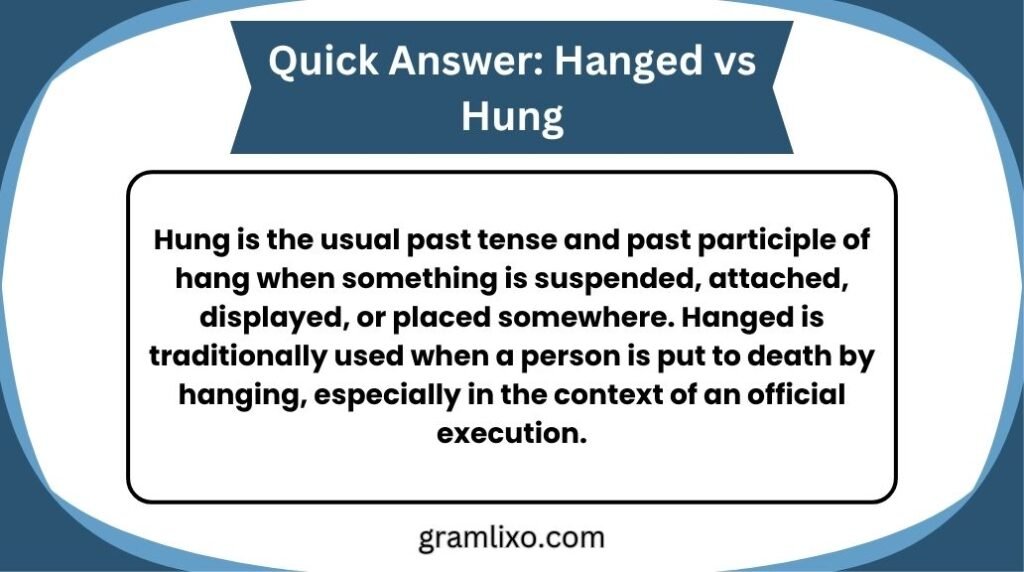
Hung is the usual past tense and past participle of hang when something is suspended, attached, displayed, or placed somewhere. Hanged is traditionally used when a person is put to death by hanging, especially in the context of an official execution.
- Hung: “We hung the painting above the fireplace.”
- Hanged: “The convicted criminal was hanged.”
Easy rule:
👉 Objects are usually hung. People executed by hanging are traditionally hanged.
Understanding the Basics of Hanged vs Hung
The confusion exists because hang has two past-tense forms: hung and hanged.
For most ordinary meanings, the past tense is hung:
- I hung my coat on the hook.
- She hung the curtains yesterday.
- They hung decorations around the room.
- The photograph was hung above the desk.
But when hang means to execute someone by suspending them by the neck, hanged is the traditional form:
- The prisoner was hanged.
- The criminal was hanged after being convicted.
- The historical figure was hanged for treason.
Merriam-Webster lists hung as the usual past form but specifically notes hanged as an established form for the execution sense. Cambridge likewise distinguishes the ordinary sense of hang, whose past forms are hung, from the execution sense, for which it gives hanged or hung, while its American Dictionary specifically lists hanged for the execution meaning.
Comparison Table
| Form | Type | Meaning | Example | Correct/Incorrect |
|---|---|---|---|---|
| hung | Past tense | Suspended or attached | She hung the picture. | ✅ Correct |
| hung | Past participle | Has been suspended or attached | The picture was hung yesterday. | ✅ Correct |
| hanged | Past tense | Executed by hanging | The prisoner was hanged. | ✅ Correct |
| hanged | Past participle | Executed by hanging | He was hanged for treason. | ✅ Correct |
| hanged | Ordinary suspension | Object suspended from a wall | She hanged the picture. | ❌ Usually incorrect |
| hung | Official execution | Person executed by hanging | The prisoner was hung. | ⚠️ Possible in some usage, but hanged is preferred in formal writing |
The most important point is that hanged vs hung is not simply a matter of choosing one spelling. The correct form depends on the meaning of the verb.
The Correct Meanings and Uses of Hung
1. Hung for Objects
Use hung when you attach or suspend an object.
For example:
She hung her coat by the door.
Here, hung means “placed on something so that it is suspended.”
The sentence can be broken down like this:
- She = subject
- hung = past-tense verb
- her coat = object
- by the door = location
More examples:
- I hung my jacket in the closet.
- We hung the decorations before the party.
- He hung the calendar beside his desk.
- They hung new curtains in the living room.
All of these use hung because nobody is being executed.
2. Hung for Pictures and Artwork
Hung is especially common with pictures, paintings, photographs, posters, and artwork.
Examples:
- The gallery hung several new paintings.
- She hung the photograph above her desk.
- We hung the poster in the hallway.
- The museum has hung the artwork near the entrance.
Notice that hanged would sound incorrect in these ordinary contexts.
❌ The museum hanged the painting.
✅ The museum hung the painting.
The reason is simple: the painting was displayed, not executed.
3. Hung for Clothing
Use hung when talking about clothing placed on a hanger, hook, rack, or similar object.
Examples:
- I hung my shirt in the closet.
- She hung her dress behind the door.
- He hung his jacket on the chair.
- We hung the uniforms in the locker room.
Merriam-Webster gives examples of hung with ordinary suspension, including hanging clothing and other objects.
4. Hung for Decorations
You also use hung when placing decorations.
Examples:
- We hung balloons around the room.
- They hung lights across the patio.
- She hung ribbons from the ceiling.
- The children hung ornaments on the tree.
Again, hung is the correct choice because the items are being suspended.
5. Hung in Expressions and Idioms
Many familiar expressions also use hung.
Examples include:
- hung up
- hung on
- hung around
- hung in the air
- hung in the balance
- hung his head
For example:
She hung up the phone.
The decision hung in the balance.
He hung his head in disappointment.
Merriam-Webster lists numerous ordinary uses of hung, including phrases involving persistence, suspension, and socializing.
The Correct Meanings and Uses of Hanged
1. Hanged for an Official Execution
The traditional rule is to use hanged when someone is executed by hanging.
For example:
The convicted criminal was hanged.
Here, hanged is not describing ordinary suspension. It describes a method of execution.
Other examples:
- The prisoner was hanged after the trial.
- The historical figure was hanged for treason.
- The convicted man was sentenced to be hanged.
- The rebel leaders were hanged after their convictions.
Cambridge identifies hanged as a past-tense form for the execution sense, while its American Dictionary specifically gives hanged as the past tense and past participle for that meaning.
2. Hanged in Historical Writing
You will frequently see hanged in historical books, biographies, legal discussions, and accounts of executions.
For example:
The accused was hanged in 1789.
This is a formal and precise use.
Historical writing often benefits from hanged because the word immediately tells the reader that the person was executed rather than simply suspended.
3. Hanged in Formal or Legal Contexts
In formal writing, hanged is generally the safest choice when referring specifically to execution by hanging.
For example:
The defendant was sentenced to be hanged.
This is clearer than using hung, especially when the sentence concerns a historical or legal execution.
Hanged vs Hung: Why the Difference Exists
The English verb hang developed with more than one past-tense form. Over time, hung became the normal form for most meanings, while hanged remained strongly associated with execution.
This is why English learners often find the verb confusing.
You do not have a completely separate verb in modern English. Instead, you have two past forms that developed specialized patterns of use.
Think of it this way:
Hang → hung
when something is suspended or attached.
Hang → hanged
when a person is executed by hanging.
That simple distinction will correctly handle most modern writing situations.
Is “Hung” Ever Used for Execution?
Yes. This is one of the most important details in the hanged vs hung debate.
It would be inaccurate to say that hung is never used for execution.
Merriam-Webster specifically explains that both hung and hanged can occur with the execution sense. However, it notes that hanged is particularly appropriate for official executions, while hung also appears in some contexts and historical usage.
Cambridge similarly records hanged or hung for the execution meaning in its broader dictionary entry, while its American Dictionary gives hanged as the execution form.
Therefore:
He was hanged.
is the safest formal choice when you mean an official execution.
But:
He was hung.
can occur in some varieties and contexts.
For polished US English, especially in formal or educational writing, hanged is usually the clearest choice for an execution.
Test Tip: How to Choose Between Hanged and Hung
Here is a quick test.
Ask yourself:
Is the sentence about suspending, attaching, displaying, or placing something?
If yes → use hung.
She hung the painting.
Is the sentence about executing a person by hanging?
If yes → use hanged.
The prisoner was hanged.
The One-Question Test
Ask:
Was something simply suspended, or was a person executed?
- Simply suspended → hung
- Executed → hanged
This test works in the vast majority of standard writing situations.
Case Study: A Workplace Email
Imagine a museum employee writing an email:
“The new photographs were hanged in the main hallway yesterday.”
At first glance, the sentence may look reasonable because hang is the verb being used. However, the meaning is ordinary suspension. The photographs were placed on the wall.
The correct sentence is:
“The new photographs were hung in the main hallway yesterday.”
Now imagine a historical report:
“The prisoner was hung after being convicted of treason.”
For formal historical writing, the preferred version is:
“The prisoner was hanged after being convicted of treason.”
Why the difference matters
In the first sentence, hung describes displaying photographs.
In the second sentence, hanged describes an execution.
Changing one letter changes the clarity and precision of the sentence.
Grammar Rules for Hanged vs Hung
The basic grammar rule is based on the different senses of hang.
Rule 1: Use Hung for Ordinary Suspension
Use hung when an object, person, or thing is suspended or attached.
Examples:
- The coat was hung on the hook.
- The painting was hung above the sofa.
- The curtains were hung yesterday.
- The lanterns were hung from the ceiling.
Rule 2: Use Hanged for Execution
Use hanged when someone is executed by hanging.
Examples:
- The prisoner was hanged.
- The criminal was hanged for treason.
- The historical figure was hanged after conviction.
Rule 3: Remember That Usage Has Some Variation
English is not always perfectly divided into two rigid boxes.
Merriam-Webster explicitly recognizes both hanged and hung in the execution sense, while noting that hanged is especially suitable for official executions.
This means you may encounter hung in historical sources or less formal writing.
That does not make the traditional rule useless. Instead, it means the traditional distinction remains the best practical guide for careful writing.
Common Mistakes With Hanged vs Hung
Mistake 1: Using Hanged for Pictures
❌ I hanged the picture on the wall.
✅ I hung the picture on the wall.
The picture was displayed, so hung is correct.
Mistake 2: Using Hung in Formal Execution Writing
⚠️ The prisoner was hung for treason.
✅ The prisoner was hanged for treason.
Although hung can occur in some usage, hanged is the clearer traditional choice for an official execution.
Mistake 3: Thinking Hanged Is Always Wrong
Some writers learn that hung is the only past tense of hang and then assume hanged is always incorrect.
That is not true.
Hanged has a legitimate and important use in the execution sense.
Mistake 4: Treating the Two Forms as Completely Interchangeable
They are not normally interchangeable.
Compare:
The portrait was hung in the gallery.
with:
The prisoner was hanged.
The meaning determines the form.
Why Do People Make These Mistakes?
There are several common reasons.
Fast Typing
When people type quickly, they often choose the more familiar form without considering the meaning.
Autocorrect
Spell-checking software may not recognize the intended distinction because both hung and hanged are valid English words.
Lack of Knowledge
Many learners are taught that hang → hung, but they are not always taught about the special execution sense.
Similar Verb Patterns
English has many irregular verbs, so learners naturally expect one past-tense form to cover every meaning.
Modern Usage
Readers may encounter hung in contexts where traditional grammar recommends hanged. This can make the rule seem inconsistent.
Similar Grammar Confusions
| Confusing Pair | Correct Use | Example |
|---|---|---|
| hanged vs hung | Meaning determines the form | The picture was hung. |
| it’s vs its | “It’s” = it is; “its” = possessive | It’s cold. / The dog wagged its tail. |
| your vs you’re | “Your” = possessive; “you’re” = you are | Your phone is here. / You’re early. |
| their vs they’re | “Their” = possessive; “they’re” = they are | Their car is new. / They’re ready. |
| affect vs effect | Usually verb vs noun | Stress can affect sleep. |
| then vs than | Time/order vs comparison | First eat, then leave. / Taller than me. |
| lay vs lie | Different verb patterns | Lay the book down. / Lie down. |
The lesson is broader than hanged vs hung: always consider the meaning and grammatical role of a word rather than relying only on how familiar it looks.
Hanged vs Hung in Different Contexts
Everyday Conversation
In ordinary conversation, hung is extremely common.
Examples:
- I hung my jacket up.
- We hung some lights outside.
- She hung the picture in her room.
- They hung the decorations yesterday.
Most everyday uses of hang involve suspension or social activities, so hung is normally the form you need.
Professional Writing
Professional writing requires more precision.
If you are describing office decorations:
The team hung the new artwork in the reception area.
If you are writing a historical or legal report:
The prisoner was hanged following the conviction.
Choosing the correct form helps prevent ambiguity and makes your writing sound polished.
Creative Writing
Creative writers may encounter both forms.
For ordinary imagery:
The mist hung over the valley.
For historical execution:
The traitor was hanged at dawn.
Creative writing can also intentionally preserve historical or dialectal usage. However, writers should understand the traditional distinction before deliberately breaking it.
Social Media and Texting
Informal digital communication often ignores strict distinctions.
You might see:
“They hung the banner yesterday.”
That is perfectly normal.
If someone writes about an execution, however, hanged remains the clearest formal choice.
Social media may contain nonstandard usage, but informal online examples should not automatically be treated as grammar rules.
Why Hanged vs Hung Matters
At first, the distinction may seem minor. After all, both words come from hang. But precise word choice matters when the meaning changes significantly.
1. Clarity
A reader should immediately understand what happened.
The painting was hung.
clearly describes display or suspension.
The prisoner was hanged.
clearly describes execution.
2. Professionalism
Correct grammar shows attention to detail.
This matters in:
- academic papers
- workplace documents
- legal writing
- journalism
- websites
- educational materials
- books
3. Digital Communication
Online writing is often read quickly. Clear word choice helps readers understand your meaning without stopping to interpret the sentence.
4. Accuracy
The difference between hung and hanged is not merely stylistic. The words can communicate fundamentally different actions.
As a useful reminder:
“Meaning determines the form.”
That principle is especially helpful with irregular and irregularly inflected verbs.
Special Exceptions and Edge Cases
There are a few interesting exceptions worth knowing.
“Hung” in Historical Expressions
Some historical expressions use hung even when the broader context involves execution.
For example, the traditional expression “hung, drawn, and quartered” is widely established. Cambridge records this idiom and explains that it referred historically to a brutal form of execution.
So, do not assume that every historical phrase involving execution will always follow the simple hanged rule.
“Hung” in Effigy
You may also encounter:
He was hung in effigy.
This means an image or representation of a person was displayed as if it were being hanged. Merriam-Webster specifically notes hung in this type of expression in its usage discussion.
This is another reminder that established expressions can behave differently from the basic rule.
“Hung” With a Jury or Parliament
Hung has another completely unrelated meaning in expressions such as:
- a hung jury
- a hung parliament
A hung jury is one that cannot reach a decision because its members are too evenly divided. Cambridge lists this as a separate meaning of hung.
For example:
The trial ended with a hung jury.
Here, hung has nothing to do with physically hanging something.
Quick Recap Checklist
Use this checklist whenever you are unsure about hanged vs hung.
| Question | If Yes → Use |
|---|---|
| Did you suspend a picture? | hung |
| Did you place clothes on a hanger? | hung |
| Did you attach decorations? | hung |
| Did something remain suspended in the air? | hung |
| Did you mean an official execution by hanging? | hanged |
| Are you writing a formal historical account of an execution? | hanged |
| Are you using a fixed expression such as “hung in effigy”? | hung |
| Are you describing a hung jury? | hung |
Practice Example 1
She ___ the curtains yesterday.
Answer: hung
She hung the curtains yesterday.
The curtains were suspended.
Practice Example 2
The prisoner was ___ after being convicted.
Answer: hanged
The prisoner was hanged after being convicted.
The sentence refers to an execution.
Practice Example 3
The photographs were ___ along the hallway.
Answer: hung
The photographs were hung along the hallway.
The photographs were displayed.
Frequently Asked Questions About Hanged vs Hung
1. What is the difference between hanged and hung?
Hung is normally used when something is suspended, attached, or displayed. Hanged is traditionally used when a person is executed by hanging. For example, “She hung the picture” but “The prisoner was hanged.”
2. Is “hanged” grammatically correct?
Yes. Hanged is a standard past-tense and past-participle form of hang when referring to execution by hanging. Merriam-Webster specifically recognizes hanged as an established form for this sense.
3. Is it “I hung the picture” or “I hanged the picture”?
The correct standard choice is:
I hung the picture.
Use hung for attaching or displaying an object.
4. Is it “He was hung” or “He was hanged”?
For a formal statement about an official execution, He was hanged is the traditional and preferred choice.
However, dictionaries recognize that hung can also occur in the execution sense in some usage. Merriam-Webster notes this variation while identifying hanged as especially appropriate for official executions.
5. Can “hung” ever refer to a person?
Yes. Hung can describe ordinary suspension or many other meanings of hang.
For example:
His coat hung on the chair.
It can also appear in expressions such as hung jury, hung in the balance, or hung out with friends.
6. What is the easiest way to remember hanged vs hung?
Remember this:
Things are usually hung; people who are executed are traditionally hanged.
If you are talking about a painting, coat, curtain, decoration, photograph, or similar object, choose hung. If you are describing an official execution, choose hanged.
Conclusion
The difference between hanged vs hung becomes much easier once you focus on meaning. In ordinary situations, hung is the correct past tense and past participle of hang. Use it for pictures, clothes, curtains, decorations, photographs, and other things that are suspended or displayed.
When hang refers specifically to executing someone by suspension from the neck, hanged is the traditional and clearest form, especially in formal, historical, or legal writing. Merriam-Webster recognizes some variation, including hung in certain execution contexts, but identifies hanged as particularly appropriate for official executions.
So, when you are unsure, ask yourself one simple question: Am I describing ordinary suspension, or am I describing an execution?
Ordinary suspension → hung.
Official execution → hanged.
Once you connect the form to the meaning, hanged vs hung is no longer a confusing grammar problem—it becomes a simple rule you can apply with confidence.

I’m Michael Williams, an English writer and grammar enthusiast at Gramlixo. I’m passionate about making grammar easier to learn and helping readers write with greater confidence.
[…] |Hanged vs Hung: What’s the Difference? […]